

Archive position — measured, not model output
1 like on Devpost
505 of the 7,850 archived projects have more likes, and 1,758 share exactly 1 — so this project's #1,670 place in the like-ranked listing is a tie-break inside that group, not a ranking.
Projects (log scale)
Likes on Devpost. ▲ marks this project's group.
Show the figures
| Likes | Projects | Share of archive |
|---|---|---|
| 0 | 5,587 | 71.2% |
| 1 | 1,758 | 22.4% |
| 2 | 284 | 3.6% |
| 3–4 | 132 | 1.7% |
| 5–9 | 75 | 1.0% |
| 10+ | 14 | 0.2% |
 User Stories BotA demo video on every pull request
Get a demo video on every new feature
GitHub App that watches your pull requests and records a narrated, captioned demo.
Save time on demo prep and make informed decisions faster with a video walkthrough of every new feature.
Executive Summary
What the company appears to be
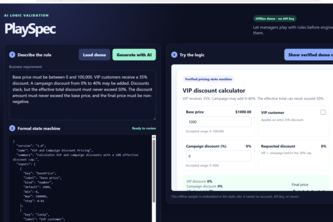
PlaySpec, as described by its author, is a tool that allows business managers to visually validate business rules before engineering implementation begins. It takes natural-language requirements and turns them into formal specifications, TypeScript code, and property-based tests.
What changed
The project was submitted to the OpenAI 2026 hackathon, indicating it is in an early-stage prototype or proof-of-concept phase. No commercial traction, revenue, or customer data are evidenced.
Single most important open question
Is there a viable market need for a tool that bridges business rule validation and engineering implementation, and does the author’s approach to AI integration and sandboxed code generation offer sufficient reliability for real-world use?
What The Product Actually Is
The description states:
- PlaySpec is a system that allows managers to validate business rules visually.
- It generates formal specifications, TypeScript implementations, and property-based tests from natural-language inputs.
- It includes an offline demo with no login or payment required.
Inference It appears to be a prototype tool for validating business logic using AI and code generation, with a focus on sandboxed execution and test verification.
Evidence
- The author describes it as turning “business requirements into formal state-machine specification, an interactive visual playground, and TypeScript logic with property-based tests.”
- It uses React/Vite frontend, Express API, Docker sandboxing, Jest, fast-check, and GPT-5.6 for AI processing.
Not evidenced
- No actual product or live deployment beyond the demo is described.
- No customer base, usage metrics, or commercial adoption are mentioned.
Positioning & Claim Evolution
The description states:
- PlaySpec aims to make business logic “visible, interactive, and testable before production code is written.”
- It targets a workflow where managers can approve logic before engineers implement it.
- The tool is positioned as solving the gap between business requirements and engineering interpretation.
Inference The product is being pitched as a solution for reducing miscommunication in business-to-engineering workflows, particularly around rule-based systems like pricing or discount logic.
Not evidenced
- No claims about market size, competitive positioning, or differentiation from existing tools are made.
- No evidence of prior versions or evolution from earlier concepts.
Target Customer & ICP
The description states:
- The primary users are “managers” who need to validate business rules.
- It is designed for use by non-engineers to interact with logic before code generation.
Inference The target customer appears to be business stakeholders or product managers working in rule-heavy environments (e.g., pricing, discounts, compliance).
Not evidenced
- No specific industry, company size, or role definitions are given.
- No evidence of a defined ICP beyond “managers” and “non-engineers.”
Business Model & Pricing Evidence
The description states:
- PlaySpec includes a public demo that is fully functional offline, with no login, API key, server, or payment required.
- The project was submitted to a hackathon, suggesting it is not yet monetized.
Inference There is no evidence of a commercial business model or pricing strategy at this time.
Not evidenced
- No revenue streams, pricing tiers, or monetization plans are described.
- No indication of whether the tool will be offered as SaaS, open-source, or freemium.
Technical & Delivery Signals
The description states:
- The frontend is built with React and Vite in TypeScript.
- The backend uses Express.js.
- AI processing is done via GPT-5.6 through OpenRouter.
- Generated code is sandboxed using Docker with restricted access.
- Tests are run with Jest and fast-check property-based testing.
Inference The tool uses modern development practices, including sandboxing for security, AI for logic generation, and test-driven development workflows.
Not evidenced
- No evidence of scalability, performance metrics, or production deployment details.
- No mention of how the sandboxed environment handles edge cases or errors in generated code.
Traction & Maturity Signals
The description states:
- The project was submitted to a hackathon (OpenAI 2026).
- It includes an offline demo with a realistic pricing rule and verified test output.
- It is described as a “complete manager-to-engineering workflow” rather than just a prototype.
Inference The tool is in an early-stage prototype or proof-of-concept phase, likely built for demonstration purposes.
Not evidenced
- No evidence of user adoption, customer feedback, or usage data.
- No evidence of revenue, funding, or product-market fit.
- No mention of any production use or integration with existing systems.
Competitive Context
The description states:
- PlaySpec aims to bridge the gap between business rules and engineering implementation.
- It uses AI for rule interpretation and code generation.
Inference It may compete with tools that automate rule-based logic, such as low-code platforms, AI-assisted development tools, or formal specification systems.
Not evidenced
- No mention of existing competitors or market analysis.
- No evidence of differentiation from similar tools in the market.
Open Questions & Risks
The description states:
- The main challenge was making AI output reliable for a manager-facing workflow.
- Models can return incomplete JSON or unsafe widget code.
- The tool uses GPT-5.6, which is not publicly available and may be unstable or unreliable.
Inference There are risks related to AI reliability, sandboxing limitations, and the lack of production-grade validation.
Not evidenced
- No evidence of how these risks will be mitigated at scale.
- No mention of long-term sustainability or scalability beyond a hackathon demo.
Questions the description leaves open
- What is the actual business problem you're solving, and how do you know it’s significant?
- How do you plan to ensure AI-generated outputs are reliable and safe for production use?
- Are there any existing tools or platforms that already solve this problem, and how does PlaySpec differ?
- What is the path from prototype to commercial product, and what resources are needed?
- How do you intend to monetize this tool, and what pricing model are you considering?
- Have you validated your approach with real users or stakeholders in a business context?
Overall Assessment
The description states:
- PlaySpec is a hackathon submission with an offline demo and no commercial traction.
- It is described as a “complete manager-to-engineering workflow” but lacks evidence of real-world adoption.
Inference At this stage, the project appears to be a prototype or proof-of-concept with potential for further development, but it does not yet demonstrate a viable product-market fit or commercial readiness.
Not evidenced
- No evidence of revenue, customers, or funding.
- No indication of whether the team has the resources or experience to scale this idea into a product.
User Stories BotA demo video on every pull request
Get a demo video on every new feature
GitHub App that watches your pull requests and records a narrated, captioned demo.
Save time on demo prep and make informed decisions faster with a video walkthrough of every new feature.
Source
Submitted to the OpenAI 2026 hackathon on Devpost. Project home on Devpost. Back to the full gallery on Devpost.
This competitive analysis was produced by top-founders.com (opens in a new tab)
Generated by a language model from this project's public Devpost page — its tagline, the author's own write-up and any built-with tags listed there — as captured in August 2026. Short quotations are the author's words. It is an opinion on the idea as a business, not on the people behind it, and it reflects the description as published then. If the project has moved on, request a correction below. The analysis is not independent research and contains no verified traction, revenue or customer data.
An independent guide by KFG International LLC — not affiliated with, endorsed by, or connected to Devpost or OpenAI.