

Archive position — measured, not model output
2 likes on Devpost
221 of the 7,850 archived projects have more likes, and 284 share exactly 2 — so this project's #406 place in the like-ranked listing is a tie-break inside that group, not a ranking.
Projects (log scale)
Likes on Devpost. ▲ marks this project's group.
Show the figures
| Likes | Projects | Share of archive |
|---|---|---|
| 0 | 5,587 | 71.2% |
| 1 | 1,758 | 22.4% |
| 2 | 284 | 3.6% |
| 3–4 | 132 | 1.7% |
| 5–9 | 75 | 1.0% |
| 10+ | 14 | 0.2% |
 User Stories BotA demo video on every pull request
Get a demo video on every new feature
GitHub App that watches your pull requests and records a narrated, captioned demo.
Save time on demo prep and make informed decisions faster with a video walkthrough of every new feature.
Executive Summary
What the company appears to be
Nook is a self-reported AI-powered home inventory assistant that uses computer vision and conversational AI to catalog items in a home space, track their locations and expiry dates, and answer natural language questions about them. It is described as an agent that remembers your home, built by one person (Zhe Zhang) for the OpenAI 2026 hackathon.
What changed
The project description is self-reported and unverified. It does not indicate any prior version or evolution beyond its hackathon submission. No evidence of prior traction, funding, or product iteration exists in the provided description.
Single most important open question
Is there any evidence that Nook has been used by anyone beyond its creator, or that it has moved beyond a prototype or proof-of-concept stage?
What The Product Actually Is
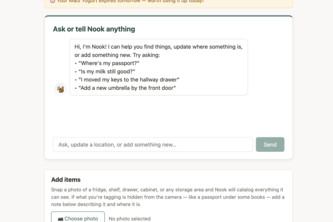
The description states that Nook is an AI agent that catalogs home spaces from photos and answers questions about items in those spaces. It uses OpenAI vision models to identify visible items, stores metadata in SQLite, and allows users to ask natural language questions like “Where is my passport?” or “Is my milk still good?”
It combines four layers:
- Vision: OpenAI multimodal models analyze uploaded images.
- Memory: SQLite database stores item data.
- Agent: Conversational assistant searches the memory and uses tools to update records.
- Human correction: Users can edit AI-generated details.
The product is described as a "helpful roommate" that remembers what you own, where it is, and when it might expire. It supports manual input for items not visible in photos and allows updates through conversation.
Evidence
- The author states Nook uses OpenAI vision models.
- It stores item data in SQLite.
- It supports natural language queries.
- It allows human correction of AI outputs.
- It is built with technologies like React, Express.js, Bun, and Vite.
Inference Nook appears to be a prototype or proof-of-concept tool rather than a commercial product. No evidence suggests it has been deployed beyond the hackathon context.
Positioning & Claim Evolution
The description states that Nook explores a simpler idea: “what if your home could remember for you?” It positions itself as an alternative to manual inventory tracking, aiming to reduce mental burden by automating item recognition and location tracking.
It claims to feel less like inventory software and more like a helpful roommate — aware of what you own, honest about uncertainty, and ready when needed.
The author also notes that the most valuable part is not the database but removing the effort around it. This suggests a shift from data collection to utility.
Evidence
- The tagline: “Nook is an AI agent that remembers your home.”
- The write-up emphasizes reducing mental burden.
- It positions itself as a conversational assistant, not just a tool for listing items.
- It highlights trustworthiness through visible correction mechanisms.
Inference The positioning evolved from a basic inventory app to a conversational memory aid. However, no evidence of prior versions or market feedback is provided.
Target Customer & ICP
The description does not name specific customer segments or personas. It implies the target is individuals who struggle with remembering where things are or when they expire, such as those who have “stood in front of an open fridge wondering whether something is still good.”
It also suggests a use case for people who want to prepare for activities like travel, implying a consumer-focused audience.
Evidence
- The inspiration section refers to common household problems.
- It mentions preparing for trips and packing lists.
- It describes the user as someone who wants to ask questions instead of search manually.
Inference The ICP likely includes tech-savvy individuals or early adopters of AI tools, possibly in the home management or productivity space. No explicit segmentation or targeting beyond general consumer needs is stated.
Business Model & Pricing Evidence
There is no evidence of a business model or pricing structure in the description. The project is described as a hackathon submission with no mention of monetization, subscriptions, or sales channels.
Evidence
- No revenue streams are mentioned.
- No pricing information is provided.
- No indication of how Nook would be sold or distributed.
Inference The product is not yet commercialized. It appears to be a prototype or proof-of-concept with no evidence of monetization strategy.
Technical & Delivery Signals
Nook is built using:
- OpenAI vision models
- SQLite for data storage
- React, Express.js, Bun, Vite, CSS, Jimp, and Codex for development
- A layered architecture combining vision, memory, agent, and human correction
It supports image uploads, natural language queries, and manual corrections. It uses tools to update records based on conversation.
Evidence
- The author lists the tech stack.
- It describes how the system works in layers.
- It mentions that users can redraw item crops or correct dates manually.
Inference The technical approach is straightforward and modular, suggesting a lightweight implementation suitable for prototyping. No evidence of scalability or enterprise-grade infrastructure is provided.
Traction & Maturity Signals
There is no evidence of traction, customers, or adoption beyond the hackathon submission. The project is described as a solo effort by one developer (Zhe Zhang), and there are no mentions of usage statistics, user feedback, or product iterations.
Evidence
- Team size: 1.
- Submitted to a hackathon.
- No mention of users, customers, or real-world deployment.
Inference The project is at an early stage—likely a prototype or proof-of-concept. There is no evidence of product-market fit or user engagement.
Competitive Context
The description does not provide any information about competitors or market positioning relative to existing solutions. It does not reference similar tools, platforms, or market players in the home inventory or AI assistant space.
Evidence
- No mention of competitors.
- No comparison with existing products.
Inference Without external context, it is unclear whether Nook addresses a gap or overlaps with existing offerings. The lack of competitive analysis suggests no prior market research or benchmarking.
Open Questions & Risks
- Prototype-only status: No evidence that Nook has moved beyond a hackathon prototype.
- No traction or users: The project is described as a solo effort with no real-world usage.
- Unproven business model: No indication of how the product would be monetized.
- Limited scalability: Built on lightweight tech stack, no evidence of enterprise-grade infrastructure.
- Unclear path to market: No mention of distribution or go-to-market strategy.
Evidence
- Team size: 1.
- Submitted to a hackathon.
- No revenue, customers, or adoption data.
Inference The project lacks commercial viability indicators. It is not evident that it has progressed beyond an idea or proof-of-concept stage.
Questions the description leaves open
- Has Nook been tested with real users beyond the hackathon?
- What are the technical limitations of the current implementation, and how might they scale?
- Is there any plan to monetize Nook or turn it into a commercial product?
- How does Nook handle privacy concerns, especially around storing household data locally?
- Are there any plans for voice input or mobile integration beyond the stated vision?
- What is the long-term roadmap for Nook’s functionality and user experience?
Overall Assessment
Not evidenced.
The description does not provide sufficient evidence to assess whether Nook is a viable investment or partnership opportunity. It is described as a hackathon submission by one person, with no traction, revenue, or commercialization strategy evident.
The project appears to be at an early stage—possibly a prototype or proof-of-concept—and lacks indicators of product-market fit, scalability, or monetization potential.
Confidence Low. This analysis is based entirely on self-reported information and does not reflect any independent verification or historical data.
User Stories BotA demo video on every pull request
Get a demo video on every new feature
GitHub App that watches your pull requests and records a narrated, captioned demo.
Save time on demo prep and make informed decisions faster with a video walkthrough of every new feature.
Source
Submitted to the OpenAI 2026 hackathon on Devpost. Project home on Devpost. Back to the full gallery on Devpost.
This competitive analysis was produced by top-founders.com (opens in a new tab)
Generated by a language model from this project's public Devpost page — its tagline, the author's own write-up and any built-with tags listed there — as captured in August 2026. Short quotations are the author's words. It is an opinion on the idea as a business, not on the people behind it, and it reflects the description as published then. If the project has moved on, request a correction below. The analysis is not independent research and contains no verified traction, revenue or customer data.
An independent guide by KFG International LLC — not affiliated with, endorsed by, or connected to Devpost or OpenAI.