

Archive position — measured, not model output
0 likes on Devpost
2,263 of the 7,850 archived projects have more likes, and 5,587 share exactly 0 — so this project's #5,666 place in the like-ranked listing is a tie-break inside that group, not a ranking.
Projects (log scale)
Likes on Devpost. ▲ marks this project's group.
Show the figures
| Likes | Projects | Share of archive |
|---|---|---|
| 0 | 5,587 | 71.2% |
| 1 | 1,758 | 22.4% |
| 2 | 284 | 3.6% |
| 3–4 | 132 | 1.7% |
| 5–9 | 75 | 1.0% |
| 10+ | 14 | 0.2% |
 User Stories BotA demo video on every pull request
Get a demo video on every new feature
GitHub App that watches your pull requests and records a narrated, captioned demo.
Save time on demo prep and make informed decisions faster with a video walkthrough of every new feature.
Executive Summary
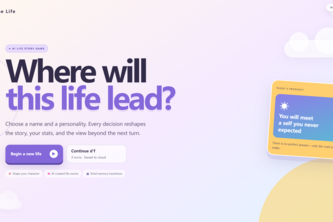
The company appears to be a two-person team building an AI-powered life choice simulator, self-described as an experiential product for exploring everyday decisions around work, family, housing, and relationships. The project is described as a hackathon submission with no evidence of revenue, customers or traction. The single most important open question is whether the product has sufficient commercial viability to warrant further investment or partnership consideration — a question that cannot be answered from the self-reported description alone.
What The Product Actually Is
The description states:
- One life is an AI-powered life choice simulator.
- Players create a character and experience different stages of life.
- At each stage, players face concrete situations with multiple choices.
- Every decision affects the character's state (finances, health, relationships, stress, future opportunities).
- GPT-5.6 Sol is used to generate structured future events and simulate consequences of decisions.
Inference: The product appears to be an interactive narrative experience built using AI for content generation and decision modeling. It is not a SaaS or marketplace product but rather a digital simulation tool.
Positioning & Claim Evolution
The description states:
- Inspiration: to explore "difficult choices people face in everyday life" rather than abstract or extraordinary adventures.
- The project aims to simulate realistic life decisions such as changing jobs, paying rent, supporting family members, maintaining relationships, and balancing stability with personal goals.
Inference: The positioning has evolved from a general life simulator to one focused on relatable, real-world dilemmas. This shift is implied in the author's reflection that early versions were too abstract and were revised toward "recognizable everyday problems."
Target Customer & ICP
The description states:
- The product targets people interested in exploring how choices shape their lives.
- It simulates life stages and decisions relevant to work, family, housing, and relationships.
Not evidenced: No explicit customer persona or ideal customer profile (ICP) is defined beyond general interest in life simulations.
Business Model & Pricing Evidence
The description states:
- The project is a hackathon submission.
- No pricing model, monetization strategy or business model is described.
Inference: There is no evidence of any commercial business model or pricing structure at this stage.
Technical & Delivery Signals
The description states:
- Built with Next.js, React, TypeScript, Vinext, and OpenAI's Responses API.
- GPT-5.6 Sol is used for generating structured events and simulating consequences.
- Codex was used to accelerate development workflows including code understanding, interface implementation, multilingual support, testing, deployment diagnostics, and GitHub workflow management.
Inference: The technical stack suggests a modern web-based application with AI integration. However, no evidence of production delivery, scalability or infrastructure maturity is provided.
Traction & Maturity Signals
The description states:
- This is a hackathon submission (OpenAI 2026).
- No revenue, customer base, or adoption metrics are mentioned.
- The team plans to expand life stages, improve continuity, add explanations of consequences, and conduct user testing.
Not evidenced: No traction, usage data, or product maturity beyond initial development is reported.
Competitive Context
The description states:
- Many life simulators focus on "extraordinary adventures or abstract statistics."
- One life aims to be different by focusing on everyday decisions.
Inference: The competitive landscape includes other life simulation games or tools that may not emphasize realism or personal relevance. However, no specific competitors are named or described.
Open Questions & Risks
The description states:
- The project is a hackathon submission with no revenue or traction.
- Challenges included maintaining continuity and creating meaningful trade-offs.
- The team has not yet conducted user testing to validate realism or engagement.
Inference: Key risks include lack of commercial viability, unproven market demand, limited product maturity, and absence of validated user feedback.
Questions the description leaves open
- What is the intended monetization strategy for this product?
- Have you conducted any form of user testing or validation beyond internal review?
- How do you plan to scale beyond a hackathon prototype?
- What are your assumptions about user engagement and retention in this type of simulation?
- Are there any existing users or early adopters who have provided feedback?
Overall Assessment
The description states:
- This is a hackathon submission with no evidence of traction, revenue, or customer adoption.
- The team consists of two members and has not yet launched publicly.
Inference: Based on the self-reported information, there is insufficient evidence to support an investment or partnership decision at this stage. The product lacks commercial viability indicators and shows no signs of market readiness or traction.
User Stories BotA demo video on every pull request
Get a demo video on every new feature
GitHub App that watches your pull requests and records a narrated, captioned demo.
Save time on demo prep and make informed decisions faster with a video walkthrough of every new feature.
Source
Submitted to the OpenAI 2026 hackathon on Devpost. Project home on Devpost. Back to the full gallery on Devpost.
This competitive analysis was produced by top-founders.com (opens in a new tab)
Generated by a language model from this project's public Devpost page — its tagline, the author's own write-up and any built-with tags listed there — as captured in August 2026. Short quotations are the author's words. It is an opinion on the idea as a business, not on the people behind it, and it reflects the description as published then. If the project has moved on, request a correction below. The analysis is not independent research and contains no verified traction, revenue or customer data.
An independent guide by KFG International LLC — not affiliated with, endorsed by, or connected to Devpost or OpenAI.