

Archive position — measured, not model output
1 like on Devpost
505 of the 7,850 archived projects have more likes, and 1,758 share exactly 1 — so this project's #1,544 place in the like-ranked listing is a tie-break inside that group, not a ranking.
Projects (log scale)
Likes on Devpost. ▲ marks this project's group.
Show the figures
| Likes | Projects | Share of archive |
|---|---|---|
| 0 | 5,587 | 71.2% |
| 1 | 1,758 | 22.4% |
| 2 | 284 | 3.6% |
| 3–4 | 132 | 1.7% |
| 5–9 | 75 | 1.0% |
| 10+ | 14 | 0.2% |
 User Stories BotA demo video on every pull request
Get a demo video on every new feature
GitHub App that watches your pull requests and records a narrated, captioned demo.
Save time on demo prep and make informed decisions faster with a video walkthrough of every new feature.
Executive Summary
What the company appears to be
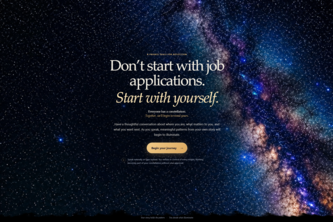
North Star Career Guide is a self-reported AI-powered career coaching application built as a web app using Next.js, TypeScript, and GPT-5.6 via OpenAI’s Responses API. It positions itself as an adaptive, voice- and text-enabled coach that builds a personalized understanding of a user's experience, strengths, and goals before offering career guidance.
What changed
The author states that the project began as an idea during her own career transition and evolved through iterative design based on usability testing feedback. The initial version was restructured around “understanding” rather than completing rigid checklists, with changes to conversational logic, memory handling, and user control over insights.
Single most important open question
Is there sufficient evidence of traction or early adoption to validate the commercial viability of this product concept?
What The Product Actually Is
The description states that North Star Career Guide is a voice- and text-enabled AI career coach, built as a Next.js and TypeScript web application using GPT-5.6 Sol through the OpenAI Responses API.
It uses a conversational loop involving:
- User response
- Conversational-signal detection
- Fact, correction, and evidence extraction
- User-model update
- Working-hypothesis update
- Conversation-state assessment
- Next-action selection
- Natural response generation
The system distinguishes between facts (e.g., “user previously worked as a Quality Analyst”) and working hypotheses (e.g., “user may prefer analytical, behind-the-scenes work”). It also separates explicit facts from provisional interpretations.
It includes:
- Visual constellation of insights over time
- Speech-to-text and text-to-speech capabilities
- Adaptive responses based on user input
- Deterministic safeguards to prevent repetition or incorrect assumptions
Not evidenced:
- Whether the product is currently live or accessible beyond the Devpost submission.
- Any revenue, customer base, or usage metrics.
Positioning & Claim Evolution
The author claims that North Star was built around the premise:
“Before an AI helps someone apply for jobs, it should first understand the person.”
This reflects a shift from traditional career tools that begin with résumés or job titles to one focused on understanding the user’s background and motivations.
Key positioning elements include:
- An emphasis on user autonomy
- A focus on recognizing valuable skills in non-traditional work
- A goal of helping users articulate their experience, especially those whose careers don’t fit a corporate template (e.g., gig workers, caregivers, students)
The author notes that the original idea was restructured after early usability tests revealed issues like:
- Repeatedly asking for more examples
- Confusing current and past employment
- Assuming standard career structures
These insights led to the creation of two internal documents:
- North Star OS – reusable conversational reasoning rules
- Career Guide Coaching Manual – career-specific coaching methodology
Inferred:
The evolution from a basic AI chatbot to a structured, adaptive system suggests a deliberate move toward a more thoughtful and trustworthy product.
Not evidenced:
- No claims about market positioning beyond the hackathon submission.
- No evidence of branding or messaging outside of this self-report.
Target Customer & ICP
The author states that North Star targets people whose careers do not fit a polished corporate template:
- Hourly workers
- Gig workers
- Caregivers returning to work
- Students
- People who have been laid off
- Career changers
It aims to help users recognize and articulate valuable skills buried in ordinary work—such as customer service, organizing information, training, volunteering, qualitative improvements, or problem-solving.
The product is described as useful for people at any career stage, but particularly those who struggle to explain what they are good at or how their experience translates into meaningful outcomes.
Inferred:
The target audience likely includes individuals seeking career clarity and direction rather than just job applications.
Not evidenced:
- No specific segmentation data.
- No evidence of customer personas or user research beyond the author’s personal experience.
- No indication of whether the tool is intended for individual users, enterprise clients, or both.
Business Model & Pricing Evidence
The description does not provide any information about:
- Revenue model
- Pricing strategy
- Monetization approach
- Subscription tiers or freemium options
Not evidenced:
- No business model details.
- No pricing structure or commercial framework.
Technical & Delivery Signals
The product is built using:
- Next.js
- TypeScript
- GPT-5.6 Sol via OpenAI Responses API
- Codex as engineering collaborator
- React, Voice AI, Speech-to-text, Text-to-speech
It includes features such as:
- Conversational reasoning architecture (North Star Brain v1)
- Visual constellation of insights
- Correction-aware behavior
- Deterministic protections against repetition and incorrect assumptions
- Automated regression tests based on usability failures
The author emphasizes:
- That the system listens, learns from testing, recovers from mistakes, and treats the person—not its own checklist—as the center of the experience.
- That it was deployed publicly during a hackathon.
Inferred:
The technical stack suggests a modern web-based SaaS product with generative AI integration. The use of Codex indicates an early-stage developer tooling approach.
Not evidenced:
- No production deployment details beyond Devpost.
- No scalability or infrastructure information.
- No mention of data privacy, security, or compliance measures.
Traction & Maturity Signals
The author describes the product as having been:
- Built from scratch in a matter of days
- Deployed publicly during an OpenAI hackathon
- Redesigned multiple times based on usability feedback
- Tested with real users during development
However, there is no evidence of:
- Actual user base or adoption
- Revenue or monetization
- Customer testimonials or case studies
- Product usage analytics or retention metrics
Not evidenced:
- No traction data.
- No sign of product-market fit beyond the author’s own experience.
Competitive Context
The description does not mention any competitors or direct market comparisons. The author only references the general category of career tools that start with résumés or job titles, but does not name specific products or platforms in this space.
Inferred:
- North Star appears to be positioned as a more personalized and understanding alternative to traditional job-search tools.
- It may compete with AI-powered career coaches, resume builders, or general career guidance platforms.
Not evidenced:
- No competitive analysis.
- No mention of existing tools or market leaders.
Open Questions & Risks
Several potential risks are implied by the self-report:
- Unproven commercial viability: The product exists only as a prototype built during a hackathon with no evidence of traction, revenue, or customer adoption.
- Founder background mismatch: The founder is described as a product manager and MBA student with no prior coding experience—raising questions about long-term technical execution.
- Limited scope in MVP: While the author claims to have focused on foundational interaction, there’s no indication that the current version supports core features like résumé generation or interview prep.
- Trust and data handling concerns: The product asks users to share personal career history, setbacks, and aspirations—yet lacks clear information about data privacy, encryption, consent controls, or secure storage.
- Dependency on GPT-5.6: The system relies heavily on a proprietary model that may not be available long-term or scalable for commercial use.
Not evidenced:
- No evidence of risk mitigation strategies.
- No indication of how the team plans to scale beyond the hackathon prototype.
Questions the description leaves open
- What is your plan for transitioning from a hackathon prototype to a sustainable product?
- How do you intend to validate user trust and data security in a tool that collects sensitive personal information?
- Can you describe how you will monetize this product, and what revenue model you are considering?
- Have you conducted any formal usability testing beyond the internal feedback loop described?
- What is your roadmap for scaling beyond the current MVP features (e.g., account-based memory, résumé generation)?
- How do you plan to differentiate North Star from existing career tools in the market?
- Do you have a strategy for building and maintaining a user base post-hackathon?
- What are the key assumptions underlying your product design, and how will you test them?
Overall Assessment
Confidence Level: Low
The description presents a compelling narrative about a product concept rooted in empathy and user-centered design. However, it is entirely self-reported and unverified, with no evidence of traction, revenue, customers, or even a functioning public product beyond the Devpost submission.
While the founder shows initiative and technical capability in building a prototype from scratch, there is insufficient evidence to assess:
- Commercial viability
- Product-market fit
- Scalability
- Long-term execution ability
This is an early-stage idea with strong potential for development, but lacks the signal required to evaluate whether it should be pursued as a serious investment or partnership opportunity.
Assessment Not evidenced. The project appears to be a promising concept with limited validation. A follow-up diligence effort would require access to actual user data, product performance metrics, and a clearer path to monetization.
User Stories BotA demo video on every pull request
Get a demo video on every new feature
GitHub App that watches your pull requests and records a narrated, captioned demo.
Save time on demo prep and make informed decisions faster with a video walkthrough of every new feature.
Source
Submitted to the OpenAI 2026 hackathon on Devpost. Project home on Devpost. Back to the full gallery on Devpost.
This competitive analysis was produced by top-founders.com (opens in a new tab)
Generated by a language model from this project's public Devpost page — its tagline, the author's own write-up and any built-with tags listed there — as captured in August 2026. Short quotations are the author's words. It is an opinion on the idea as a business, not on the people behind it, and it reflects the description as published then. If the project has moved on, request a correction below. The analysis is not independent research and contains no verified traction, revenue or customer data.
An independent guide by KFG International LLC — not affiliated with, endorsed by, or connected to Devpost or OpenAI.