

Archive position — measured, not model output
0 likes on Devpost
2,263 of the 7,850 archived projects have more likes, and 5,587 share exactly 0 — so this project's #5,579 place in the like-ranked listing is a tie-break inside that group, not a ranking.
Projects (log scale)
Likes on Devpost. ▲ marks this project's group.
Show the figures
| Likes | Projects | Share of archive |
|---|---|---|
| 0 | 5,587 | 71.2% |
| 1 | 1,758 | 22.4% |
| 2 | 284 | 3.6% |
| 3–4 | 132 | 1.7% |
| 5–9 | 75 | 1.0% |
| 10+ | 14 | 0.2% |
 User Stories BotA demo video on every pull request
Get a demo video on every new feature
GitHub App that watches your pull requests and records a narrated, captioned demo.
Save time on demo prep and make informed decisions faster with a video walkthrough of every new feature.
Executive Summary
What the company appears to be
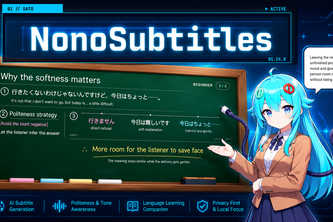
NonoSubtitles is a self-reported macOS application that generates live subtitles for local videos and application audio, with integrated AI-powered language learning lessons. It was built as a hackathon project by one developer (Nicholas Giordano) using OpenAI models and a tech stack including Tauri, Svelte, and Rust.
What changed
The project is described as an experimental tool developed in a short timeframe for the OpenAI 2026 hackathon. It has no evidence of prior commercialization or user adoption beyond personal use by the creator.
Single most important open question
Is there any evidence that NonoSubtitles has moved beyond a prototype or personal project, and whether it can scale to support broader language learning or content consumption needs?
What The Product Actually Is
The description states:
- NonoSubtitles is a macOS application (with Windows and Linux planned) that processes local videos or audio from applications like web browsers.
- It produces subtitles in the original language and translates them into a target language (currently tested with Japanese to English).
- Subtitles are displayed on top of content without a formal window, and can be styled with different themes.
- Clicking on a subtitle opens an AI teacher interface where users can ask questions about the content, with lesson presets like “Break this sentence down” or “Explain cultural significance.”
- The system uses OpenAI models for transcription, translation, and lesson generation.
Inference The product is described as a utility that combines real-time subtitle generation with AI-driven language learning. It is not a marketplace, SaaS platform, or platform-as-a-service offering.
Positioning & Claim Evolution
The description states:
- The app was built to solve the problem of missing or inaccurate subtitles for non-native speakers watching foreign media.
- It aims to provide not just translation but also cultural context and language lessons.
- The app is positioned as a fun, lighthearted tool with an AI mascot named Nono, who embodies the brand’s values: no tracking, no ads, no subscriptions, no accounts.
Inference The positioning is personal and niche — targeting language learners who consume foreign media. It does not claim to be a mass-market product or a general-purpose subtitle tool.
Target Customer & ICP
The description states:
- The target audience includes people learning Japanese (or other languages) through media like YouTube videos, livestreams, and shows.
- Users are described as those who want to understand not just the words but also cultural nuances in conversations.
- The app is intended for users who value personality and expressiveness in apps.
Inference The ICP appears to be language learners (especially those learning Japanese) who are interested in immersive media consumption and personalized language education.
Business Model & Pricing Evidence
The description states:
- The app is described as having a “pay-as-you-go” model, though it’s unclear how this would work.
- It is mentioned that the only feature that might require an account is payment tracking.
- There is no mention of pricing tiers, monetization strategy, or revenue streams.
Inference No business model or pricing evidence is provided beyond a vague “pay-as-you-go” idea. The app’s commercial viability and monetization path remain unclear.
Technical & Delivery Signals
The description states:
- Built with Tauri, Svelte, Rust, and OpenAI APIs.
- Uses gpt-4o-transcribe-diarize for local video processing (separates speech from up to four speakers).
- Uses gpt-realtime-whisper for source-only subtitles.
- Uses gpt-5.6-terra and gpt-realtime-translate for translations.
- Uses gpt-5.6-sol for lesson creation.
- The app supports macOS, with Windows and Linux versions planned.
- Audio capture uses Apple’s native screen sharing system.
Inference The technical stack is modern and cross-platform, but the product is described as a hackathon prototype with limited testing and no production-grade infrastructure or scalability features.
Traction & Maturity Signals
The description states:
- The app was built in a week-long hackathon.
- It has not been tested beyond personal use by the developer.
- There are no customer testimonials, user numbers, or usage metrics.
- No evidence of revenue, funding, or product-market fit.
Inference There is no traction or maturity evidence. The project is described as a prototype with no commercial or user adoption data.
Competitive Context
The description states:
- The app addresses language barriers in online media.
- It combines subtitle generation with AI language lessons — a niche but potentially differentiated approach.
- No direct competitors are named, though it may overlap with general subtitle tools and language learning apps.
Inference No competitive analysis is provided. The product’s positioning suggests a unique angle (AI teacher + subtitles), but there is no evidence of market research or competitor benchmarking.
Open Questions & Risks
The description states:
- The app was built in one week, with limited testing and bug fixes.
- A major technical issue was Mac's Keychain preventing agentic testing.
- Windows hardware failure disrupted development.
- The app is described as a hackathon prototype with no production-grade features.
- No monetization strategy or business model is defined.
Inference Key risks include lack of scalability, incomplete functionality, and unclear commercial viability. The product appears to be in early-stage experimentation, not ready for market deployment.
Questions the description leaves open
- What is the current development status of NonoSubtitles beyond the hackathon prototype?
- Are there any plans for monetization or revenue models beyond “pay-as-you-go”?
- How does the app handle accuracy and reliability of OpenAI model outputs, especially in multilingual contexts?
- Is there a roadmap for expanding beyond Japanese-to-English translation?
- What are the technical challenges in porting to Windows and Linux, and how are they being addressed?
- Has any user feedback or testing been conducted with actual language learners?
Overall Assessment
The description states:
- NonoSubtitles is a hackathon project built by one person (Nicholas Giordano).
- It has no evidence of traction, revenue, or customer adoption.
- The app is described as experimental and not yet production-ready.
Inference There is no evidence to support investment or partnership interest at this stage. The product is in a very early phase and lacks commercial viability indicators. It may be a promising idea but has not demonstrated any traction or scalability potential.
User Stories BotA demo video on every pull request
Get a demo video on every new feature
GitHub App that watches your pull requests and records a narrated, captioned demo.
Save time on demo prep and make informed decisions faster with a video walkthrough of every new feature.
Source
Submitted to the OpenAI 2026 hackathon on Devpost. Project home on Devpost. Back to the full gallery on Devpost.
This competitive analysis was produced by top-founders.com (opens in a new tab)
Generated by a language model from this project's public Devpost page — its tagline, the author's own write-up and any built-with tags listed there — as captured in August 2026. Short quotations are the author's words. It is an opinion on the idea as a business, not on the people behind it, and it reflects the description as published then. If the project has moved on, request a correction below. The analysis is not independent research and contains no verified traction, revenue or customer data.
An independent guide by KFG International LLC — not affiliated with, endorsed by, or connected to Devpost or OpenAI.