

Archive position — measured, not model output
0 likes on Devpost
2,263 of the 7,850 archived projects have more likes, and 5,587 share exactly 0 — so this project's #5,561 place in the like-ranked listing is a tie-break inside that group, not a ranking.
Projects (log scale)
Likes on Devpost. ▲ marks this project's group.
Show the figures
| Likes | Projects | Share of archive |
|---|---|---|
| 0 | 5,587 | 71.2% |
| 1 | 1,758 | 22.4% |
| 2 | 284 | 3.6% |
| 3–4 | 132 | 1.7% |
| 5–9 | 75 | 1.0% |
| 10+ | 14 | 0.2% |
 User Stories BotA demo video on every pull request
Get a demo video on every new feature
GitHub App that watches your pull requests and records a narrated, captioned demo.
Save time on demo prep and make informed decisions faster with a video walkthrough of every new feature.
Executive Summary
What the company appears to be
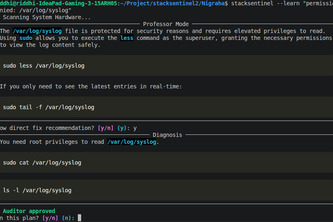
The project described as "Nigraha" (also known as "StackSentinel") is a self-healing system watchdog for Linux environments, built as a command-line tool with an AI-powered diagnosis and remediation engine. It operates at root level on a machine, tailing logs in real time, detecting critical errors, and using OpenAI models to propose fixes — which are then audited and executed only if safe.
What changed
The author states that the project was developed for the OpenAI 2026 hackathon. It represents an experimental system designed to automate infrastructure repair using AI, with strong emphasis on safety through local execution auditing and a lightweight UI dashboard.
Single most important open question — the commercial due-diligence read
Is there evidence of real-world usage or traction beyond this hackathon project? The description contains no data about revenue, customers, adoption, or product-market fit. It is unclear whether this is a prototype or an early-stage product with potential for further development.
What The Product Actually Is
The description states that StackSentinel is a self-healing watchdog for Linux infrastructure. It operates in real time, tailing system logs and detecting CRITICAL or ERROR signals. When such signals are detected, it passes the raw log context to an OpenAI model for diagnosis. If a fix is proposed, it undergoes local execution auditing before being applied automatically.
- The core component is written in Python.
- It uses OpenAI's Responses API with gpt-5.6-luna as a default model.
- A local execution auditor enforces a blocklist and allowlist of commands to prevent destructive actions.
- A Flask-based C2 dashboard streams telemetry from the root-level watchdog to a user-level UI, which is local-only by default.
- It includes features like snapshot restoration and atomic JSON writes for IPC.
Inference The system is designed to be edge-deployed and autonomous, with no public exposure by default. It is built for use in environments where system administrators want proactive log monitoring and automated recovery without human intervention.
Positioning & Claim Evolution
The author claims that StackSentinel moves beyond traditional reactive dashboards and aims to provide a proactive, AI-driven solution for infrastructure repair. The positioning centers on:
- Autonomy: A server can diagnose and heal itself before a human wakes up.
- AI Integration: Uses OpenAI models for diagnosis.
- Safety: Built-in safeguards prevent dangerous commands from executing.
- Local Operation: No public exposure by default, with local-only telemetry.
Inference The project is positioned as an experimental tool for system administrators or developers who want to reduce downtime through AI-assisted automation. It does not claim to be a commercial product or platform but rather a proof-of-concept or prototype.
Target Customer & ICP
The description states that the inspiration came from frustration with broken dependencies and missing configuration files, particularly in Ubuntu environments and complex architectures for coursework. The target audience appears to include:
- System administrators
- Developers working on Linux-based systems
- Users who want to automate infrastructure maintenance
Inference The project is likely aimed at users who are technically proficient and operate Linux servers or development environments where log monitoring and system stability are critical.
Business Model & Pricing Evidence
There is no evidence of a business model or pricing structure in the description. The author does not mention any monetization strategy, subscription plans, or licensing models.
Not evidenced
Technical & Delivery Signals
The project is built with:
- CLI tools
- Python
- OpenAI API integration (gpt-5.6-luna)
- Shell scripting
- JSON and XML for data exchange
- Flask-based dashboard UI
- Inter-process communication via atomic JSON writes
- Exponential backoff algorithm for API rate limiting
It includes safety mechanisms such as:
- Blocklist of destructive commands
- Allowlist of safe commands
- No shell=True execution
- Local-only dashboard
- Dedicated app paths module for persistence
- Snapshot restoration logic
Inference The system is built with a focus on security and modularity, using Python and OpenAI APIs. It shows some engineering sophistication in handling root-level operations, IPC, and API rate limiting.
Traction & Maturity Signals
There is no evidence of traction or maturity beyond the hackathon submission. No revenue data, customer base, or adoption metrics are provided. The project is described as a working prototype with end-to-end functionality but not as a product in production.
Not evidenced
Competitive Context
The description does not mention any direct competitors. However, it implies a space that includes:
- Traditional monitoring tools (e.g., Nagios, Zabbix)
- AI-powered infrastructure management or automation platforms
- Self-healing systems or auto-remediation tools
Inference The project enters a niche area of AI-driven system administration and self-healing infrastructure. It is not clear how it compares to existing tools in the market.
Open Questions & Risks
Key risks and open questions based on the description:
- Unproven commercial viability: No evidence of traction, customers, or revenue.
- Limited scope: The project is described as a hackathon submission with no indication of scalability or production readiness.
- Safety assumptions: While the system includes safety mechanisms, it is unclear how robust these are in real-world deployment.
- No public exposure: The local-only dashboard may limit adoption or visibility for enterprise users.
- AI dependency: Reliance on OpenAI APIs introduces risk from API availability and cost.
Questions the description leaves open
- What is the current state of the product? Is it being used in any real environments?
- How does the system handle edge cases or unexpected log formats?
- Are there plans to expand support beyond Linux or to other operating systems?
- What are the long-term goals for StackSentinel — is this a prototype or a commercial product?
- How do you plan to manage API costs and rate limits in production?
- What kind of feedback have you received from users or system administrators?
Overall Assessment
The description indicates that this is an experimental project submitted for a hackathon, with no evidence of traction, revenue, or commercial adoption.
Assessment Not ready for investment or partnership at this stage. The product shows promise in terms of technical execution and safety design but lacks any indication of real-world usage or market demand. It may be a valuable prototype to explore further, but it is not yet a viable business or product.
User Stories BotA demo video on every pull request
Get a demo video on every new feature
GitHub App that watches your pull requests and records a narrated, captioned demo.
Save time on demo prep and make informed decisions faster with a video walkthrough of every new feature.
Source
Submitted to the OpenAI 2026 hackathon on Devpost. Project home on Devpost. Back to the full gallery on Devpost.
This competitive analysis was produced by top-founders.com (opens in a new tab)
Generated by a language model from this project's public Devpost page — its tagline, the author's own write-up and any built-with tags listed there — as captured in August 2026. Short quotations are the author's words. It is an opinion on the idea as a business, not on the people behind it, and it reflects the description as published then. If the project has moved on, request a correction below. The analysis is not independent research and contains no verified traction, revenue or customer data.
An independent guide by KFG International LLC — not affiliated with, endorsed by, or connected to Devpost or OpenAI.