

Archive position — measured, not model output
0 likes on Devpost
2,263 of the 7,850 archived projects have more likes, and 5,587 share exactly 0 — so this project's #5,346 place in the like-ranked listing is a tie-break inside that group, not a ranking.
Projects (log scale)
Likes on Devpost. ▲ marks this project's group.
Show the figures
| Likes | Projects | Share of archive |
|---|---|---|
| 0 | 5,587 | 71.2% |
| 1 | 1,758 | 22.4% |
| 2 | 284 | 3.6% |
| 3–4 | 132 | 1.7% |
| 5–9 | 75 | 1.0% |
| 10+ | 14 | 0.2% |
 User Stories BotA demo video on every pull request
Get a demo video on every new feature
GitHub App that watches your pull requests and records a narrated, captioned demo.
Save time on demo prep and make informed decisions faster with a video walkthrough of every new feature.
Executive Summary
What the company appears to be
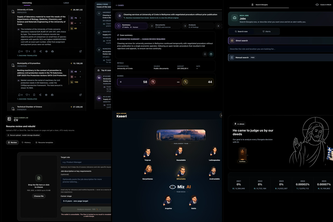
MizAI is a self-reported AI-powered civic platform built by one developer (Aggelos Diamantopoulos) in Greece. The platform claims to aggregate public data from official Greek sources like Διαύγεια and ΚΗΜΔΗΣ, and make it accessible through four connected layers: Investigate public records, Participate in review, Use public data for work, and Explore playful civic experiences.
What changed
During OpenAI Build Week, the author extended MizAI with unified search across official sources, evidence-first discovery, AI/manual job finder with alerts, GPT-5.6-powered CV analysis, e-Jesus confessional, Kaseri improvements, English UI, and security hardening. The changes are timestamped in Git history.
Single most important open question
Is there any evidence of actual public usage or adoption beyond the author's own development work?
Note
This is a self-reported, unverified account. No revenue, customer data, traction metrics, or independent validation are available. All claims are from the author’s own description and must be treated as such.
What The Product Actually Is
The description states that MizAI is an AI-powered civic platform with four connected layers:
- Investigate public records: Retrieves records from Διαύγεια and ΚΗΜΔΗΣ, preserves identifiers, payloads, linked PDFs, and source provenance; extracts checkable evidence; presents Maths, AI, and Human scores as distinct signals; supports chat with explicit missing-evidence language.
- Participate in review: Allows signed-in users to submit moderated ratings that affect score; supports public comments, likes, bookmarks, sharing, correction requests, and contribution leaderboards; keeps different types of scores visibly distinct.
- Use public data for work: Provides AI and manual Job Finder paths over Diavgeia; saves job criteria and sends bounded daily alerts; reviews PDF/DOC resumes, marks issues on original pages, and rebuilds ATS-ready CV without inventing claims.
- Explore playful civic experiences: Includes Kaseri (a satirical flying game) and e-Jesus (a GPT-5.6 confessional).
The core path is available without an account at mizai.gr.
Claim
MizAI is a working platform with these four layers.
Evidence Author's own description.
Inference The author built it using TypeScript/Next.js frontend and FastAPI backend, integrating with official APIs and document storage systems. AI paths use structured schemas, bounded reasoning/output budgets, idempotency, provider accounting, and store=false for case-content requests.
Positioning & Claim Evolution
The description states that MizAI was built around the idea that “AI should make public data useful to ordinary people without pretending to be the authority.” It emphasizes:
- Evidence-bound tools: AI scores are separate from human judgment.
- Explicit boundaries between discovery and confirmed facts.
- Community participation with moderation.
- Satirical elements as part of civic engagement.
- Preservation of source documents and metadata.
During Build Week, the author extended the product with:
- Unified search across live procurement evidence.
- Evidence-first unusual-case discovery with explicit uncertainty.
- AI/manual job finder with alerts.
- GPT-5.6 routing for bounded planning, structured analysis, chat, CV reconstruction, and e-Jesus.
- A metered e-Jesus confessional.
- Competition-ready English UI and translation cache.
Claim
MizAI positions itself as a platform that makes public data useful while maintaining clear boundaries between AI, human, and official sources.
Evidence Author's own description.
Inference The platform aims to democratize access to public information, but also to avoid misrepresenting AI-generated content as authoritative.
Target Customer & ICP
The description does not clearly define a target customer or ideal customer profile (ICP). It mentions:
- Analysts evaluating procurement cases.
- Users seeking public-sector job notices.
- Citizens participating in reviews.
- General users interested in civic engagement or playful experiences.
It also notes that the core path is available without an account, suggesting broad accessibility.
Claim
MizAI targets analysts, job seekers, and citizens engaged in civic participation.
Evidence Author's own description.
Inference No specific segmentation or persona details are provided beyond general categories. The platform appears designed for a wide audience with varying levels of technical literacy.
Business Model & Pricing Evidence
There is no evidence of any business model or pricing structure in the description. The author states that the core public reviewer path is available without an account, and mentions AI usage being metered for e-Jesus and CV analysis.
Claim
No explicit business model or pricing information.
Evidence Author's own description.
Inference If there is a monetization strategy, it is not described. The platform seems to be focused on utility rather than commercial gain.
Technical & Delivery Signals
The project uses:
- Frontend: TypeScript/Next.js
- Backend: FastAPI, SQLAlchemy, Alembic, PostgreSQL
- Storage: S3-compatible document storage (Minio)
- AI models: GPT-5.6 Luna, Terra, Sol
- Tools: Docker, Playwright, Tailwind CSS, React, Pydantic, Tailscale, Temporal
Key technical features include:
- Structured schemas for AI outputs.
- Bounded reasoning/output budgets.
- Idempotency and provider accounting.
- Private records are excluded from ingestion/scoring/translation.
- Source-preserving English experience while keeping Greek original authoritative.
Claim
MizAI is technically built with modern stack and follows best practices around AI usage, privacy, and data integrity.
Evidence Author's own description.
Inference The platform appears to be engineered for reliability, traceability, and bounded AI use. However, no production metrics or scalability data are provided.
Traction & Maturity Signals
There is no evidence of traction or user adoption beyond the author’s development efforts. The project is described as a live, public, bilingual multi-product platform, but no customer base, usage statistics, or engagement data are mentioned.
Claim
No traction or maturity indicators.
Evidence Author's own description.
Inference While the platform exists and has been extended during Build Week, there is no indication of real-world usage or impact.
Competitive Context
The description does not mention any competitors. It focuses on how MizAI handles fragmentation in Greek public data and integrates AI with transparency and source preservation.
Claim
No competitive landscape described.
Evidence Author's own description.
Inference The platform may compete with other open data platforms or civic tech tools, but no direct comparison or market positioning is given.
Open Questions & Risks
- Single-person development: The entire project was built by one individual (Aggelos Diamantopoulos), raising questions about scalability and long-term maintenance.
- No revenue or customer data: No evidence of monetization, users, or adoption beyond the author’s own work.
- Unverified claims: All statements are self-reported and unverified — no third-party validation or external sources.
- AI governance concerns: While the platform claims to avoid fraud assessments and maintain boundaries, it's unclear how these rules are enforced at scale.
- Limited scope of AI use: The author notes that GPT-5.6 is used in a bounded way, but there’s no evidence of how this is implemented or monitored.
Claim
Risks include lack of team, traction, and scalability; unverified claims; and potential governance issues.
Evidence Author's own description.
Inference The platform may be a prototype or proof-of-concept rather than a scalable product. Long-term viability depends on future development and adoption.
Questions the description leaves open
- What is the actual source of public data used? Are there any legal or compliance risks in aggregating it?
- How are community contributions moderated, and what happens if someone submits false information?
- Has the platform been tested with real users beyond the author’s own use?
- What are the plans for expanding beyond Greece or other languages?
- How is AI output validated or audited to ensure accuracy and avoid misleading results?
- Are there any existing partnerships or collaborations with government bodies or NGOs?
- What is the long-term vision for monetization or sustainability?
Claim
These questions aim to probe deeper into technical, legal, and operational aspects.
Evidence Author's own description.
Inference These are necessary due to the lack of external validation and user feedback in the provided information.
Overall Assessment
Not evidenced.
Claim
No investment or partnership potential can be assessed without further data.
Evidence Author's own description.
Inference The platform appears to be a personal project with no clear path to commercialization or scale. It may serve as a prototype or proof-of-concept, but lacks indicators of traction, revenue, or strategic value for investors or partners.
User Stories BotA demo video on every pull request
Get a demo video on every new feature
GitHub App that watches your pull requests and records a narrated, captioned demo.
Save time on demo prep and make informed decisions faster with a video walkthrough of every new feature.
Source
Submitted to the OpenAI 2026 hackathon on Devpost. Project home on Devpost. Back to the full gallery on Devpost.
This competitive analysis was produced by top-founders.com (opens in a new tab)
Generated by a language model from this project's public Devpost page — its tagline, the author's own write-up and any built-with tags listed there — as captured in August 2026. Short quotations are the author's words. It is an opinion on the idea as a business, not on the people behind it, and it reflects the description as published then. If the project has moved on, request a correction below. The analysis is not independent research and contains no verified traction, revenue or customer data.
An independent guide by KFG International LLC — not affiliated with, endorsed by, or connected to Devpost or OpenAI.