

Archive position — measured, not model output
0 likes on Devpost
2,263 of the 7,850 archived projects have more likes, and 5,587 share exactly 0 — so this project's #5,266 place in the like-ranked listing is a tie-break inside that group, not a ranking.
Projects (log scale)
Likes on Devpost. ▲ marks this project's group.
Show the figures
| Likes | Projects | Share of archive |
|---|---|---|
| 0 | 5,587 | 71.2% |
| 1 | 1,758 | 22.4% |
| 2 | 284 | 3.6% |
| 3–4 | 132 | 1.7% |
| 5–9 | 75 | 1.0% |
| 10+ | 14 | 0.2% |
 User Stories BotA demo video on every pull request
Get a demo video on every new feature
GitHub App that watches your pull requests and records a narrated, captioned demo.
Save time on demo prep and make informed decisions faster with a video walkthrough of every new feature.
Executive Summary
What the company appears to be
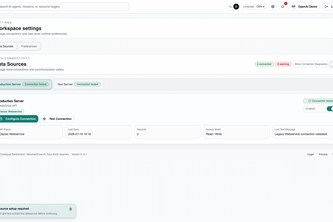
MerchantCore AI is a self-reported SaaS platform for ecommerce merchants that provides an agentic operations layer over commerce automation. The description states it offers a searchable catalog of AI agents and a personal workspace where teams can configure, launch, and monitor controlled missions on PrestaShop stores.
What changed
The project was submitted to the OpenAI 2026 hackathon by a solo developer (Janos Kozma) as a full-stack product demonstration. It represents an early-stage prototype with three initial AI agents focused on catalog quality, category structure, and product images.
Single most important open question
Is there evidence of actual merchant adoption or revenue generation beyond the hackathon submission? The description contains no information about customers, pricing, or commercial traction.
What The Product Actually Is
The description states that MerchantCore AI is:
- An agentic operations SaaS platform for ecommerce merchants
- A platform with a searchable catalog of ready-to-run AI agents
- A personal workspace where teams can configure and launch controlled missions
- Built around a "mission" concept that includes preview, test, and production modes
- Designed to work with PrestaShop through a legacy webservice adapter
- Capable of producing PDF reports and CSV exports from agent operations
The platform is described as having three initial AI agents: Catalog Quality, Category Structure, and Product Image. It includes features like mission monitoring, detailed results and logs, immutable execution history, and customer-specific agent publication.
Positioning & Claim Evolution
The description states that the company's guiding principle was "simple and sober on the surface, extremely powerful underneath." It positions itself as:
- An operating layer around commerce automation rather than another isolated utility
- A platform that allows merchants to find capabilities, configure missions, preview them, and understand results without needing developer knowledge
- A system that keeps important boundaries visible through explicit Preview, Test, and Production modes
The positioning appears to have evolved from a hackathon prototype to a vision of an open-ended catalog of commerce workflows that can grow beyond the initial three agents.
Target Customer & ICP
The description states:
- The target customer is "commerce merchants"
- The platform works with PrestaShop stores
- It's designed for teams that handle operational work like finding inconsistent product identifiers, repairing category structures, improving images, maintaining translations, and monitoring changes across live stores
- The platform includes features like multilingual support (TEN/CEN/country-locale architecture) suggesting it targets international merchants
The description does not provide evidence of specific customer segments beyond "commerce merchants" or detailed ICP criteria.
Business Model & Pricing Evidence
Not evidenced. The description contains no information about pricing, revenue models, or commercial arrangements beyond the fact that it's a SaaS platform.
Technical & Delivery Signals
The description states:
- Built with React, TypeScript, Django, Celery, RabbitMQ, Playwright, OpenAI Codex
- Uses a "persistent Django Job" to own mission lifecycle while Celery workers execute
- Has a connector boundary isolating commerce-platform communication from agent logic
- Implements a "core runtime rule" where browser creates mission once and becomes observer
- Includes features like immutable execution history, audit records, and durable application state
- Uses a "shared source of truth" for summaries, counters, findings, reports, exports, and archived history
- Has a multilingual architecture with Technical English, Custom English, and country-specific locales
Traction & Maturity Signals
Not evidenced. The description contains no information about:
- Customer adoption or retention
- Revenue generation
- User engagement metrics
- Product usage data
- Market traction beyond the hackathon submission
The project is described as a "working catalog" with three agents, but there's no evidence of commercial deployment or user base.
Competitive Context
Not evidenced. The description does not mention competitors, market positioning relative to existing solutions, or competitive advantages.
Open Questions & Risks
- Solo developer team: Only one team member (Janos Kozma) is mentioned, which raises questions about scalability and operational capacity
- Hackathon prototype: The project was submitted to a hackathon, suggesting it's an early-stage demonstration rather than a mature product
- No commercial evidence: No revenue, customers, or traction data provided beyond the self-reported description
- Limited connector support: Currently only supports PrestaShop with plans for Shopify and other platforms
- Unverified claims: All statements are self-reported without independent verification
Questions the description leaves open
- What is the actual commercial traction beyond the hackathon submission?
- How does the platform handle data security and privacy compliance?
- What is the timeline for expanding to additional commerce platforms beyond PrestaShop?
- How do you plan to monetize this platform given it's currently a prototype?
- What are the specific technical challenges that remain before production deployment?
- How will you scale from a solo developer to a sustainable business model?
Overall Assessment
Not evidenced. The description contains no information about:
- Financial performance or projections
- Market opportunity size
- Competitive advantages
- Go-to-market strategy
- Founders' track record
- Funding history or investment requirements
The project appears to be an early-stage hackathon prototype with no demonstrated commercial traction, revenue, or customer base. The description is self-reported and unverified, containing only claims about product functionality without evidence of actual adoption or business metrics.
User Stories BotA demo video on every pull request
Get a demo video on every new feature
GitHub App that watches your pull requests and records a narrated, captioned demo.
Save time on demo prep and make informed decisions faster with a video walkthrough of every new feature.
Source
Submitted to the OpenAI 2026 hackathon on Devpost. Project home on Devpost. Back to the full gallery on Devpost.
This competitive analysis was produced by top-founders.com (opens in a new tab)
Generated by a language model from this project's public Devpost page — its tagline, the author's own write-up and any built-with tags listed there — as captured in August 2026. Short quotations are the author's words. It is an opinion on the idea as a business, not on the people behind it, and it reflects the description as published then. If the project has moved on, request a correction below. The analysis is not independent research and contains no verified traction, revenue or customer data.
An independent guide by KFG International LLC — not affiliated with, endorsed by, or connected to Devpost or OpenAI.