

Archive position — measured, not model output
0 likes on Devpost
2,263 of the 7,850 archived projects have more likes, and 5,587 share exactly 0 — so this project's #7,848 place in the like-ranked listing is a tie-break inside that group, not a ranking.
Projects (log scale)
Likes on Devpost. ▲ marks this project's group.
Show the figures
| Likes | Projects | Share of archive |
|---|---|---|
| 0 | 5,587 | 71.2% |
| 1 | 1,758 | 22.4% |
| 2 | 284 | 3.6% |
| 3–4 | 132 | 1.7% |
| 5–9 | 75 | 1.0% |
| 10+ | 14 | 0.2% |
 User Stories BotA demo video on every pull request
Get a demo video on every new feature
GitHub App that watches your pull requests and records a narrated, captioned demo.
Save time on demo prep and make informed decisions faster with a video walkthrough of every new feature.
Executive Summary
What the company appears to be
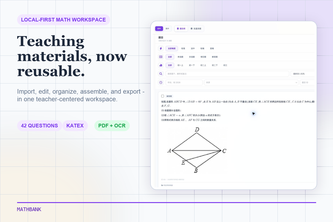
The project described as 西瓜 math (MathBank) is a self-reported local-first application designed for math teachers to build, organize, and export reusable question banks and worksheets. It integrates PDF processing, OCR, mathematical formula rendering, and structured metadata management within a single workflow.
What changed
The author states that this project was built as part of the OpenAI 2026 hackathon submission. The description indicates an early-stage prototype with functional capabilities but no evidence of commercial traction or product-market fit beyond personal use.
Single most important open question — the commercial due-diligence read
Is there a viable market need for a local-first, teacher-focused math question bank and worksheet tool, and does the author’s self-reported functionality align with what teachers actually want to use in practice?
What The Product Actually Is
The description states that 西瓜 math is an intelligent mathematics question bank and worksheet-building platform designed for teachers. It supports:
- Creating, editing, classifying, and searching mathematical questions
- Organizing questions by grade, topic, difficulty, source, and custom metadata
- Rendering mathematical formulas using LaTeX and KaTeX
- Importing questions from documents and images via PDF processing and OCR
- Previewing questions during editing
- Assembling selected questions into printable worksheets or tests
- Exporting high-quality PDFs
- Storing data locally for privacy
The author describes the product as a local-first workspace, built with Python (FastAPI), SQLite, SQLAlchemy, HTML/CSS/JS, and tools like OCR, LaTeX rendering, and AI-assisted development.
Inference The tool appears to be a prototype or MVP focused on solving internal workflow inefficiencies for math teachers rather than a commercial product with external users or monetization.
Positioning & Claim Evolution
The author positions 西瓜 math as a solution to fragmented workflows in math education. It aims to consolidate tasks such as question collection, formatting, classification, and worksheet creation into one integrated platform.
Key claims include:
- Reducing repetitive preparation work for teachers
- Bringing together scattered content-management processes
- Supporting local data storage for privacy
- Enabling reuse of questions across multiple lessons or classes
Inference The positioning reflects a teacher-centric, productivity-focused, and privacy-conscious approach. However, the description does not indicate whether this addresses a widespread market need or if it is tailored to niche use cases.
Target Customer & ICP
The author states that 西瓜 math is designed for math teachers who spend time collecting questions, organizing materials, and creating printable worksheets.
No further segmentation of target customers (e.g., grade level, school type, geographic region) is provided in the description.
Inference The ICP seems to be individual math educators, likely at primary or secondary levels, with a focus on local or private institutions where data privacy is important. No evidence suggests targeting schools, districts, or edtech platforms.
Business Model & Pricing Evidence
There is no mention of pricing, monetization strategy, or business model in the description.
The author describes the tool as local-first, which implies no cloud-based subscription or SaaS model. However, optional encrypted synchronization across devices and learning analytics are mentioned as future features.
Inference The current version appears to be a free, self-hosted tool with no commercial revenue streams. Future monetization strategies are speculative and not described.
Technical & Delivery Signals
The author reports that the backend is built using:
- Python
- FastAPI
- SQLite + SQLAlchemy
- PDF processing and OCR tools (e.g., pymupdf)
- KaTeX for formula rendering
Frontend uses HTML5, CSS3, JavaScript, Tailwind CSS.
AI tools like OpenAI Codex were used during development to assist with prototyping, debugging, and interface design.
Inference The technical stack suggests a lightweight, local-first architecture, suitable for personal or small-scale use. It is not described as scalable or enterprise-grade.
Traction & Maturity Signals
The description states that:
- This is a prototype
- It already supports a practical workflow
- It can manage structured question libraries and generate printable documents
- It runs locally without uploading data externally
There is no evidence of user adoption, customer feedback, revenue, or usage metrics.
Inference The product has reached an early-stage MVP with functional capabilities but lacks any signs of traction or market validation.
Competitive Context
No mention of competitors or existing solutions in the description.
The author notes that current tools are fragmented, suggesting a gap in the market for integrated platforms. However, no specific competitors are named or described.
Inference The competitive landscape is unclear, but there may be room for a local-first, teacher-focused solution if it addresses real pain points in math education workflows.
Open Questions & Risks
- No revenue or customer data: The project is described as a prototype with no evidence of commercial traction.
- Single-person team: Only one developer is involved, which may limit scalability and feature development speed.
- Local-first design limits growth potential: While privacy-focused, this approach may hinder broader adoption unless cloud features are added later.
- Unverified claims about AI integration: Features like automatic question extraction or semantic search are described as planned but not implemented yet.
- Lack of market validation: No evidence that teachers actually want or need such a tool beyond the author’s personal use case.
Questions the description leaves open
- What specific problems do math teachers face in their current workflows, and how does this tool solve them?
- Have you tested this with actual teachers? If so, what feedback did you receive?
- How do you plan to transition from a local-first prototype to a scalable product or service?
- Are there any existing tools that already address these needs, and how is your solution different?
- What are the key assumptions about user behavior and adoption that underpin this project?
Overall Assessment
Not evidenced: There is no evidence of revenue, customers, traction, or a clear path to monetization.
The project appears to be an early-stage prototype, likely built for personal use or as a hackathon submission. It shows some technical capability and addresses a plausible need in math education, but lacks commercial viability indicators.
Confidence level: Low — based on self-reported evidence only, with no external validation or data points.
Assessment: Not ready for investment or partnership at this stage. Further validation through user testing, market research, and product development is needed before considering any strategic move.
User Stories BotA demo video on every pull request
Get a demo video on every new feature
GitHub App that watches your pull requests and records a narrated, captioned demo.
Save time on demo prep and make informed decisions faster with a video walkthrough of every new feature.
Source
Submitted to the OpenAI 2026 hackathon on Devpost. Project home on Devpost. Back to the full gallery on Devpost.
This competitive analysis was produced by top-founders.com (opens in a new tab)
Generated by a language model from this project's public Devpost page — its tagline, the author's own write-up and any built-with tags listed there — as captured in August 2026. Short quotations are the author's words. It is an opinion on the idea as a business, not on the people behind it, and it reflects the description as published then. If the project has moved on, request a correction below. The analysis is not independent research and contains no verified traction, revenue or customer data.
An independent guide by KFG International LLC — not affiliated with, endorsed by, or connected to Devpost or OpenAI.