

Archive position — measured, not model output
2 likes on Devpost
221 of the 7,850 archived projects have more likes, and 284 share exactly 2 — so this project's #377 place in the like-ranked listing is a tie-break inside that group, not a ranking.
Projects (log scale)
Likes on Devpost. ▲ marks this project's group.
Show the figures
| Likes | Projects | Share of archive |
|---|---|---|
| 0 | 5,587 | 71.2% |
| 1 | 1,758 | 22.4% |
| 2 | 284 | 3.6% |
| 3–4 | 132 | 1.7% |
| 5–9 | 75 | 1.0% |
| 10+ | 14 | 0.2% |
 User Stories BotA demo video on every pull request
Get a demo video on every new feature
GitHub App that watches your pull requests and records a narrated, captioned demo.
Save time on demo prep and make informed decisions faster with a video walkthrough of every new feature.
Executive Summary
What the company appears to be
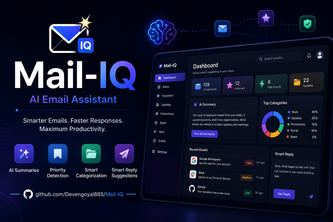
MailIQ-demo is a self-reported AI-powered email intelligence platform designed to reduce notification overload by summarizing, extracting tasks, detecting deadlines, and triggering voice alerts for high-priority emails. It integrates with Gmail via webhooks and uses OpenAI and Gemini models for processing.
What changed
The project was submitted as a hackathon entry (OpenAI 2026) and includes a frontend-only demo mode intended for judges and recruiters. No production deployment or customer data are evidenced.
Single most important open question
Is there any evidence of actual user adoption, revenue generation or product-market fit beyond the self-reported demo?
What The Product Actually Is
The description states that MailIQ-demo is an AI Email Productivity Copilot, built as a frontend-only demo for hackathon evaluation. It integrates with Gmail via OAuth 2.0 and uses webhooks to process incoming emails.
- The system architecture includes:
- Incoming Gmail Webhooks → Express Data Gateway → Security Pre-Filter (spam/newsletter/malicious prompt injection detection) → Clean Payload → AI Engine (Gemini 3.5)
- If a deadline is detected, it checks if it's <24 hours and high priority → triggers Twilio Voice API for synthetic voice call
- Features include:
- Instant AI Summary & Sentiment
- Automatic Task Extraction to Kanban board
- Cyber Shield Protection against prompt injection attacks
- Voice Alarm Engine for critical deadlines
- Context-Aware Smart Reply
- Smart Sender Pockets (chronological grouping)
- It is built using CSS, HTML, JavaScript, TypeScript and OpenAI/Gemini APIs.
Inference The product appears to be a proof-of-concept or prototype, not a production-ready SaaS offering. The use of Framer-Motion for UI interactions and a guided tour suggests it's designed for demonstration rather than real-world deployment.
Positioning & Claim Evolution
The author positions MailIQ-demo as:
- An AI Email Productivity Copilot
- A tool that transforms passive emails into actionable Kanban tasks
- A solution to notification overload, particularly for urgent or emergency situations
It claims to go beyond simple spam filtering by actively reading, summarizing, and extracting commitments from emails.
Inference The positioning is aspirational — it implies a future product with advanced automation capabilities. However, the self-reported nature of the description does not confirm any real-world usage or traction.
Target Customer & ICP
The description does not clearly define a specific customer segment or ideal customer profile (ICP). It implies the platform targets individuals who receive high volumes of email and need prioritization tools.
Inference Given its focus on personal productivity and integration with Gmail, it may target professionals or knowledge workers. However, no explicit targeting is stated.
Business Model & Pricing Evidence
There is no evidence in the description of a business model or pricing structure. The project is presented as a demo for a hackathon submission.
Inference If this evolves into a commercial product, it would likely be SaaS-based, possibly subscription-driven, but no such details are provided.
Technical & Delivery Signals
- Built with frontend-only technologies: CSS, HTML, JavaScript, TypeScript
- Uses OpenAI and Gemini AI models
- Integrates with Gmail via OAuth 2.0 webhooks
- Implements Twilio Voice API for alarm notifications
- Designed with Framer-Motion micro-interactions, glassmorphism UI, and guided showcase tour
- Supports local development and static deployment (Netlify/Vercel/Render)
Inference The technical stack suggests a lightweight prototype built for rapid iteration and demonstration. The lack of backend infrastructure or data persistence beyond the demo implies no real-world functionality.
Traction & Maturity Signals
There is no evidence of traction, revenue, customers, or adoption beyond the hackathon submission.
- The project is described as a demo mode
- No mention of actual users, usage metrics, or product-market fit
- No production deployment or live service is referenced
Inference This is a pre-product stage prototype with no demonstrated market traction.
Competitive Context
The description does not reference competitors directly. However, based on the features described (email summarization, task extraction, deadline detection), it aligns with:
- Email productivity tools
- AI-powered email assistants
- Task management integrations
Inference It competes in a crowded space of AI-enhanced email tools like SaneBox, Boomerang, or Notion’s email integrations. But no competitive positioning is stated.
Open Questions & Risks
- No real-world usage: The project is only described as a demo.
- Unverified claims: All features and functionality are self-reported without validation.
- Limited scope: Built for hackathon presentation, not scalable or production-ready.
- Lack of business model clarity: No indication of monetization strategy.
- Team size: Only two members listed — raises questions about execution capacity.
Inference The risk of misalignment between stated goals and actual product development is high. The lack of traction or revenue makes it difficult to assess viability.
Questions the description leaves open
- What is the current status of the platform beyond the demo? Is there a working prototype?
- Have you conducted any user testing or feedback collection?
- How do you plan to monetize this product if it were to scale?
- Are there any existing partnerships or integrations with email providers?
- What are your plans for scaling beyond the current hackathon-level architecture?
Overall Assessment
Not evidenced
There is no evidence of revenue, customers, traction, or a clear path to monetization. The project is presented as a hackathon demo and lacks any indication of commercial viability or product-market fit.
Confidence Level Low This analysis is based entirely on self-reported information from the author. No external validation or data exists to support claims made in the description.
User Stories BotA demo video on every pull request
Get a demo video on every new feature
GitHub App that watches your pull requests and records a narrated, captioned demo.
Save time on demo prep and make informed decisions faster with a video walkthrough of every new feature.
Source
Submitted to the OpenAI 2026 hackathon on Devpost. Project home on Devpost. Back to the full gallery on Devpost.
This competitive analysis was produced by top-founders.com (opens in a new tab)
Generated by a language model from this project's public Devpost page — its tagline, the author's own write-up and any built-with tags listed there — as captured in August 2026. Short quotations are the author's words. It is an opinion on the idea as a business, not on the people behind it, and it reflects the description as published then. If the project has moved on, request a correction below. The analysis is not independent research and contains no verified traction, revenue or customer data.
An independent guide by KFG International LLC — not affiliated with, endorsed by, or connected to Devpost or OpenAI.