

Archive position — measured, not model output
2 likes on Devpost
221 of the 7,850 archived projects have more likes, and 284 share exactly 2 — so this project's #223 place in the like-ranked listing is a tie-break inside that group, not a ranking.
Projects (log scale)
Likes on Devpost. ▲ marks this project's group.
Show the figures
| Likes | Projects | Share of archive |
|---|---|---|
| 0 | 5,587 | 71.2% |
| 1 | 1,758 | 22.4% |
| 2 | 284 | 3.6% |
| 3–4 | 132 | 1.7% |
| 5–9 | 75 | 1.0% |
| 10+ | 14 | 0.2% |
 User Stories BotA demo video on every pull request
Get a demo video on every new feature
GitHub App that watches your pull requests and records a narrated, captioned demo.
Save time on demo prep and make informed decisions faster with a video walkthrough of every new feature.
Executive Summary
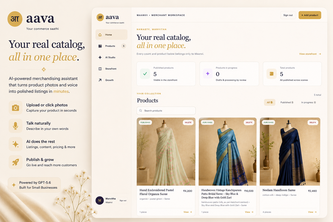
The company appears to be a hackathon project named Aava, self-described as an AI merchandising assistant for small businesses. The description states that it helps users create complete product listings from photos and conversation using multimodal reasoning powered by OpenAI models.
What changed: This is a self-reported, unverified project submitted to the OpenAI 2026 hackathon. No evidence of commercial traction, revenue, or customer adoption exists in the provided description.
Single most important open question: Is there any evidence that Aava has moved beyond the prototype stage or demonstrated product-market fit with real users?
What The Product Actually Is
The description states that Aava is an AI merchandising assistant. It allows users to upload images and describe products via voice or text, then uses multimodal reasoning to understand the product, ask follow-up questions when needed, and generate:
- Product attributes
- Descriptions
- Pricing suggestions
- SEO tags
- Hashtags
- Marketing content
After publishing, it continues offering merchandising insights and recommendations.
Inference: The system is designed to reduce time spent on online product listing creation from hours to minutes. It integrates vision, reasoning, and conversation into a single workflow using OpenAI models.
Not evidenced: No information about actual functionality beyond the hackathon demo, or whether it has been tested with real users.
Positioning & Claim Evolution
The description claims Aava gives small businesses "the same merchandising and marketing capabilities that large brands have—using AI."
It positions itself as a "marketing team in every shopkeeper's pocket" and aims to help businesses build an online presence while saving time, reducing costs, and improving competitiveness.
Inference: The positioning is centered on democratizing access to professional-grade merchandising tools for small businesses, particularly those without dedicated marketing teams.
Not evidenced: No evidence of how this compares to existing solutions or whether the claims have been validated with users.
Target Customer & ICP
The description states that Aava was built around fashion but works for "jewelry, handmade products, furniture, home décor, food products, or any business trying to build an online presence."
It also mentions that it targets "hundreds of millions of small and medium-sized businesses worldwide" who lack access to dedicated marketing or merchandising teams.
Inference: The target customer is small business owners across various product categories looking to streamline their e-commerce operations.
Not evidenced: No specific segmentation, personas, or user research data provided. No evidence of actual customers or market validation.
Business Model & Pricing Evidence
The description does not mention any pricing model or revenue streams.
It states that Aava aims to publish directly to platforms like Shopify, Etsy, Instagram, and WhatsApp Business, but no commercial details are given.
Inference: If the product becomes commercialized, it likely would involve platform integrations and possibly subscription-based access to AI services.
Not evidenced: No pricing structure, monetization strategy, or business model details provided.
Technical & Delivery Signals
The project was built using OpenAI's models including GPT-5.5/5.6, ChatGPT Pro, Sora, and Whisper.
It leverages multimodal reasoning combining vision, conversation, and text generation within a single workflow.
ChatGPT was used for rapid prototyping, debugging, UX refinement, and iteration.
Inference: The team prioritized speed of development over scalability or robustness due to hackathon constraints.
Not evidenced: No information about technical architecture, API usage limits, performance metrics, or long-term infrastructure plans.
Traction & Maturity Signals
The project is described as a hackathon submission from the OpenAI 2026 hackathon on Devpost. It was built within limited time and budget constraints.
It mentions that they invested in OpenAI API credits and optimized prompts to get value from each request, indicating early-stage development.
Inference: The product exists only as a prototype or proof-of-concept at this stage.
Not evidenced: No evidence of user adoption, customer feedback, revenue, ARR, or any form of traction beyond the hackathon submission.
Competitive Context
The description does not reference competitors directly. However, it implies that Aava addresses gaps in current solutions for small businesses trying to manage online product listings manually.
It positions itself as an AI-powered alternative to manual merchandising workflows involving multiple tools and teams.
Inference: The competitive space includes traditional e-commerce platforms (Shopify, Etsy), content creation tools, and possibly other AI assistants focused on marketing or product listing automation.
Not evidenced: No competitive analysis, market size estimates, or differentiation from existing offerings.
Open Questions & Risks
- Prototype-only status: The project is described as a hackathon submission with no evidence of commercial viability.
- Dependency on third-party APIs: Heavy reliance on OpenAI models may create scalability and cost risks.
- Lack of user feedback or testing: No mention of real-world usage or iteration based on customer input.
- Unproven business model: No indication of how the product will generate revenue or sustain itself beyond a hackathon demo.
Inference: The risk of failure is high if Aava does not evolve significantly beyond its current prototype stage.
Questions the description leaves open
- Has Aava been tested with actual users outside of the hackathon?
- What specific problems do users report when using Aava today?
- How does Aava handle edge cases or ambiguous product details?
- Are there any plans to monetize or scale beyond the current prototype?
- What is the roadmap for integrating with e-commerce platforms like Shopify or Etsy?
- Have you considered data privacy and intellectual property implications of AI-generated content?
Overall Assessment
Not evidenced: There is no evidence that Aava has achieved any level of commercial traction, revenue, or customer adoption.
The description presents a compelling vision but lacks substantiation for viability or scalability.
Confidence level: Low — this analysis is based entirely on self-reported claims from a hackathon project with no external validation. Any future potential must be inferred from the author’s stated intentions and assumptions, not facts.
Conclusion: Aava appears to be an early-stage idea with strong positioning but no demonstrated progress toward commercialization or market fit.
User Stories BotA demo video on every pull request
Get a demo video on every new feature
GitHub App that watches your pull requests and records a narrated, captioned demo.
Save time on demo prep and make informed decisions faster with a video walkthrough of every new feature.
Source
Submitted to the OpenAI 2026 hackathon on Devpost. Project home on Devpost. Back to the full gallery on Devpost.
This competitive analysis was produced by top-founders.com (opens in a new tab)
Generated by a language model from this project's public Devpost page — its tagline, the author's own write-up and any built-with tags listed there — as captured in August 2026. Short quotations are the author's words. It is an opinion on the idea as a business, not on the people behind it, and it reflects the description as published then. If the project has moved on, request a correction below. The analysis is not independent research and contains no verified traction, revenue or customer data.
An independent guide by KFG International LLC — not affiliated with, endorsed by, or connected to Devpost or OpenAI.