

Archive position — measured, not model output
0 likes on Devpost
2,263 of the 7,850 archived projects have more likes, and 5,587 share exactly 0 — so this project's #5,073 place in the like-ranked listing is a tie-break inside that group, not a ranking.
Projects (log scale)
Likes on Devpost. ▲ marks this project's group.
Show the figures
| Likes | Projects | Share of archive |
|---|---|---|
| 0 | 5,587 | 71.2% |
| 1 | 1,758 | 22.4% |
| 2 | 284 | 3.6% |
| 3–4 | 132 | 1.7% |
| 5–9 | 75 | 1.0% |
| 10+ | 14 | 0.2% |
 User Stories BotA demo video on every pull request
Get a demo video on every new feature
GitHub App that watches your pull requests and records a narrated, captioned demo.
Save time on demo prep and make informed decisions faster with a video walkthrough of every new feature.
Executive Summary
LoreLock Studio is a self-reported tool built for visual storytellers to maintain continuity in generative media workflows. The author states it uses GPT-5.6 to evaluate candidate panels against structured story canon, returning assessments (approve, revise, reject) with evidence and corrected prompts. It includes an interface and evidence ledger, designed as a generic product layer for judging hackathon submissions.
The project is presented as a standalone React/Express application using OpenAI APIs and Zod for validation. The author claims it supports multimodal input, structured outputs, and deterministic evaluation without requiring credentials.
Key open question
Is there any evidence of actual use or traction beyond the hackathon submission?
What The Product Actually Is
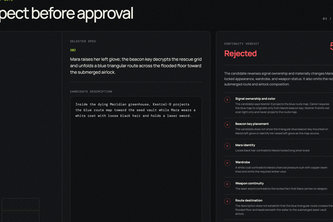
The description states that LoreLock Studio is a continuity engine that turns story canon into shot plans and evaluates candidate panels for visual drift. It uses GPT-5.6 to perform checks on:
- Character identity and appearance
- Wardrobe and props
- Power ownership and visual effects
- Location continuity
- Required story beats
Each check returns an assessment (approved, revise, rejected), exact canon evidence, correction path, and production-safe replacement prompt.
It also includes an evidence ledger that records decisions for review, and supports both image and text input. The system is built with React 19, TypeScript, Express.js, and Zod contracts.
The author claims the tool can be used to generate shot plans from a story bible and evaluate candidate panels against them in real time using GPT-5.6.
Inference: Based on the description, this appears to be a prototype or proof-of-concept for managing continuity in generative storytelling workflows, likely intended for creative teams working with AI-generated visuals.
Positioning & Claim Evolution
The author positions LoreLock Studio as a continuity gate for visual storytellers who are concerned about narrative correctness being lost in generative tools. The tagline states it is a “GPT-5.6 continuity engine” that turns story canon into shot plans, detects visual drift, and records evidence-backed assessments.
The project evolved from the need to address how generative tools can create visually appealing content while silently breaking story consistency. It aims to make "canon executable" by structuring checks and providing actionable feedback.
Claim: The tool is designed to prevent narrative inconsistencies in AI-generated visual media.
Inference: This is a response to perceived gaps in current generative tools where visual quality does not guarantee narrative fidelity.
Target Customer & ICP
The description states that LoreLock Studio targets visual storytellers who are concerned about continuity issues in generative workflows. These users may include:
- Writers or developers working with AI-generated visuals
- Production teams managing creative content pipelines
- Creators using generative tools for sci-fi, fantasy, or other narrative-heavy genres
The author mentions that the tool was built during a hackathon and includes a demo case (The Glass Meridian) to illustrate its functionality.
Inference: The target customer is likely early-stage creators or small teams working with AI in creative production environments. No specific customer segments or personas are defined beyond this general category.
Business Model & Pricing Evidence
There is no evidence of pricing, monetization strategy, or business model in the description.
Not evidenced
Technical & Delivery Signals
The product is built using:
- Frontend: React 19, TypeScript
- Backend: Express.js, Node.js
- AI: GPT-5.6 via OpenAI API
- Validation: Zod contracts
- Tools: Vite, Codex (for development assistance)
It supports:
- Multimodal input (text and image)
- Structured outputs from GPT models
- Evidence ledger persistence
- JSON export of assessments
- Standalone server functionality
The author notes that the tool includes a demo case (The Glass Meridian) for judges to test without credentials.
Inference: The technical stack suggests a lightweight, developer-focused prototype built for rapid iteration and demonstration. It is not described as scalable or production-ready beyond its hackathon use.
Traction & Maturity Signals
There is no evidence of revenue, customers, user adoption, or product traction beyond the hackathon submission.
Not evidenced
Competitive Context
The description does not mention any competitors or existing solutions in the space. It implies that there is a gap in the market for tools that ensure continuity in generative visual storytelling, but no reference to prior art or similar products.
Inference: The product may address an unmet need in AI-assisted creative workflows, particularly around narrative consistency and production safety. However, no competitive landscape is described.
Open Questions & Risks
- Unverified claims: The description makes strong claims about GPT-5.6 capabilities and structured outputs without evidence of performance or accuracy.
- No traction or revenue data: No evidence of real-world usage or monetization.
- Limited scope: The tool is described as a hackathon prototype, not a mature product.
- Self-reported metrics only: All accomplishments are self-assessed without external validation.
- Unproven scalability: No indication that the system can handle large-scale or enterprise-level use cases.
Inference: The project lacks commercial viability indicators and appears to be an experimental tool with no clear path to market traction or monetization.
Questions the description leaves open
- What specific continuity issues were you trying to solve, and how did you validate the need?
- How does the system handle edge cases or ambiguous canon elements?
- Are there any known limitations of GPT-5.6 in performing these checks reliably?
- Has the tool been tested with actual users or teams beyond the hackathon?
- What is the plan for integrating with existing creative production tools?
- How would you scale this solution to support larger teams or workflows?
Overall Assessment
There is no evidence of revenue, traction, or commercial viability beyond a hackathon submission.
Not evidenced
The project is presented as a proof-of-concept for managing continuity in generative storytelling. While it shows some technical sophistication and addresses a potential pain point, there is no indication that it has moved beyond the prototype stage or gained any real-world adoption.
Confidence level: Low — based entirely on self-reported evidence with no external validation or data.
User Stories BotA demo video on every pull request
Get a demo video on every new feature
GitHub App that watches your pull requests and records a narrated, captioned demo.
Save time on demo prep and make informed decisions faster with a video walkthrough of every new feature.
Source
Submitted to the OpenAI 2026 hackathon on Devpost. Project home on Devpost. Back to the full gallery on Devpost.
This competitive analysis was produced by top-founders.com (opens in a new tab)
Generated by a language model from this project's public Devpost page — its tagline, the author's own write-up and any built-with tags listed there — as captured in August 2026. Short quotations are the author's words. It is an opinion on the idea as a business, not on the people behind it, and it reflects the description as published then. If the project has moved on, request a correction below. The analysis is not independent research and contains no verified traction, revenue or customer data.
An independent guide by KFG International LLC — not affiliated with, endorsed by, or connected to Devpost or OpenAI.