

Archive position — measured, not model output
0 likes on Devpost
2,263 of the 7,850 archived projects have more likes, and 5,587 share exactly 0 — so this project's #5,070 place in the like-ranked listing is a tie-break inside that group, not a ranking.
Projects (log scale)
Likes on Devpost. ▲ marks this project's group.
Show the figures
| Likes | Projects | Share of archive |
|---|---|---|
| 0 | 5,587 | 71.2% |
| 1 | 1,758 | 22.4% |
| 2 | 284 | 3.6% |
| 3–4 | 132 | 1.7% |
| 5–9 | 75 | 1.0% |
| 10+ | 14 | 0.2% |
 User Stories BotA demo video on every pull request
Get a demo video on every new feature
GitHub App that watches your pull requests and records a narrated, captioned demo.
Save time on demo prep and make informed decisions faster with a video walkthrough of every new feature.
Executive Summary
Loopit is a self-reported tool that allows users to create autonomous AI agent workflows that run continuously without requiring constant human input. The author describes it as a system that turns a goal into a repeatable, autonomous workflow using Codex and runs locally on the user’s machine. It was built for personal research use and later expanded to help others automate tasks by delegating work to an AI agent for extended periods.
The project is in early development, with no evidence of revenue, customers or traction beyond the author's own experience. The description does not indicate any funding, partnerships, or commercial adoption.
Most important open question
Is there a real market need for autonomous workflows that can run 24/7 without human intervention, and if so, how does Loopit differentiate from existing tools in this space?
What The Product Actually Is
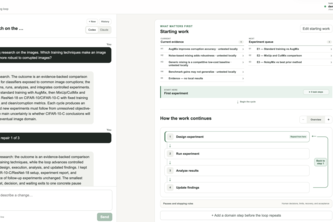
The description states that Loopit turns AI agents into continuous workflows that run 24/7, instead of stopping every 15 minutes to ask what’s next. It is described as a web interface built around Codex that runs directly on the user's local machine.
It allows users to define a process, specify how each iteration should work, and test whether the loop can continue reliably. At the end of each iteration, Loopit returns the agent to a well-defined state so it can evaluate the result, decide what comes next, and begin another cycle.
Inference The tool appears to be an experimental or prototype system designed to enable long-running autonomous tasks using AI agents, particularly in coding contexts.
Positioning & Claim Evolution
The author claims that Loopit was inspired by a personal need to automate research work. It evolved from a "research tool I built for myself" into something intended to help others automate their own work through AI agents.
It positions itself as a way to delegate tasks to Codex or similar tools for 24 hours rather than giving instructions every 15 minutes, suggesting an intent to reduce human oversight in repetitive or iterative processes.
Inference The positioning reflects a niche use case focused on autonomous task execution using AI agents, likely targeting developers or researchers who want to offload routine work.
Target Customer & ICP
The description does not explicitly name target customers. However, the author notes that many people who use Codex or Claude Code do not work with loops and instead ask for new instructions after each task completion.
This implies a potential audience of individuals or teams using AI coding tools who are looking to increase automation and reduce manual intervention in workflows.
Inference The likely ICP includes developers, researchers, or technical professionals who use AI agents for coding tasks and seek more autonomous execution capabilities.
Business Model & Pricing Evidence
There is no evidence of a business model or pricing structure in the description. The project is presented as a personal research tool that has been expanded to help others automate work.
Not evidenced
Technical & Delivery Signals
Loopit is built using Codex, and the interface runs directly on the user’s local machine. It includes a web-based UI and supports workflows that can repeat autonomously.
The author mentions challenges in making loops easy to understand, indicating an emphasis on usability and abstraction of technical complexity for non-expert users.
Inference The tool is technically experimental, designed around a local runtime environment with a focus on user experience over deep technical sophistication.
Traction & Maturity Signals
There is no evidence of traction or maturity beyond the author’s own development experience. The project was submitted to an OpenAI hackathon and has no mention of users, customers, revenue, or adoption metrics.
Not evidenced
Competitive Context
The description does not provide information about competitors or similar products. It does not reference existing tools for AI agent automation or workflow orchestration.
Not evidenced
Open Questions & Risks
- No commercial traction: The project is described as a personal tool with no evidence of market adoption.
- Single founder: Only one team member is listed, which may limit scalability and execution capability.
- Limited scope: The tool appears to be focused on local machine use and AI coding tasks, potentially limiting its applicability.
- Unverified claims: All statements are self-reported and unverifiable.
Questions the description leaves open
- What specific problems are you solving for users beyond the current limitations of AI agents?
- How do you plan to scale beyond a single developer’s use case?
- Are there any known edge cases or failure modes in long-running workflows?
- What is your roadmap for expanding beyond local machine execution?
- Have you identified any early adopters or potential users?
Overall Assessment
There is no evidence of a viable business model, revenue, customers or traction to support an investment or partnership decision at this stage.
The project appears to be in very early development and lacks commercial signals. Any strategic interest would depend on future product evolution and market validation.
Not evidenced
User Stories BotA demo video on every pull request
Get a demo video on every new feature
GitHub App that watches your pull requests and records a narrated, captioned demo.
Save time on demo prep and make informed decisions faster with a video walkthrough of every new feature.
Source
Submitted to the OpenAI 2026 hackathon on Devpost. Project home on Devpost. Back to the full gallery on Devpost.
This competitive analysis was produced by top-founders.com (opens in a new tab)
Generated by a language model from this project's public Devpost page — its tagline, the author's own write-up and any built-with tags listed there — as captured in August 2026. Short quotations are the author's words. It is an opinion on the idea as a business, not on the people behind it, and it reflects the description as published then. If the project has moved on, request a correction below. The analysis is not independent research and contains no verified traction, revenue or customer data.
An independent guide by KFG International LLC — not affiliated with, endorsed by, or connected to Devpost or OpenAI.