

Archive position — measured, not model output
0 likes on Devpost
2,263 of the 7,850 archived projects have more likes, and 5,587 share exactly 0 — so this project's #5,049 place in the like-ranked listing is a tie-break inside that group, not a ranking.
Projects (log scale)
Likes on Devpost. ▲ marks this project's group.
Show the figures
| Likes | Projects | Share of archive |
|---|---|---|
| 0 | 5,587 | 71.2% |
| 1 | 1,758 | 22.4% |
| 2 | 284 | 3.6% |
| 3–4 | 132 | 1.7% |
| 5–9 | 75 | 1.0% |
| 10+ | 14 | 0.2% |
 User Stories BotA demo video on every pull request
Get a demo video on every new feature
GitHub App that watches your pull requests and records a narrated, captioned demo.
Save time on demo prep and make informed decisions faster with a video walkthrough of every new feature.
Executive Summary
What the company appears to be
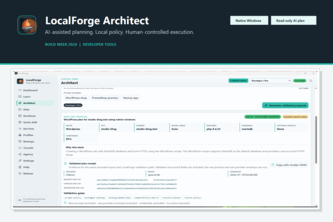
LocalForge Architect is a self-reported Windows-native development environment planning tool that uses AI to interpret natural-language development requests into typed, catalog-backed proposals. It operates as an advisory layer over an existing local development platform, maintaining strict human control and native execution boundaries.
What changed
The project adds an optional AI-assisted planning layer (Architect) to an already-existing Windows-native local development control center (LocalForge). The new layer supports natural-language input, catalog-based resolution, and a Git review/export workflow for AI-generated plans. It does not replace or bypass the existing manual planner or native execution tools.
The single most important open question
Is there any evidence of real-world usage or adoption of LocalForge or its Architect extension beyond the hackathon demo?
What The Product Actually Is
The description states that LocalForge Architect is a tool that converts natural-language development requests into versioned, typed proposals using AI. It resolves only catalog-backed recipes, runtimes, packages, services, and providers. It integrates with an existing Windows-native local development platform called LocalForge, which includes features like compatibility checks, managed services, databases, HTTPS, backups, diagnostics, and guarded tunnels.
The Architect layer is described as optional and does not replace the manual planner; it can prefill the manual planner only after explicit confirmation. The tool supports a Git review/export workflow for AI-generated plans but keeps execution under human control.
Evidence
- "Converts a natural-language development request into a versioned, typed proposal."
- "Resolves only catalog-backed recipes, runtimes, packages, services, and providers."
- "Runs LocalForge compatibility, installation-planning, and tunnel-safety checks before presenting a result."
- "Prefills the existing manual Sites planner only after explicit confirmation."
- "Provides seven responsive Learn paths that delegate to the same manual planner."
- "Adds metadata-only Agency handoffs and an offline, plan-confirmed Git status, initialization, and clean-HEAD bundle workflow for one selected project."
Inference The product is a planning assistant for developers working in Windows environments, not a full development environment or execution engine.
Positioning & Claim Evolution
The author states that LocalForge Architect is built to keep AI advisory while maintaining native managers as authoritative. It does not require Docker, WSL, or Hyper-V and aims to avoid creating a second execution engine. The tool emphasizes safety, with no free-form fields in the output schema and strict validation of inputs and outputs.
Evidence
- "We built LocalForge Architect so AI remains advisory while LocalForge's native managers remain authoritative."
- "There is no command, script, environment, arbitrary path, or free-form URL field in the Architect output schema."
- "Installation still passes through RecipeManager, InstallPlanner, CompatibilityManager, and the existing confirmation gates."
Inference The positioning is that of a safe, controlled AI assistant for local development setup — not an autonomous tool.
Target Customer & ICP
The description does not explicitly name target customers or personas. However, it implies a developer audience working in Windows environments who need to set up complex local stacks with specific frameworks, runtimes, and services.
Evidence
- "Setting up a local Windows development environment is rarely one decision."
- "A developer must align framework versions, runtimes, databases, ports, HTTPS, services, public-preview policy, and installation constraints."
Inference The primary ICP appears to be professional developers working in Windows environments who need structured, safe, and repeatable local stack setup.
Business Model & Pricing Evidence
There is no evidence of pricing, revenue, or business model in the description. The project is presented as a hackathon submission with no mention of monetization or customer acquisition.
Evidence
- No pricing information.
- No mention of customers or sales.
- No indication of commercial use beyond the demo.
Inference The business model is not evident from the provided description.
Technical & Delivery Signals
The project is built using Rust, Tauri, React, TypeScript, and various AI tools including Codex, GPT-5.6, Ollama, and OpenAI. It uses JSON schema for typed inputs/outputs and includes a CLI with deterministic, parseable JSON. The system supports offline Git workflows and redacted error handling.
Evidence
- "The durable policy lives in Rust."
- "The CLI exposes deterministic, parseable JSON."
- "Tauri exposes narrow asynchronous commands with redacted public errors."
- "React provides validation, loading, retry, fixture disclosure, blocker, confirmation, and manual-handoff states."
- "The OpenAI provider uses the Responses API with tools: [], store: false, and a strict JSON schema."
Inference The technical stack suggests a focus on safety, determinism, and native Windows integration.
Traction & Maturity Signals
There is no evidence of traction or adoption beyond the hackathon submission. The project includes test results (e.g., 625 Rust workspace tests passed), but no data about users, customers, or real-world usage.
Evidence
- "625 Rust workspace tests passed with zero failures."
- "39 Tauri Rust tests passed."
- "33 desktop Playwright tests passed."
- "Twelve current 1920x930 native screenshots passed the capture gate."
- "Four deterministic demo scenarios passed parseability, stability, safe refusal, and no-data-root assertions."
Inference The project shows technical maturity in testing and development but lacks evidence of real-world usage or adoption.
Competitive Context
The description does not mention competitors. It implies that LocalForge is a native Windows local development platform, which may compete with tools like Docker Desktop, WSL, or other local stack management solutions, but no direct comparison or competitive positioning is stated.
Evidence
- "LocalForge already existed as a native Windows local-development control center."
- "It does not require Docker, WSL, or another virtualization layer for its normal path."
Inference The product may compete with tools that manage local development environments on Windows but lacks explicit competitive context.
Open Questions & Risks
- No commercial traction or adoption: The project is presented as a hackathon submission with no evidence of real-world usage.
- No pricing or monetization strategy: No indication of how the product would be sold or funded.
- Limited scope: The tool only supports catalog-backed recipes and does not replace manual planning, limiting its utility for complex or custom setups.
- AI dependency without clear value-add: The AI is described as advisory, but it's unclear what benefit it provides over a manual process.
Evidence
- No mention of customers, revenue, or usage.
- No pricing or monetization strategy.
- The tool does not replace the manual planner; it only pre-fills it.
Questions the description leaves open
- What is the current status of LocalForge outside of this hackathon project?
- Is there any evidence of real-world usage or feedback from developers using LocalForge or its Architect extension?
- How does the product plan to monetize or scale beyond a hackathon demo?
- What are the specific catalog entries and providers that are supported, and how are they curated?
- Are there plans to support other platforms beyond Windows?
Overall Assessment
Not evidenced.
The description is self-reported and unverified, with no evidence of revenue, customers, or traction. The project appears to be a hackathon submission that demonstrates technical capability but lacks commercial viability or market validation.
Confidence Low
Reasoning
No data on adoption, revenue, or customer feedback; the product is described as an extension to an existing platform, but no evidence of that platform’s usage or success. The project is not presented as a commercial product but as a proof-of-concept.
User Stories BotA demo video on every pull request
Get a demo video on every new feature
GitHub App that watches your pull requests and records a narrated, captioned demo.
Save time on demo prep and make informed decisions faster with a video walkthrough of every new feature.
Source
Submitted to the OpenAI 2026 hackathon on Devpost. Project home on Devpost. Back to the full gallery on Devpost.
This competitive analysis was produced by top-founders.com (opens in a new tab)
Generated by a language model from this project's public Devpost page — its tagline, the author's own write-up and any built-with tags listed there — as captured in August 2026. Short quotations are the author's words. It is an opinion on the idea as a business, not on the people behind it, and it reflects the description as published then. If the project has moved on, request a correction below. The analysis is not independent research and contains no verified traction, revenue or customer data.
An independent guide by KFG International LLC — not affiliated with, endorsed by, or connected to Devpost or OpenAI.