

Archive position — measured, not model output
1 like on Devpost
505 of the 7,850 archived projects have more likes, and 1,758 share exactly 1 — so this project's #1,343 place in the like-ranked listing is a tie-break inside that group, not a ranking.
Projects (log scale)
Likes on Devpost. ▲ marks this project's group.
Show the figures
| Likes | Projects | Share of archive |
|---|---|---|
| 0 | 5,587 | 71.2% |
| 1 | 1,758 | 22.4% |
| 2 | 284 | 3.6% |
| 3–4 | 132 | 1.7% |
| 5–9 | 75 | 1.0% |
| 10+ | 14 | 0.2% |
 User Stories BotA demo video on every pull request
Get a demo video on every new feature
GitHub App that watches your pull requests and records a narrated, captioned demo.
Save time on demo prep and make informed decisions faster with a video walkthrough of every new feature.
Executive Summary
What the company appears to be
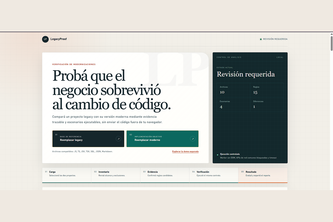
LegacyProof is a self-reported local web-based tool designed to help developers verify that modern rewrites of legacy systems preserve original business behavior. It operates as an MVP with deterministic verification workflows, comparing legacy and replacement codebases through executable test scenarios.
What changed
The project was submitted to the OpenAI 2026 hackathon, indicating a recent development phase. It is described as a minimal viable product (MVP) focused on local execution in the browser, using pattern-matching and scenario-based comparison to detect behavioral mismatches.
Single most important open question — the commercial due-diligence read
Is there a clear path from MVP to a scalable SaaS or developer tooling product that can be adopted by teams doing legacy modernization at scale?
What The Product Actually Is
The description states that LegacyProof is a local web MVP that compares two project folders:
- A legacy project
- A modern replacement project
It recursively reads both folders in the browser, filters supported source files, and builds a technical inventory of the selected workspace.
Key features include:
- Filtering out dependencies, generated output, secrets, binaries, and oversized files
- Inventorying files, languages, lines, functions, classes, conditions, endpoints, SQL tables, and SQL operations
- Detecting candidate business rules using deterministic pattern matching
- Attaching exact evidence to each candidate (source file, line number, excerpt, rationale)
- Allowing users to review, confirm, discard, or reopen detected rules
- Loading shared JSON scenario contracts
- Executing both project adapters with the same input
- Comparing outputs deterministically
- Reporting preserved behavior, mismatches, execution errors, and unverifiable cases
- Exporting results as JSON and HTML reports
The tool is not described as fully automating equivalence proof or executing arbitrary real projects with runtime dependencies.
Positioning & Claim Evolution
The author states that LegacyProof was created to answer a practical question:
"Does the rewritten system still behave like the original one within the scenarios we can execute and verify?"
It positions itself as a local, reproducible verification tool for teams modernizing legacy systems. The project emphasizes:
- Not relying on AI-generated text for equivalence decisions
- Using deterministic verification flow based on executable tests
- Focusing on evidence-based inspection plus deterministic behavior comparison
The claim evolution shows a shift from a hackathon MVP to a potential developer workflow tool, with future enhancements like CI/CD integration and editor support.
Target Customer & ICP
The description does not name specific customers or personas. However, it implies the following:
- Teams working on legacy system modernization
- Developers or engineering teams who need to verify behavior preservation during rewrites
- Users likely operating in environments where business rules are undocumented or scattered
There is no evidence of a defined Ideal Customer Profile (ICP), segmentation, or targeting beyond general software modernization use cases.
Business Model & Pricing Evidence
No business model or pricing information is provided. The description only mentions that LegacyProof is an MVP and does not yet support full automation or AI-assisted decision-making.
There is no indication of monetization strategy, subscription tiers, or paid features.
Technical & Delivery Signals
The current architecture consists of:
- A deterministic core engine responsible for scanning files, building inventories, detecting candidate rules, validating scenarios, executing adapters, comparing outputs, and producing structured reports.
- A local web application handling folder selection, local file loading, UI controls, result visualization, and report export.
Key technical details:
- Built with browser-based technologies: JavaScript, TypeScript, HTML, CSS
- Uses Vite, Vitest, Web Workers, and Prettier
- Adapters must be self-contained and executed in isolated browser Workers
- Network APIs are blocked; timeouts apply
- Supports a limited set of file types and languages (based on supported source files)
The MVP is intentionally scoped and does not support full semantic equivalence or arbitrary project execution.
Traction & Maturity Signals
Not evidenced. There is no mention of:
- Revenue
- Customers
- Usage metrics
- Product adoption
- Market traction
- Funding rounds
- Headcount beyond one person (delacruz97 Baneki)
The project is described as an MVP submitted to a hackathon, with no indication of prior user base or product maturity.
Competitive Context
Not evidenced. The description does not mention:
- Competitors
- Existing tools in the legacy modernization space
- Market positioning relative to other verification or testing platforms
No competitive analysis or differentiation is provided.
Open Questions & Risks
Inferences based on self-reported information:
- MVP Scope Limitations: The tool is explicitly scoped as an MVP and does not claim full semantic equivalence or AI-driven decision-making.
- Browser-Based Execution Constraints: Execution happens in browser Workers with timeouts, limited network access, and no support for real project dependencies.
- No Revenue or Traction Evidence: No signs of monetization, customer base, or product adoption beyond the hackathon submission.
- Single Developer Team: The team size is listed as one, suggesting limited development capacity.
- Unproven Market Demand: There is no evidence that teams are actively seeking this type of verification tool at scale.
Questions the description leaves open
- What specific legacy modernization workflows are you targeting, and how do they differ from general testing or code review practices?
- How does the deterministic approach compare to AI-based tools in terms of accuracy and coverage for business rule detection?
- Are there any internal or external users currently testing this tool beyond the MVP phase?
- What is your roadmap for moving from local browser execution to broader deployment (e.g., cloud, CI/CD integration)?
- How do you plan to monetize this tool, if at all?
- What are the biggest technical challenges in scaling beyond the current browser-based MVP?
Overall Assessment
Not evidenced.
There is no evidence of:
- Revenue or financial performance
- Customer traction or adoption
- Market validation
- Product-market fit
- Strategic partnerships or use cases
The project is described as a hackathon submission and MVP with limited scope. It has not demonstrated commercial viability, scalability, or market demand beyond its own self-reporting.
Confidence Level: Low — based on thin evidence, mostly self-reported, and no external validation or traction data.
User Stories BotA demo video on every pull request
Get a demo video on every new feature
GitHub App that watches your pull requests and records a narrated, captioned demo.
Save time on demo prep and make informed decisions faster with a video walkthrough of every new feature.
Source
Submitted to the OpenAI 2026 hackathon on Devpost. Project home on Devpost. Back to the full gallery on Devpost.
This competitive analysis was produced by top-founders.com (opens in a new tab)
Generated by a language model from this project's public Devpost page — its tagline, the author's own write-up and any built-with tags listed there — as captured in August 2026. Short quotations are the author's words. It is an opinion on the idea as a business, not on the people behind it, and it reflects the description as published then. If the project has moved on, request a correction below. The analysis is not independent research and contains no verified traction, revenue or customer data.
An independent guide by KFG International LLC — not affiliated with, endorsed by, or connected to Devpost or OpenAI.