

Archive position — measured, not model output
0 likes on Devpost
2,263 of the 7,850 archived projects have more likes, and 5,587 share exactly 0 — so this project's #7,578 place in the like-ranked listing is a tie-break inside that group, not a ranking.
Projects (log scale)
Likes on Devpost. ▲ marks this project's group.
Show the figures
| Likes | Projects | Share of archive |
|---|---|---|
| 0 | 5,587 | 71.2% |
| 1 | 1,758 | 22.4% |
| 2 | 284 | 3.6% |
| 3–4 | 132 | 1.7% |
| 5–9 | 75 | 1.0% |
| 10+ | 14 | 0.2% |
 User Stories BotA demo video on every pull request
Get a demo video on every new feature
GitHub App that watches your pull requests and records a narrated, captioned demo.
Save time on demo prep and make informed decisions faster with a video walkthrough of every new feature.
Executive Summary
What the company appears to be
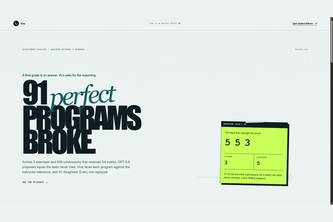
Viva is a tool designed for educational use, specifically to detect hidden defects in student programming submissions that pass standard test suites. It uses GPT-5.6 to generate edge-case inputs based on assignment specifications and reference solutions, then compiles and runs both the student's and instructor's code against those inputs. If outputs differ, it triggers a code defense where students must explain their result.
What changed
The project is self-described as an experimental tool built for a hackathon (OpenAI 2026), with no evidence of prior commercialization or product-market fit beyond its author’s own testing and validation on a small dataset. It has not been deployed in any real classroom or scaled beyond the scope of one developer's prototype.
Single most important open question
Is there evidence that Viva can be meaningfully adopted by educators or integrated into existing learning platforms, or does it remain a proof-of-concept with limited commercial viability?
What The Product Actually Is
The description states that Viva:
- Takes a student’s C submission and the instructor's reference solution.
- Uses GPT-5.6 to read the assignment specification and propose inputs the test suite likely never tried (e.g., ties, zero, negatives).
- Compiles both programs using GCC via WSL on Windows.
- Runs each proposed input on both programs.
- Only opens a code defense when outputs differ and reproduce reliably.
- Conducts the defense through GPT-5.6, asking students to explain their output in their own words.
- Provides teachers with a brief listing misconceptions caught, ranked by frequency, and a reteach plan based on the exact input that exposed the gap.
This is described as a prototype built for a hackathon, not a commercial product. The system is composed of multiple components: GPT-5.6 for input generation, a C compiler/runner, and a feedback loop involving student explanations and model grading.
Evidence
- Author states Viva "takes a student's C submission and the instructor's own reference solution."
- GPT-5.6 "reads the assignment specification and proposes inputs the test suite most likely never tried."
- Programs are compiled with GCC through WSL.
- Only differences that reproduce are considered findings.
- A defense is conducted where students explain their outputs.
- Teachers receive a brief and reteach plan.
Inference The tool appears to be an academic experiment rather than a scalable SaaS offering. It lacks any indication of user interface for teachers or students beyond the author’s own demonstration.
Positioning & Claim Evolution
The description states:
- Viva aims to detect defects in student code that pass standard test suites.
- It focuses on uncovering misconceptions, not accusing students.
- The tool is built around the idea that "the grade was measuring the test suite, not the student."
- The author emphasizes that it never asks whether they used AI — only what they can explain.
Claims made
- Viva identifies hidden defects in student code.
- It improves educational outcomes by exposing misconceptions.
- It avoids false accusations or AI attribution.
- It uses GPT-5.6 to generate edge cases intelligently, not just randomly.
Evidence
- The author claims that 14.5% of submissions that scored full marks contained defects the autograder missed.
- All findings replayed independently.
- Misconceptions like ties were dominant (83 out of 91).
- The tool avoids cosmetic differences and focuses only on real answer-changing divergences.
Inference The positioning is clearly educational, focused on improving assessment quality in programming education. However, there is no evidence that this has been validated with educators or students outside the author’s own testing.
Target Customer & ICP
The description states:
- Viva targets educators and instructors who grade student programming assignments.
- It is intended for use in introductory programming courses.
- The tool is designed to help teachers identify misconceptions missed by traditional test suites.
Evidence
- The tool is described as being useful for "intro-programming submissions."
- Teachers get a brief listing of misconceptions and a reteach plan.
- The author mentions piloting with educators after consent.
Inference The ICP appears to be instructors teaching introductory programming, particularly in higher education or K-12 settings. However, there is no evidence of actual adoption or customer interviews.
Business Model & Pricing Evidence
Not evidenced.
Evidence There is no mention of pricing, licensing, subscription models, or monetization strategy. The project is described as a hackathon submission with no indication of commercial intent or revenue streams.
Technical & Delivery Signals
The description states:
- Built using GPT-5.6, Codex, Next.js, Node.js, React, Tailwind CSS, Vercel, WSL.
- Uses GCC via WSL to compile and run student code.
- Input generation is done by GPT-5.6 reading the spec and reference solution.
- Execution uses a runner that compiles both programs and runs them on proposed inputs.
- Only reproducible differences trigger a defense.
- Output is capped to prevent buffer overflows.
Evidence
- The system uses WSL for compiling C code.
- GPT-5.6 generates inputs based on the spec.
- Execution is batched to reduce runtime.
- A guard prevents out-of-domain inputs from being considered valid findings.
- Output is limited to avoid crashes.
Inference The technical stack suggests a prototype built in a short timeframe, likely for demonstration purposes. There is no evidence of scalability or production-grade infrastructure.
Traction & Maturity Signals
Not evidenced.
Evidence
There is no mention of:
- Customers
- Revenue
- Usage metrics
- Product adoption
- Feedback from educators or students
- Deployment in classrooms or LMS integrations
The project is described as a hackathon submission with no indication of real-world traction or product maturity.
Competitive Context
Not evidenced.
Evidence
There is no information about:
- Existing tools for automated grading or code analysis.
- Competitors in the educational technology space.
- Market positioning relative to other platforms like GitHub Classroom, CodeGrade, or similar tools.
The author does not reference any competitive landscape or prior art.
Open Questions & Risks
Key Risks
- No commercial traction: The tool is described as a hackathon project with no evidence of real-world adoption.
- Limited scalability: The system uses WSL and manual execution steps, which may not scale to large classes or institutions.
- Dependency on GPT-5.6: The tool relies heavily on a proprietary AI model that may not be available for production use.
- Educational niche only: It is built for introductory programming, limiting its potential market.
- No monetization strategy: No indication of how the tool would generate revenue or be sold.
Open Questions
- The author is a single individual (Jonathan SolvesProblems).
- No evidence of team, funding, or investor interest.
- No mention of partnerships with schools, edtech companies, or LMS providers.
- The system is described as experimental and not yet validated in real classrooms.
Questions the description leaves open
- What is the current status of the tool? Is it being used in any classrooms?
- How do you plan to scale this beyond a single developer’s prototype?
- Are there any partnerships or pilot programs with educators or institutions?
- What are your plans for monetization or product development beyond the hackathon?
- How do you intend to integrate Viva into existing LMS platforms?
- What is the long-term vision for expanding the tool beyond C programming and introductory courses?
Overall Assessment
Not evidenced.
Evidence
There is no indication of:
- Funding rounds
- Investors or partners
- Commercial traction
- Product-market fit
- Go-to-market strategy
The project is described as a hackathon submission with no evidence of commercial viability or strategic value beyond its author’s own use case. It lacks any signs of product development, customer validation, or scalability.
Inference At this stage, Viva appears to be an experimental idea with limited commercial potential unless it undergoes significant development and validation in real-world educational settings.
User Stories BotA demo video on every pull request
Get a demo video on every new feature
GitHub App that watches your pull requests and records a narrated, captioned demo.
Save time on demo prep and make informed decisions faster with a video walkthrough of every new feature.
Source
Submitted to the OpenAI 2026 hackathon on Devpost. Project home on Devpost. Back to the full gallery on Devpost.
This competitive analysis was produced by top-founders.com (opens in a new tab)
Generated by a language model from this project's public Devpost page — its tagline, the author's own write-up and any built-with tags listed there — as captured in August 2026. Short quotations are the author's words. It is an opinion on the idea as a business, not on the people behind it, and it reflects the description as published then. If the project has moved on, request a correction below. The analysis is not independent research and contains no verified traction, revenue or customer data.
An independent guide by KFG International LLC — not affiliated with, endorsed by, or connected to Devpost or OpenAI.