

Archive position — measured, not model output
2 likes on Devpost
221 of the 7,850 archived projects have more likes, and 284 share exactly 2 — so this project's #363 place in the like-ranked listing is a tie-break inside that group, not a ranking.
Projects (log scale)
Likes on Devpost. ▲ marks this project's group.
Show the figures
| Likes | Projects | Share of archive |
|---|---|---|
| 0 | 5,587 | 71.2% |
| 1 | 1,758 | 22.4% |
| 2 | 284 | 3.6% |
| 3–4 | 132 | 1.7% |
| 5–9 | 75 | 1.0% |
| 10+ | 14 | 0.2% |
 User Stories BotA demo video on every pull request
Get a demo video on every new feature
GitHub App that watches your pull requests and records a narrated, captioned demo.
Save time on demo prep and make informed decisions faster with a video walkthrough of every new feature.
Executive Summary
What the company appears to be
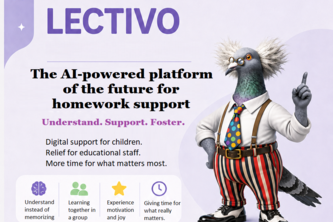
Lectivo is an AI-powered platform for homework support in after-school care centers, designed to assist supervisors with primary school children (grades 1–4). The description states it aims to solve staff shortages by enabling non-educators to provide high-quality homework help through age-appropriate explanations and motivation.
What changed
The project was submitted as part of the OpenAI 2026 hackathon, indicating a development phase focused on rapid prototyping using AI tools like Codex and ChatGPT. It is described as having reached a functional demo version in one day.
Single most important open question
Is there evidence of traction or early adoption beyond the hackathon submission? The description does not indicate any revenue, customers, or usage data — only self-reported claims about functionality and development speed.
What The Product Actually Is
The description states that Lectivo is an interactive AI-powered platform for homework support in after-school care facilities. It supports supervisors working with primary school children (grades 1–4), providing structured explanations of material, motivation, and answering questions using age-appropriate language.
It is described as not replacing teachers, but rather supporting supervisors who may lack educational backgrounds.
The product was built primarily using:
- Prompt programming
- Codex
- Visual Studio Code
- ChatGPT for image creation
- Adobe Illustrator, Bazel, C++, Movavi (as tools used in development)
Inference The platform appears to be a virtual assistant, likely involving AI-generated content and interactive elements tailored for young learners.
Positioning & Claim Evolution
The description states that Lectivo is:
- For after-school care centers
- Designed to address staff shortages
- Aids supervisors without educational training in delivering quality homework support
It positions itself as a solution to workforce constraints in educational settings, particularly for younger children.
There is no indication of prior positioning or evolution beyond the hackathon submission. The author claims:
- They used AI throughout the entire development process (from idea to product)
- They created a functional demo in one day
- This was their first full-scale use of AI in a project
Inference The positioning seems to be evolving from an experimental prototype into a potential pilot-ready solution, but no evidence suggests it has moved beyond that stage.
Target Customer & ICP
The description states:
- Primary users: Supervisors in after-school care centers
- Target audience: Primary school children (grades 1–4)
- Institutional context: After-school care facilities
It also mentions:
- The platform is designed to help even those without a background in education
Inference The ICP appears to be after-school care institutions, particularly those facing staffing challenges, with a focus on early-grade students.
Business Model & Pricing Evidence
Not evidenced.
The description does not contain any information about:
- Revenue model
- Pricing structure
- Monetization strategy
- Customer acquisition plans
Inference No business model or pricing evidence is provided beyond the self-reported nature of the project.
Technical & Delivery Signals
The platform was built using:
- Prompt programming (via Codex)
- Visual Studio Code
- ChatGPT for image generation
- Adobe Illustrator, Bazel, C++, Movavi
Development process:
- Started with storyboard
- Used AI to generate images and videos
- Converted these into application components via prompts
- Built a functional demo in one day
Challenges:
- AI struggles with perspective, spatial orientation, and movement repetition
Inference The technical approach relies heavily on AI-assisted development, particularly for UI/UX and content generation. However, the platform is still in an early stage of development.
Traction & Maturity Signals
Not evidenced.
The description states:
- A functional demo was created in one day
- It was submitted to a hackathon
- The team is looking for a municipality or institution to pilot the product
There is no evidence of:
- Revenue
- Customers
- Usage metrics
- Product adoption
- Market testing beyond the hackathon
Inference No traction or maturity signals are evident. The project remains in a pre-pilot phase, with no indication of real-world deployment.
Competitive Context
Not evidenced.
The description does not mention:
- Competitors
- Existing solutions in the market
- Market size or competitive landscape
Inference No competitive context is provided, making it impossible to assess how Lectivo fits into existing offerings.
Open Questions & Risks
- No traction or revenue: The project is described only as a hackathon submission with no evidence of real-world use.
- Unverified claims: All statements are self-reported and unverified.
- Limited maturity: The platform is at an early stage, with no indication of product-market fit or scalability.
- AI dependency risks: Reliance on AI tools like Codex and ChatGPT may introduce inconsistencies or inaccuracies in output quality.
- No pricing or monetization strategy: No evidence of how the platform will be monetized.
Questions the description leaves open
- What is the current status of the pilot project you're seeking? Have you identified any institutions willing to participate?
- How do you plan to validate that the AI-generated content meets educational standards for young learners?
- Are there any specific use cases or scenarios where the platform has already been tested, even informally?
- What is your roadmap for scaling beyond a single demo or pilot?
- Do you have any plans for integrating feedback from educators or supervisors during development?
Overall Assessment
Not evidenced.
There is no evidence of:
- Revenue
- Customers
- Traction
- Market validation
- Financials
- Strategic partnerships
Inference This project is in a very early stage, likely pre-pilot, and lacks any commercial due-diligence signals. It cannot be evaluated for investment or partnership potential without further evidence of progress beyond the hackathon submission.
User Stories BotA demo video on every pull request
Get a demo video on every new feature
GitHub App that watches your pull requests and records a narrated, captioned demo.
Save time on demo prep and make informed decisions faster with a video walkthrough of every new feature.
Source
Submitted to the OpenAI 2026 hackathon on Devpost. Project home on Devpost. Back to the full gallery on Devpost.
This competitive analysis was produced by top-founders.com (opens in a new tab)
Generated by a language model from this project's public Devpost page — its tagline, the author's own write-up and any built-with tags listed there — as captured in August 2026. Short quotations are the author's words. It is an opinion on the idea as a business, not on the people behind it, and it reflects the description as published then. If the project has moved on, request a correction below. The analysis is not independent research and contains no verified traction, revenue or customer data.
An independent guide by KFG International LLC — not affiliated with, endorsed by, or connected to Devpost or OpenAI.