

Archive position — measured, not model output
0 likes on Devpost
2,263 of the 7,850 archived projects have more likes, and 5,587 share exactly 0 — so this project's #4,790 place in the like-ranked listing is a tie-break inside that group, not a ranking.
Projects (log scale)
Likes on Devpost. ▲ marks this project's group.
Show the figures
| Likes | Projects | Share of archive |
|---|---|---|
| 0 | 5,587 | 71.2% |
| 1 | 1,758 | 22.4% |
| 2 | 284 | 3.6% |
| 3–4 | 132 | 1.7% |
| 5–9 | 75 | 1.0% |
| 10+ | 14 | 0.2% |
 User Stories BotA demo video on every pull request
Get a demo video on every new feature
GitHub App that watches your pull requests and records a narrated, captioned demo.
Save time on demo prep and make informed decisions faster with a video walkthrough of every new feature.
Executive Summary
Company: Khandaan Amanat (Family Safekeeping)
Self-reported basis: The entire analysis is based on a single author-supplied project description from Devpost, submitted to the OpenAI 2026 hackathon. No independent verification or additional data sources are available.
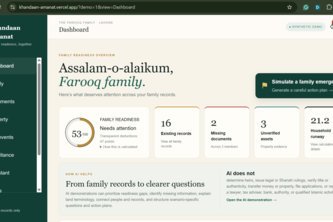
What it appears to be: A proof-of-concept AI-powered platform for family preparedness and document management, designed to help families navigate complex emergency scenarios by assessing readiness and recommending next steps.
What changed: The author describes building an MVP using AI tools (ChatGPT, Codex) in a short timeframe, focusing on demonstrating core features like Family Readiness Score calculation and proactive AI guidance.
Most important open question: Is there evidence of real-world demand or user testing beyond the author’s own experience?
What The Product Actually Is
The description states that Khandaan Amanat is an AI-powered family preparedness platform. It helps families organize documents such as identity records, property details, insurance policies, medical information, wills, and investments in one place.
Rather than being a traditional document repository, it uses AI to transform stored data into actionable insights. The MVP includes:
- Calculating a Family Readiness Score
- Highlighting missing or incomplete records
- Recommending proactive next steps
- Simulating emergency scenarios with prioritized tasks and step-by-step guidance
Inference: The platform is described as an MVP built using demo data, not yet a production-ready system. It is not evidenced to have real users or live functionality beyond the prototype.
Positioning & Claim Evolution
The author positions Khandaan Amanat as a solution for unexpected family emergencies, aiming to help families prepare before an event occurs rather than react after. The tagline suggests a focus on navigating complexity during emotional times.
Key claims:
- AI assesses family readiness
- AI recommends personalized next steps
- Platform guides users through complex processes
Inference: The positioning is rooted in empathy and personal experience (the author is the only daughter of her parents). It is not evidenced to have evolved from market research or user feedback beyond the author’s own perspective.
Target Customer & ICP
The description states that the platform targets families, especially those navigating complex document and responsibility management after unexpected loss. The author identifies herself as a single daughter, suggesting a personal motivation tied to family dynamics.
Inference: No explicit ICP is defined beyond "families". There is no evidence of segmentation by age, income, or cultural context. The platform appears to be aimed at individuals or households who may not have formal estate planning or emergency preparedness systems in place.
Business Model & Pricing Evidence
There is no evidence of a business model or pricing structure in the description. The author mentions building an MVP and future system design, but does not describe monetization, subscription tiers, or revenue streams.
Inference: The platform is described as a prototype with no commercial implementation yet. It is unclear whether it will be offered as a SaaS product, a free tool, or something else entirely.
Technical & Delivery Signals
The author built the MVP using:
- ChatGPT for idea validation and specification
- Codex for rapid code generation
- Web application framework (5.6-sol-light)
The platform is described as:
- AI-driven
- Focused on user experience and iteration
- Designed to evolve into a scalable system with encrypted storage, secure APIs, role-based access control, audit logging, and privacy-first AI
Inference: The technical stack is not detailed beyond the tools used in development. No evidence of production architecture or scalability planning is provided.
Traction & Maturity Signals
The description states that this is an MVP built for a hackathon, using demo data to validate the concept. There is no evidence of:
- Real users
- Customer feedback
- Revenue
- Product adoption
- Live deployment
Inference: The platform has not yet reached product-market fit or demonstrated traction beyond the author’s own use case.
Competitive Context
There is no evidence in the description of existing competitive products or market positioning. The author does not reference competitors, similar tools, or market gaps they are addressing.
Inference: No competitive analysis or differentiation strategy is provided. It is unclear whether this addresses a known gap or overlaps with existing solutions (e.g., document management platforms, estate planning tools).
Open Questions & Risks
- No real-world validation: The platform is built on demo data and the author’s personal experience — no evidence of user testing or feedback
- Unproven business model: No indication of how the product will generate revenue or scale
- Limited team size: Only one person involved, which raises questions about execution capacity and long-term development
- Highly sensitive domain: The platform deals with personal and family documents — any security or privacy issues could be catastrophic
- Unverified claims: All features are self-reported without evidence of functionality or impact
Questions the description leaves open
- What specific user feedback did you gather during development?
- How do you plan to validate the Family Readiness Score and its recommendations?
- Have you tested the platform with actual families, or is it based solely on your own experience?
- What are the key assumptions about user behavior that underpin this product?
- How will you ensure data security and privacy in a system handling highly sensitive family information?
- What is your plan for monetization and scaling beyond the MVP?
- Are there any legal or regulatory considerations around estate planning and family document management that you’ve addressed?
Overall Assessment
Not evidenced.
The description provides no evidence of traction, revenue, customers, or even a clear business model. It is a self-reported prototype built in a short timeframe for a hackathon. The author’s personal motivation is evident, but there is no indication that the platform has moved beyond concept stage or proven market demand.
Confidence level: Very low. This is an unverified idea with no external validation or product-market fit evidence. Any investment or partnership decision would require further due diligence into user testing, market validation, and commercial viability.
User Stories BotA demo video on every pull request
Get a demo video on every new feature
GitHub App that watches your pull requests and records a narrated, captioned demo.
Save time on demo prep and make informed decisions faster with a video walkthrough of every new feature.
Source
Submitted to the OpenAI 2026 hackathon on Devpost. Project home on Devpost. Back to the full gallery on Devpost.
This competitive analysis was produced by top-founders.com (opens in a new tab)
Generated by a language model from this project's public Devpost page — its tagline, the author's own write-up and any built-with tags listed there — as captured in August 2026. Short quotations are the author's words. It is an opinion on the idea as a business, not on the people behind it, and it reflects the description as published then. If the project has moved on, request a correction below. The analysis is not independent research and contains no verified traction, revenue or customer data.
An independent guide by KFG International LLC — not affiliated with, endorsed by, or connected to Devpost or OpenAI.