

Archive position — measured, not model output
0 likes on Devpost
2,263 of the 7,850 archived projects have more likes, and 5,587 share exactly 0 — so this project's #4,780 place in the like-ranked listing is a tie-break inside that group, not a ranking.
Projects (log scale)
Likes on Devpost. ▲ marks this project's group.
Show the figures
| Likes | Projects | Share of archive |
|---|---|---|
| 0 | 5,587 | 71.2% |
| 1 | 1,758 | 22.4% |
| 2 | 284 | 3.6% |
| 3–4 | 132 | 1.7% |
| 5–9 | 75 | 1.0% |
| 10+ | 14 | 0.2% |
 User Stories BotA demo video on every pull request
Get a demo video on every new feature
GitHub App that watches your pull requests and records a narrated, captioned demo.
Save time on demo prep and make informed decisions faster with a video walkthrough of every new feature.
Executive Summary
What the company appears to be
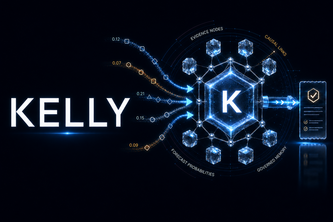
KELLY / Causalea is a self-reported governed decision-intelligence system built by one person (Aaron Moyer) using AI coding agents. It claims to enable users to make decisions under uncertainty through structured evidence intake, forecasting, causal analysis, and memory management with proof and lineage.
What changed
The project began as a personal "25-Second Decision Card" for decision-making under uncertainty and evolved into a multi-application system that connects evidence intake, forecasting, settlement against reality, replay, and governed memory. The author reports using AI agents like Codex and GPT-5.6 to build it without prior coding experience.
Single most important open question
Is there any evidence of real-world usage or adoption beyond the solo builder's own testing and demonstration?
Note: This analysis is based entirely on the self-reported, unverified description provided by the author. No external corroboration, revenue data, customer base, or traction metrics are available.
What The Product Actually Is
The description states that KELLY / Causalea is a governed decision-intelligence system for questions where the answer is uncertain and evidence may change. It includes:
- Evidence and source intake
- Question and hypothesis generation
- Forecasting and causal analysis
- Scenario and Monte Carlo reasoning
- Settlement against later observations
- Calibration and replay
- Governed memory-cell admission
- Proof, lineage, and audit visibility
It distinguishes three components:
- KELLY — the internal engine
- Causalea — the public lens into it
- The Glass Lab — a transparency console
Users can ask questions, inspect forecasts, explore specialized labs, and follow returned evidence into Glass Lab. Public users can query and audit KELLY but cannot write its memory or alter ground truth.
Inference: The system appears to be designed for structured decision-making under uncertainty, with an emphasis on traceability and governance.
Positioning & Claim Evolution
The author describes the origin of the idea as a personal "25-Second Decision Card" aimed at reducing paralysis during uncertain decisions. This evolved into a broader framework involving:
- Uncertainty estimation
- Evidence gathering from trustworthy sources
- Forecasting with settlement against reality
- Replay and calibration
- Memory with proof and lineage
The system is positioned as a tool for making better decisions by grounding them in evidence, uncertainty, and learnable outcomes.
Claim: The system aims to turn "live evidence into forecasts, proofs, and memory."
Inference: The evolution from a simple card to a complex multi-application system suggests an ambition to scale decision-making frameworks beyond personal use.
Target Customer & ICP
The description does not explicitly name target customers or define an Ideal Customer Profile (ICP). However, it implies:
- Users who make decisions under uncertainty
- Individuals or teams needing structured reasoning and evidence-based answers
- Researchers, policymakers, or analysts working with dynamic data
- Anyone seeking transparency in decision-making processes
Claim: The system is for users who want more than just an answer—they want to see the evidence, assumptions, falsifiers, settlement status, and proof trail.
Inference: The public-facing interface (Causalea) and read-only Glass Lab suggest a focus on transparency rather than direct control or editing by end-users.
Business Model & Pricing Evidence
There is no mention of pricing, monetization strategy, or business model in the description. The project appears to be a solo-built prototype submitted for a hackathon.
Claim: Not evidenced.
Inference: Given the lack of commercial elements and the focus on open-source-like transparency (e.g., public audit), it is unclear whether this will evolve into a paid product or service.
Technical & Delivery Signals
The system was built solo using AI coding agents including:
- Codex
- GPT-5.6
- Grok
- GitHub Actions
- Docker, Next.js, React, Node.js, Python, PostgreSQL, Neon, Vercel, Cloudflare R2, Modal, Sentry, Firecrawl
Key technical features mentioned include:
- Canonical probability and scoring rules
- Grounded routing and streaming protocol
- Settlement and memory-admission correctness
- Neon transaction hardening
- Deployment parity checks
- Regression tests
- Judge-facing live demo
Claim: The system uses AI agents to build and maintain a distributed, governed system with structured interfaces for forecasting, markets, science, policy, etc.
Inference: The use of AI coding agents suggests rapid prototyping and scaling capabilities, but also raises questions about long-term maintainability and governance without human oversight.
Traction & Maturity Signals
The project has:
- A live public interface
- Conversational Ask KELLY experience
- Specialized domain labs
- Read-only transparency console
- Evidence, uncertainty, settlement, and replay contracts
- Governed memory and lineage paths
- Explicit public write boundaries
- Tests that reject unsupported or fabricated evidence
- Git-based workflow allowing multiple AI agents to contribute
However, there is no evidence of:
- Real-world users or adoption
- Revenue or monetization
- Customer feedback or usage metrics
- Product-market fit validation
Claim: The system has been built and tested in a live environment with various interfaces.
Inference: While functional, the lack of external validation or user engagement indicates early-stage maturity.
Competitive Context
The description does not reference specific competitors. However, the concept overlaps with:
- Decision intelligence platforms
- AI-powered forecasting systems
- Evidence-based reasoning tools
- Causal inference frameworks
- Knowledge management and memory systems
Claim: Not evidenced.
Inference: The system's focus on governance, memory, and proof trails places it in a niche between general-purpose AI assistants and specialized analytical tools.
Open Questions & Risks
- Single-person development: Risk of burnout or lack of scalability.
- Heavy reliance on AI agents: Potential for inconsistent outputs or loss of control over system behavior.
- Lack of user feedback or real-world testing: No evidence of actual usage or product-market fit.
- Unverifiable claims about reliability and correctness: Statements like “receipts are fresh,” “outcomes settle,” and “memory birth actually occurs” are not independently verified.
- No pricing or monetization strategy: Unclear path to commercial viability.
Inference: The project is in a very early stage, likely pre-product-market fit, with no clear traction or revenue model.
Questions the description leaves open
- What specific types of decisions are users asking KELLY to help with?
- How does the system handle conflicting evidence from different sources?
- Can you demonstrate how the memory and lineage features work in practice?
- Are there any known limitations or edge cases where the system fails to produce reliable outputs?
- What is the plan for scaling beyond solo development?
- How do you intend to monetize this product if at all?
- Have you conducted any user studies or gathered feedback from people using it?
- What are the key assumptions behind the architecture, and how have they been validated?
Overall Assessment
This is a solo-built prototype submitted for a hackathon with no evidence of traction, revenue, or customer adoption. The system appears to be technically sophisticated but lacks real-world validation.
Confidence Level: Low
Reasoning: The description is self-reported and unverified; there is no evidence of users, customers, or commercial activity beyond the builder’s own testing.
Assessment: Not ready for investment or partnership at this time. Further due diligence would require proof of usage, user feedback, and a clear path to monetization.
User Stories BotA demo video on every pull request
Get a demo video on every new feature
GitHub App that watches your pull requests and records a narrated, captioned demo.
Save time on demo prep and make informed decisions faster with a video walkthrough of every new feature.
Source
Submitted to the OpenAI 2026 hackathon on Devpost. Project home on Devpost. Back to the full gallery on Devpost.
This competitive analysis was produced by top-founders.com (opens in a new tab)
Generated by a language model from this project's public Devpost page — its tagline, the author's own write-up and any built-with tags listed there — as captured in August 2026. Short quotations are the author's words. It is an opinion on the idea as a business, not on the people behind it, and it reflects the description as published then. If the project has moved on, request a correction below. The analysis is not independent research and contains no verified traction, revenue or customer data.
An independent guide by KFG International LLC — not affiliated with, endorsed by, or connected to Devpost or OpenAI.