

Archive position — measured, not model output
1 like on Devpost
505 of the 7,850 archived projects have more likes, and 1,758 share exactly 1 — so this project's #1,265 place in the like-ranked listing is a tie-break inside that group, not a ranking.
Projects (log scale)
Likes on Devpost. ▲ marks this project's group.
Show the figures
| Likes | Projects | Share of archive |
|---|---|---|
| 0 | 5,587 | 71.2% |
| 1 | 1,758 | 22.4% |
| 2 | 284 | 3.6% |
| 3–4 | 132 | 1.7% |
| 5–9 | 75 | 1.0% |
| 10+ | 14 | 0.2% |
 User Stories BotA demo video on every pull request
Get a demo video on every new feature
GitHub App that watches your pull requests and records a narrated, captioned demo.
Save time on demo prep and make informed decisions faster with a video walkthrough of every new feature.
Executive Summary
What the company appears to be
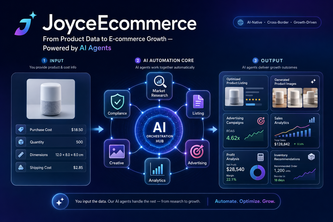
JoyceEcommerce is an AI-native automation pipeline for cross-border e-commerce, built as a multi-agent system that automates workflows from product sourcing through ongoing operations.
What changed
The project was submitted to the OpenAI 2026 hackathon and describes itself as a framework for small business owners to operate with capabilities traditionally requiring full e-commerce teams. It is presented as an experimental or prototype solution, not yet commercially deployed.
Single most important open question
Is there evidence of real-world usage or traction from actual cross-border e-commerce sellers?
The description states that JoyceEcommerce is an AI-native automation pipeline for cross-border e-commerce, built as a multi-agent system. It claims to automate workflows from product sourcing through ongoing operations using specialized AI agents and orchestration. The author describes it as a working framework, but no evidence of revenue, customers, or adoption exists beyond the self-reported project description.
What The Product Actually Is
The description states that JoyceEcommerce is an AI-native automation pipeline for cross-border e-commerce. It is built as a multi-agent system with specialized agents including:
- Market Research Agent
- Product and Compliance Agent
- Cost and Pricing Agent
- Listing Content Agent
- Creative and Image Agent
- Advertising Agent
- Inventory and Operations Agent
- Data Analysis Agent
- Quality Review Agent
The system receives product data from sellers, breaks work into tasks, assigns them to appropriate agents, and passes results between stages. It combines large language models, structured workflows, reusable prompts, databases, marketplace reports, and image-generation tools.
Evidence The description states this is a multi-agent system with 9 specialized agents, built using LLMs, workflows, prompts, databases, and image tools.
Inference This appears to be an experimental or prototype automation framework rather than a commercial product, based on the hackathon context and lack of evidence for deployment.
Positioning & Claim Evolution
The description states that JoyceEcommerce was created to turn product procurement data into an automated business workflow. The author claims it allows small business owners to operate with the capabilities of a full e-commerce team, transforming repetitive tasks into one continuous workflow from product sourcing to ongoing operations.
The project positions itself as solving the fragmented workflow problem in cross-border e-commerce, where sellers manage multiple tools and processes manually. It aims to replace manual work with AI-driven automation while maintaining human oversight for critical decisions.
Evidence The description states the project was inspired by the need to operate with full team capabilities using only basic product information.
Inference This is a self-described positioning statement that reflects the author's intent, not evidence of market adoption or proven effectiveness.
Target Customer & ICP
The description states that JoyceEcommerce targets small business owners running cross-border e-commerce businesses. These sellers are described as needing to manage fragmented workflows including product research, compliance checks, pricing, listing creation, image production, advertising, inventory tracking, and financial analysis.
The system is designed for sellers who enter basic product information (product, purchase price, quantity, specifications, shipping costs) and want automated assistance with the remaining steps.
Evidence The description states that the target is small business owners managing cross-border e-commerce workflows.
Inference The ICP appears to be small-scale cross-border e-commerce operators, but there's no evidence of actual customer base or market validation.
Business Model & Pricing Evidence
The description does not provide any information about pricing, revenue models, or monetization strategies. It only describes the automation capabilities and workflow processes.
Evidence Not evidenced.
Inference The project appears to be in early development (hackathon submission) with no commercial model described.
Technical & Delivery Signals
The description states that JoyceEcommerce was built as a multi-agent system rather than a single chatbot. It uses:
- Large language models
- Structured workflows
- Reusable prompts
- Product and financial databases
- Marketplace reports
- Image-generation tools
- Central orchestration layer
- Human approval checkpoints for high-impact actions
The system is designed to handle data from different sources, maintain shared context across agents, and provide quality control mechanisms.
Evidence The description states the technical approach includes multi-agent architecture, LLMs, workflows, databases, image tools, and orchestration.
Inference This indicates a sophisticated technical approach but no evidence of production deployment or performance metrics.
Traction & Maturity Signals
The description states that this is a working automation framework built for a hackathon. It was submitted to the OpenAI 2026 hackathon on Devpost and represents an experimental project, not yet commercially deployed.
There is no evidence of revenue, customers, or adoption beyond the self-reported project description. The author mentions real operational needs from active sellers but does not provide evidence of actual usage.
Evidence The project was submitted to a hackathon and described as a working framework.
Inference This suggests early-stage development with no commercial traction or proven market adoption.
Competitive Context
The description does not mention any specific competitors. It positions itself as solving the fragmented workflow problem in cross-border e-commerce, but provides no information about existing solutions or competitive landscape.
Evidence Not evidenced.
Inference Without competitor analysis or market positioning details, it's impossible to assess competitive advantages or market differentiation.
Open Questions & Risks
Key risks and open questions based on the description:
- No commercial evidence: The project is described as a hackathon submission with no revenue, customers, or adoption data
- Unproven market fit: While it addresses real needs, there's no evidence of actual customer validation
- Technical complexity vs. reality: The multi-agent system approach may be overly complex for early-stage implementation
- Human oversight dependency: Heavy reliance on human approval checkpoints suggests incomplete automation
- Data quality challenges: The description notes difficulties with inconsistent supplier data and fragmented marketplace reports
Evidence The description mentions technical challenges around data consistency, marketplace integration, and AI accuracy.
Inference These are inherent risks in any early-stage AI automation project, but the lack of evidence for successful implementation raises concerns about execution capability.
Questions the description leaves open
- What specific cross-border e-commerce challenges were you solving, and how did you validate these with actual sellers?
- How do you handle the accuracy and reliability of AI-generated content in compliance-sensitive areas?
- What is your approach to data privacy and security for customer information?
- Have you tested the system with real product data from actual sellers?
- What are the specific technical limitations or edge cases that remain unresolved?
- How do you plan to monetize this platform, and what is your go-to-market strategy?
- What are the key assumptions about user behavior that might not hold in practice?
Overall Assessment
Confidence: Low
The description states that JoyceEcommerce is an AI-native automation pipeline built as a multi-agent system for cross-border e-commerce, submitted to a hackathon. There is no evidence of revenue, customers, or commercial traction beyond the self-reported project description.
The project appears to be in early development stage with no demonstrated market adoption or proven business model. The author describes real operational needs but provides no evidence of actual usage or validation from target customers.
Key limitations
- No revenue or customer data
- No commercial deployment evidence
- No pricing or monetization strategy
- No competitive analysis
- No performance metrics or success indicators
This represents a conceptually promising idea with significant technical sophistication, but lacks the commercial due-diligence signals necessary for investment or partnership consideration at this stage. The project appears to be an experimental framework rather than a proven product.
Assessment Not ready for investment or partnership consideration without further evidence of traction, customer validation, and commercial viability.
User Stories BotA demo video on every pull request
Get a demo video on every new feature
GitHub App that watches your pull requests and records a narrated, captioned demo.
Save time on demo prep and make informed decisions faster with a video walkthrough of every new feature.
Source
Submitted to the OpenAI 2026 hackathon on Devpost. Project home on Devpost. Back to the full gallery on Devpost.
This competitive analysis was produced by top-founders.com (opens in a new tab)
Generated by a language model from this project's public Devpost page — its tagline, the author's own write-up and any built-with tags listed there — as captured in August 2026. Short quotations are the author's words. It is an opinion on the idea as a business, not on the people behind it, and it reflects the description as published then. If the project has moved on, request a correction below. The analysis is not independent research and contains no verified traction, revenue or customer data.
An independent guide by KFG International LLC — not affiliated with, endorsed by, or connected to Devpost or OpenAI.