

Archive position — measured, not model output
0 likes on Devpost
2,263 of the 7,850 archived projects have more likes, and 5,587 share exactly 0 — so this project's #4,586 place in the like-ranked listing is a tie-break inside that group, not a ranking.
Projects (log scale)
Likes on Devpost. ▲ marks this project's group.
Show the figures
| Likes | Projects | Share of archive |
|---|---|---|
| 0 | 5,587 | 71.2% |
| 1 | 1,758 | 22.4% |
| 2 | 284 | 3.6% |
| 3–4 | 132 | 1.7% |
| 5–9 | 75 | 1.0% |
| 10+ | 14 | 0.2% |
 User Stories BotA demo video on every pull request
Get a demo video on every new feature
GitHub App that watches your pull requests and records a narrated, captioned demo.
Save time on demo prep and make informed decisions faster with a video walkthrough of every new feature.
Executive Summary
What the company appears to be
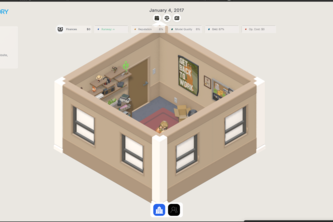
IA Tycoon is a self-reported 3D management simulation game where players build an AI startup from a garage in 2017, scaling it into a world-class AI laboratory. It simulates aspects of the AI industry including model training, resource management, funding rounds, and strategic decision-making.
What changed
The project is described as a personal endeavor by one developer (Eduardo Castro), submitted to the OpenAI 2026 hackathon. It uses tools like Codex and Unity for development, with no evidence of prior traction or commercial activity.
Single most important open question
Is there any evidence that IA Tycoon has moved beyond a prototype or proof-of-concept stage, or whether it will ever be released as a product?
What The Product Actually Is
The description states that IA Tycoon is a 3D management simulation game. It involves:
- Building an AI company from a garage in 2017.
- Scaling it into a world-class AI laboratory.
- Managing model types (Vision, NLP, Agentic AI).
- Making decisions around data sources, hiring, GPU upgrades, office expansion.
- Engaging with a simulated social media platform called TechPulse.
- Handling commercial contracts, global events, funding rounds, and board pressure.
The game is built in Unity 6 using C# and URP, targeting Windows. It includes systems for time progression, employee behavior, office diorama, and save/load functionality.
Inference The project appears to be a simulation-style game with strategic and resource management elements, but it is not evidenced to have shipped or reached users beyond its developer.
Positioning & Claim Evolution
The author positions IA Tycoon as:
- A Tycoon-style game inspired by real-world AI companies like OpenAI.
- A simulation of the AI industry, including challenges such as resource management, strategic decisions, and market dynamics.
- A personal project driven by the developer’s interest in AI and Tycoon games.
The claim evolution shows:
- Initial inspiration from Tycoon games.
- Expansion into a full simulation of an AI startup lifecycle.
- Use of modern AI tools (Codex, ChatGPT) to aid development.
There is no evidence of prior positioning or marketing claims beyond the author’s own description. No brand identity, user feedback, or commercial messaging is evident.
Target Customer & ICP
The description states that IA Tycoon targets players who enjoy:
- Tycoon-style games.
- AI industry simulation.
- Strategic and resource management gameplay.
It is implied to appeal to fans of business simulation, AI enthusiasts, and developers interested in AI tools.
However, the project is described as a single-person effort, with no evidence of market research or user testing. The ICP is not defined beyond the author’s personal interest.
Business Model & Pricing Evidence
The description does not state any business model or pricing strategy.
It is unclear whether IA Tycoon will be:
- A paid game.
- Freemium.
- Free-to-play with in-app purchases.
- A tool for education or research.
No revenue streams, monetization plans, or pricing information are provided. The author mentions no commercial intent beyond personal development and experimentation.
Technical & Delivery Signals
The project is built using:
- Unity 6
- C#
- URP (Universal Render Pipeline)
- Windows as the initial platform
Key systems mentioned include:
- GameManager and TimeController
- Simulation systems for projects, employees, office tiers, energy/heat management
- TechPulse social feed
- uGUI-based HUD with analytics charts
- JSON save/load system
- Isometric office diorama that expands over time
Inference The project is technically ambitious but remains in early development. The author notes challenges with AI-assisted animation and gameplay logic, indicating ongoing technical hurdles.
Traction & Maturity Signals
The description states:
- The project was started less than a month ago.
- It is a single-person effort (Eduardo Castro).
- No evidence of users, sales, or adoption.
- No mention of public release, beta testing, or community engagement.
There are no signs of traction, user feedback, or product maturity beyond the initial concept and early development.
Competitive Context
The author references:
- Tycoon games as inspiration.
- Real-world AI companies like OpenAI.
- Social media platforms like X (Twitter) for industry reactions.
No direct competitors are named. The game appears to be in a niche space combining Tycoon simulation with AI industry themes, but no evidence of existing similar products or market positioning is provided.
Open Questions & Risks
- Single-person development: No team or external support.
- Early-stage prototype: Less than a month into development.
- AI tool dependency: Heavy reliance on Codex and ChatGPT for development, which may not scale.
- Technical challenges: Noted difficulties with AI-assisted animation and gameplay logic.
- No commercial traction: No evidence of users, revenue, or product release.
Questions the description leaves open
- What is the current status of the game? Is it playable?
- Are there any plans for monetization or distribution beyond the hackathon submission?
- How does the team plan to scale development given the single-person effort?
- Has the project been tested by others, or is it purely a personal experiment?
- What are the long-term goals for IA Tycoon — is it intended as a commercial product?
Overall Assessment
Not evidenced.
There is no evidence of:
- Revenue
- Customers
- Product-market fit
- Commercial traction
- Team size or structure beyond one person
- Any investment or partnership activity
The project is described as a personal, early-stage experiment, submitted to a hackathon. It has not demonstrated any commercial viability or market readiness.
Confidence: Low. The description offers no evidence of product maturity, user engagement, or business model traction.
User Stories BotA demo video on every pull request
Get a demo video on every new feature
GitHub App that watches your pull requests and records a narrated, captioned demo.
Save time on demo prep and make informed decisions faster with a video walkthrough of every new feature.
Source
Submitted to the OpenAI 2026 hackathon on Devpost. Project home on Devpost. Back to the full gallery on Devpost.
This competitive analysis was produced by top-founders.com (opens in a new tab)
Generated by a language model from this project's public Devpost page — its tagline, the author's own write-up and any built-with tags listed there — as captured in August 2026. Short quotations are the author's words. It is an opinion on the idea as a business, not on the people behind it, and it reflects the description as published then. If the project has moved on, request a correction below. The analysis is not independent research and contains no verified traction, revenue or customer data.
An independent guide by KFG International LLC — not affiliated with, endorsed by, or connected to Devpost or OpenAI.