

Archive position — measured, not model output
1 like on Devpost
505 of the 7,850 archived projects have more likes, and 1,758 share exactly 1 — so this project's #1,198 place in the like-ranked listing is a tie-break inside that group, not a ranking.
Projects (log scale)
Likes on Devpost. ▲ marks this project's group.
Show the figures
| Likes | Projects | Share of archive |
|---|---|---|
| 0 | 5,587 | 71.2% |
| 1 | 1,758 | 22.4% |
| 2 | 284 | 3.6% |
| 3–4 | 132 | 1.7% |
| 5–9 | 75 | 1.0% |
| 10+ | 14 | 0.2% |
 User Stories BotA demo video on every pull request
Get a demo video on every new feature
GitHub App that watches your pull requests and records a narrated, captioned demo.
Save time on demo prep and make informed decisions faster with a video walkthrough of every new feature.
Executive Summary
What the company appears to be
HiPot Pilot is a self-reported tool that converts wire-harness drawings into deterministic test definitions using AI-assisted parsing and validation logic. It claims to reduce hours of manual programming to minutes, while preserving traceability, validation, and human approval.
What changed
The project evolved from a form-based intake (V1) to a PDF-based deterministic parser with AI assistance (V3), using Codex and GPT-5.6 for development. The author states that V3 replaced manual data entry with an automated Smart Parser, which extracts connector assignments and FROM-TO tables from synthetic drawings.
The single most important open question
Is there evidence of real-world usage or customer validation beyond the author’s own testing? The description does not indicate any external adoption, revenue, or traction.
What The Product Actually Is
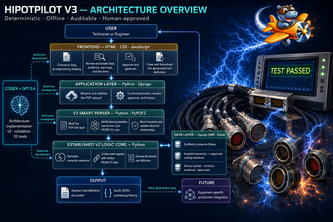
The description states that HiPot Pilot is a tool that converts wire-harness drawings into deterministic test definitions. It uses a "Smart Parser" to read supported synthetic drawings and extract connector assignments and semantic FROM-TO tables. This extracted data is then validated before being passed into an existing Django-based logic core to generate traceable test-definition previews.
It also states that the system preserves exact endpoints, source locations, and connection totals, and that no generative AI runs at runtime. The tool was built using Django, JavaScript, Python, SQLite, and PDF processing libraries.
Inference The product appears to be a niche internal tool for avionics or aerospace harness testing teams, designed to automate parts of the test-programming workflow.
Positioning & Claim Evolution
The author states that HiPot Pilot was inspired by inefficiencies in manual wire-harness testing and aims to reduce hours of programming to minutes. It positions itself as a deterministic system that ensures traceability and human approval, distinguishing it from generic AI tools that might hallucinate or misinterpret data.
Inference The positioning is rooted in avionics quality assurance needs, where accuracy and auditability are paramount. The evolution from V1 (form-based) to V3 (AI-assisted PDF parsing) reflects a shift toward automation while maintaining safety-critical controls.
Target Customer & ICP
The description states that HiPot Pilot was built for wire-harness manufacturers and aerospace R&D teams, particularly those involved in avionics testing. It is implied that the tool targets users who work with synthetic engineering drawings and need deterministic test definitions.
Inference The target customer is likely a specialized segment within aerospace or defense industries, where harness testing is a recurring, high-value activity requiring strict validation.
Business Model & Pricing Evidence
Not evidenced. The description does not mention pricing models, monetization strategies, or any commercial arrangements.
Technical & Delivery Signals
The project was built using Django, JavaScript, Python, SQLite, and PDF processing libraries (e.g., PyPDF2). It uses Codex with GPT-5.6 for development but does not run generative AI at runtime. The Smart Parser is described as deterministic and offline.
Inference The tool is a self-contained application with a clear architecture: frontend for intake and review, backend logic for validation and test generation, and an offline parser that avoids runtime AI dependencies.
Traction & Maturity Signals
Not evidenced. There is no mention of customers, revenue, usage metrics, or adoption beyond the author’s own testing. The project was submitted to a hackathon and has not been independently verified for real-world deployment.
Competitive Context
Not evidenced. No information is provided about existing tools in the wire-harness or avionics test automation space.
Open Questions & Risks
- No external validation: The tool has no evidence of customer use, feedback, or traction.
- Niche market risk: The target segment (aerospace harness testing) may be small and specialized.
- Self-reported maturity: The author’s own testing is the only evidence of functionality; there is no third-party validation.
- Limited scalability claims: No indication that the tool can scale beyond one developer or a single use case.
Questions the description leaves open
- What specific synthetic drawing formats does the Smart Parser support?
- Has the system been tested with real-world harness data from customers, or only internal test cases?
- Are there any known limitations in handling variations in drawing layouts or standards?
- How is the deterministic validation implemented? Is it fully auditable and traceable?
- What are the integration requirements for existing QA workflows in potential customer environments?
Overall Assessment
Not evidenced. There is no indication of funding, revenue, or commercial traction. The project appears to be a personal or hackathon effort with no evidence of market readiness or scalability.
Confidence Low. The description is self-reported and unverified, with no external signals of adoption or business development.
User Stories BotA demo video on every pull request
Get a demo video on every new feature
GitHub App that watches your pull requests and records a narrated, captioned demo.
Save time on demo prep and make informed decisions faster with a video walkthrough of every new feature.
Source
Submitted to the OpenAI 2026 hackathon on Devpost. Project home on Devpost. Back to the full gallery on Devpost.
This competitive analysis was produced by top-founders.com (opens in a new tab)
Generated by a language model from this project's public Devpost page — its tagline, the author's own write-up and any built-with tags listed there — as captured in August 2026. Short quotations are the author's words. It is an opinion on the idea as a business, not on the people behind it, and it reflects the description as published then. If the project has moved on, request a correction below. The analysis is not independent research and contains no verified traction, revenue or customer data.
An independent guide by KFG International LLC — not affiliated with, endorsed by, or connected to Devpost or OpenAI.