

Archive position — measured, not model output
0 likes on Devpost
2,263 of the 7,850 archived projects have more likes, and 5,587 share exactly 0 — so this project's #4,452 place in the like-ranked listing is a tie-break inside that group, not a ranking.
Projects (log scale)
Likes on Devpost. ▲ marks this project's group.
Show the figures
| Likes | Projects | Share of archive |
|---|---|---|
| 0 | 5,587 | 71.2% |
| 1 | 1,758 | 22.4% |
| 2 | 284 | 3.6% |
| 3–4 | 132 | 1.7% |
| 5–9 | 75 | 1.0% |
| 10+ | 14 | 0.2% |
 User Stories BotA demo video on every pull request
Get a demo video on every new feature
GitHub App that watches your pull requests and records a narrated, captioned demo.
Save time on demo prep and make informed decisions faster with a video walkthrough of every new feature.
Executive Summary
The description states that Harappan Civilization Explorer is an offline interactive learning studio for the Harappan (Indus Valley) Civilization, built as a static web application. It presents archaeological evidence through interactive maps and modules, with a focus on uncertainty and historical reasoning. The app works fully offline, stores progress in browser local storage, and can be distributed as a ZIP file.
The project is self-reported as a single-person effort by Zylon Nolan, submitted to the OpenAI 2026 hackathon. No evidence of revenue, customers, or traction exists beyond the author’s own account.
The single most important open question: Is this an educational tool that could be used in classrooms or museums, or is it primarily a demonstration project with limited commercial potential?
What The Product Actually Is
- The description states that Harappan Civilization Explorer is an offline interactive learning studio.
- It presents a complete exploration of the Harappan Civilization through:
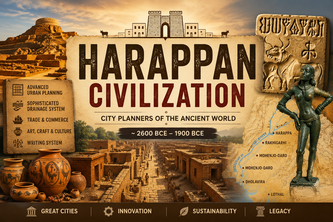
- An interactive map of Harappan sites (e.g., Harappa, Mohenjo-daro, Dholavira).
- Modules on drainage, water management, brick ratios, weights, trade networks, seals, script, burial evidence, decline theories, and Harappan-Vedic comparison.
- A cinematic documentary mode.
- Progress tracking stored in browser local storage.
- It is built as a static offline web application using HTML, CSS, JavaScript, and local data.
- The app works fully offline and can be opened directly from a ZIP or folder without a server.
Inference: Based on the description, it appears to be an educational tool for learners, not a commercial product. It is not evident whether this has been used in real classrooms or by educators beyond its author.
Positioning & Claim Evolution
- The description states that the app aims to offer a learning experience “like entering an archaeological field studio,” where learners can:
- See evidence.
- Test ideas.
- Understand why historians often speak in probabilities rather than final answers.
- It positions itself as a non-fiction, evidence-led educational tool.
- The author claims that the app does not:
- Pretend the Harappan script is deciphered.
- Reduce decline to a single dramatic cause.
- Flatten the Harappan-Vedic relationship into a simplistic claim.
- It teaches learners how historical knowledge is built.
Inference: The positioning is clearly educational and academic, not commercial. It emphasizes historical rigor over entertainment or monetization.
Target Customer & ICP
- The description states that the app is designed for learners, particularly students encountering the Harappan Civilization.
- It is described as a tool to help learners understand:
- Archaeological evidence.
- Historical reasoning.
- Uncertainty in historical interpretation.
- It is built for use in educational settings, such as classrooms or museums.
Inference: The ICP appears to be students and educators interested in Indus Valley archaeology. No evidence of institutional adoption or specific user segments beyond this is provided.
Business Model & Pricing Evidence
- Not evidenced.
Finding: There is no mention of pricing, monetization, or business model in the description.
Technical & Delivery Signals
- The app is built as a static offline web application.
- Technologies used include:
- HTML
- CSS
- JavaScript
- LocalStorage
- Embedded assets and local data
- It uses a local Harappan map engine (assets/harappan-map-engine.js).
- The app is designed to run directly from a folder or ZIP without a server.
- It was built using tools like:
- Codex
- GPT-5.6
Inference: The technical approach is lightweight and self-contained, suggesting low infrastructure costs and ease of distribution.
Traction & Maturity Signals
- Not evidenced.
Finding: There is no evidence of users, adoption, or usage beyond the author’s own account. No data on downloads, engagement, or feedback is provided.
Competitive Context
- Not evidenced.
Finding: The description does not mention competitors or similar tools in the educational or archaeological space.
Open Questions & Risks
- The app is described as a single-person project (team size: 1).
- It is built for offline use and has no online features, which may limit scalability or updates.
- No evidence of expert review or validation by archaeologists or educators.
- The app is submitted to a hackathon, suggesting it may be a prototype or demonstration rather than a mature product.
Inference: The lack of team size, traction, and expert validation raises questions about long-term viability or institutional adoption.
Questions the description leaves open
- What is the intended use case for this app — classroom, museum, personal learning?
- Has it been reviewed by historians or archaeologists?
- Are there plans to expand beyond the current scope (e.g., more sites, languages, quiz modes)?
- Is there any interest from educational institutions or museums in adopting or using this tool?
- How would you envision monetizing or scaling this product if it were to become a commercial offering?
Overall Assessment
- Not evidenced.
Finding: No evidence of funding, investment, or partnership activity is provided. The project appears to be a personal or hackathon effort with no indication of commercial intent or traction.
User Stories BotA demo video on every pull request
Get a demo video on every new feature
GitHub App that watches your pull requests and records a narrated, captioned demo.
Save time on demo prep and make informed decisions faster with a video walkthrough of every new feature.
Source
Submitted to the OpenAI 2026 hackathon on Devpost. Project home on Devpost. Back to the full gallery on Devpost.
This competitive analysis was produced by top-founders.com (opens in a new tab)
Generated by a language model from this project's public Devpost page — its tagline, the author's own write-up and any built-with tags listed there — as captured in August 2026. Short quotations are the author's words. It is an opinion on the idea as a business, not on the people behind it, and it reflects the description as published then. If the project has moved on, request a correction below. The analysis is not independent research and contains no verified traction, revenue or customer data.
An independent guide by KFG International LLC — not affiliated with, endorsed by, or connected to Devpost or OpenAI.