

Archive position — measured, not model output
1 like on Devpost
505 of the 7,850 archived projects have more likes, and 1,758 share exactly 1 — so this project's #1,156 place in the like-ranked listing is a tie-break inside that group, not a ranking.
Projects (log scale)
Likes on Devpost. ▲ marks this project's group.
Show the figures
| Likes | Projects | Share of archive |
|---|---|---|
| 0 | 5,587 | 71.2% |
| 1 | 1,758 | 22.4% |
| 2 | 284 | 3.6% |
| 3–4 | 132 | 1.7% |
| 5–9 | 75 | 1.0% |
| 10+ | 14 | 0.2% |
 User Stories BotA demo video on every pull request
Get a demo video on every new feature
GitHub App that watches your pull requests and records a narrated, captioned demo.
Save time on demo prep and make informed decisions faster with a video walkthrough of every new feature.
Executive Summary
What the company appears to be
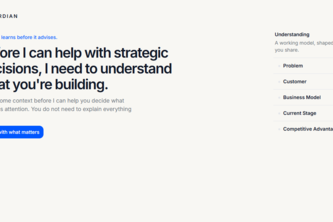
Guardian is an AI-driven strategic reasoning system built for founders. The description states it helps founders determine when they have enough evidence to make strategic decisions by building an evolving understanding before publishing a Decision Brief.
What changed
The project evolved from an early prototype into a working MVP capable of learning about a company through structured conversations, building and confirming a Working Picture, evaluating evidence instead of generating immediate advice, publishing a Decision Brief only when the evidence supports it, and recording the decision as Version 1 of a Strategic Journal.
The single most important open question
Does Guardian actually help founders make better decisions by ensuring those decisions are supported by evidence rather than assumptions — or does it simply delay judgment without adding value?
What The Product Actually Is
The description states that Guardian is an AI strategic reasoning system built for founders. It learns about the company through a structured conversation, builds an evolving Working Picture, reflects that understanding for confirmation, identifies uncertainty, compares competing explanations, and evaluates whether available evidence is sufficient to support a strategic decision.
Only when enough evidence has been gathered does Guardian publish a Decision Brief. If the evidence is insufficient, it deliberately withholds judgment and explains what information is still needed.
Guardian's reasoning pipeline was designed around explicit evidence rather than conversational responses. Every strategic conclusion is grounded in structured hypotheses, supporting evidence, uncertainty, confidence levels, clarification questions, and Decision Brief publication rules.
Once enough evidence exists, Guardian publishes a Decision Brief and records the outcome as Version 1 of a Strategic Journal, laying the foundation for long-term strategic continuity.
Evidence The author's own write-up describes how Guardian works.
Inference This is a system designed to delay decision-making until sufficient evidence is gathered — not just to generate advice.
Positioning & Claim Evolution
The description states that Guardian was inspired by the observation that founders don't struggle because they lack information; they struggle because they don't always know when they have seen enough evidence to make the right decision.
Most AI assistants are designed to answer questions immediately. While that works well for many tasks, strategic business decisions are different. Product direction, pricing, fundraising, customer adoption, and expansion decisions should be earned through evidence rather than generated from a prompt.
The philosophy behind Guardian is: "What if an AI system could determine whether enough evidence exists before publishing a strategic judgment?"
This represents a shift from immediate response to evidence-based decision-making. The goal is simple: help founders make better decisions by ensuring those decisions are supported by evidence rather than assumptions.
Evidence The author's own write-up explains the inspiration and positioning.
Inference This positions Guardian as an AI system that prioritizes trustworthiness over speed, which may be a competitive advantage or a limitation depending on user needs.
Target Customer & ICP
The description states that Guardian is built for founders. It is designed to help them make strategic decisions about product direction, pricing, fundraising, customer adoption, and expansion.
Evidence The author's own write-up identifies the target audience as founders.
Inference The system targets early-stage or growth-stage startups where strategic clarity is critical but often elusive.
Business Model & Pricing Evidence
Not evidenced.
Evidence No mention of pricing, monetization strategy, or business model in the description.
Inference If this is a product for founders, it likely needs a clear path to monetization — but none is described.
Technical & Delivery Signals
The project was built using GPT-5.6 and Codex throughout the development process, alongside a modern web application stack including Next.js, TypeScript, React, Tailwind CSS, Vercel, Groq, and Zod for structured validation.
The reasoning pipeline was designed around explicit evidence rather than conversational responses. Every strategic conclusion is grounded in structured hypotheses, supporting evidence, uncertainty, confidence levels, clarification questions, and Decision Brief publication rules.
Guardian's architecture includes:
- Structured conversation learning
- Working Picture generation
- Evidence evaluation
- Decision Brief publishing
- Strategic Journal creation
Evidence The author's own write-up describes the technical stack and reasoning pipeline.
Inference The system is built with modern web technologies and structured AI reasoning, suggesting a focus on reliability and clarity in outputs.
Traction & Maturity Signals
Not evidenced.
Evidence No mention of revenue, customers, usage metrics, or adoption data.
Inference The project is described as an MVP from a hackathon submission — no traction or maturity signals are provided.
Competitive Context
Not evidenced.
Evidence No mention of competitors, market landscape, or competitive positioning.
Inference The author does not describe any existing solutions in this space, nor how Guardian would differentiate itself from them.
Open Questions & Risks
- Lack of traction and validation: The project is described as an MVP from a hackathon submission with no evidence of real-world usage or customer feedback.
- Unclear value proposition: While the idea of withholding judgment until sufficient evidence exists sounds promising, it's unclear whether this approach actually improves decision-making or just delays it.
- No pricing or monetization strategy: There is no indication of how this product would be sold or funded.
- Single-founder team: The project was built by one person (Abdurrahman Onitilo), which raises questions about scalability and long-term development capacity.
- Unproven AI reasoning system: The system's ability to reliably evaluate evidence, identify uncertainty, and withhold judgment is untested in practice.
Evidence The description does not include any data on traction, pricing, or competitive landscape.
Questions the description leaves open
- How do you define "enough evidence" for a strategic decision? Is this subjective or based on measurable criteria?
- What are the key challenges in implementing the reasoning pipeline in practice — especially around consistency and reliability?
- Have you tested Guardian with real founders, and if so, what feedback did they give?
- How do you plan to scale beyond a single-user MVP to support teams or organizations?
- What is your path to monetization? Are you targeting individual founders, accelerators, or corporate clients?
Overall Assessment
Not evidenced.
Evidence No financials, funding history, or investment interest are mentioned in the description.
Inference Given that this is a hackathon submission and lacks traction, revenue, or clear monetization strategy, it's premature to assess its potential for investment or partnership. However, the concept of evidence-based AI reasoning may have merit if validated with real users and refined iteratively.
User Stories BotA demo video on every pull request
Get a demo video on every new feature
GitHub App that watches your pull requests and records a narrated, captioned demo.
Save time on demo prep and make informed decisions faster with a video walkthrough of every new feature.
Source
Submitted to the OpenAI 2026 hackathon on Devpost. Project home on Devpost. Back to the full gallery on Devpost.
This competitive analysis was produced by top-founders.com (opens in a new tab)
Generated by a language model from this project's public Devpost page — its tagline, the author's own write-up and any built-with tags listed there — as captured in August 2026. Short quotations are the author's words. It is an opinion on the idea as a business, not on the people behind it, and it reflects the description as published then. If the project has moved on, request a correction below. The analysis is not independent research and contains no verified traction, revenue or customer data.
An independent guide by KFG International LLC — not affiliated with, endorsed by, or connected to Devpost or OpenAI.