

Archive position — measured, not model output
0 likes on Devpost
2,263 of the 7,850 archived projects have more likes, and 5,587 share exactly 0 — so this project's #4,413 place in the like-ranked listing is a tie-break inside that group, not a ranking.
Projects (log scale)
Likes on Devpost. ▲ marks this project's group.
Show the figures
| Likes | Projects | Share of archive |
|---|---|---|
| 0 | 5,587 | 71.2% |
| 1 | 1,758 | 22.4% |
| 2 | 284 | 3.6% |
| 3–4 | 132 | 1.7% |
| 5–9 | 75 | 1.0% |
| 10+ | 14 | 0.2% |
 User Stories BotA demo video on every pull request
Get a demo video on every new feature
GitHub App that watches your pull requests and records a narrated, captioned demo.
Save time on demo prep and make informed decisions faster with a video walkthrough of every new feature.
Executive Summary
What the company appears to be
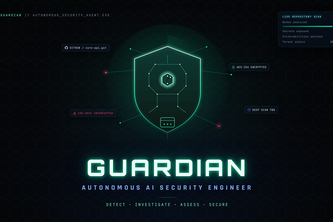
Guardian is an AI-powered tool designed to scan GitHub repositories for exposed secrets and vulnerabilities, investigate risks, explain findings, and recommend secure fixes. It was submitted as a project to the OpenAI 2026 hackathon by a single founder, Ayush Sharma.
What changed
The project was self-submitted to a hackathon, indicating an early-stage concept or prototype. No evidence of product-market fit, revenue, customers, or traction is provided.
The single most important open question
Is there any evidence that Guardian has moved beyond the prototype stage, or whether it has been tested in real-world environments?
What The Product Actually Is
The description states: “AI-powered security engineer that scans GitHub repositories, detects exposed secrets and vulnerabilities, investigates risks, explains findings, and recommends secure fixes in minutes.”
- Claimed functionality:
- Scans GitHub repositories
- Detects exposed secrets and vulnerabilities
- Investigates risks
- Explains findings
- Recommends secure fixes
Inference The product appears to be a DevSecOps tool that leverages AI for automated security auditing of code repositories.
Not evidenced
- Whether the tool is functional or tested
- Whether it integrates with GitHub or other platforms
- What specific vulnerabilities or secrets it detects
- How it explains findings or recommends fixes
Positioning & Claim Evolution
The description states: “AI-powered security engineer that scans GitHub repositories, detects exposed secrets and vulnerabilities, investigates risks, explains findings, and recommends secure fixes in minutes.”
Claimed positioning
A self-contained AI assistant for developers to automate security audits of code repositories.
Inference The tool is positioned as a DevSecOps solution aimed at developers or security teams looking to automate vulnerability detection and remediation.
Not evidenced
- Whether the product has evolved from an idea to a working prototype
- How it differentiates from existing tools (e.g., GitHub Security, Snyk, SonarQube)
- The author’s stated intent for commercialization or further development
Target Customer & ICP
The description states: “AI-powered security engineer that scans GitHub repositories…”
Claimed target customer
Developers and security engineers who work with GitHub repositories.
Inference Likely a developer audience focused on code security, particularly those in DevSecOps workflows.
Not evidenced
- Specific use cases or personas
- Customer segments or buyer personas
- Whether the tool is aimed at individuals or enterprises
- Any evidence of customer interviews or feedback
Business Model & Pricing Evidence
The description states no information about pricing or business model.
Not evidenced
- Revenue model (e.g., SaaS, freemium, enterprise licensing)
- Pricing structure or tiers
- Monetization strategy
- Whether the tool is intended for commercial sale or open-source use
Technical & Delivery Signals
The description states:
- Built with: ai, att&ck, css, cybersecurity, devsecops, framer, github, gpt, javascript, json, markdown, mitre, motion, next.js, node.js, openai, owasp, pdf, react, rest, tailwind, typescript, vercel
- Submitted to OpenAI 2026 hackathon
Inference The tool is built using modern web and AI stacks (e.g., Next.js, React, Node.js, OpenAI), suggesting a technical foundation for a software product.
Not evidenced
- Whether the tool is functional or deployed
- How it integrates with GitHub or other platforms
- Technical architecture or performance metrics
- Any delivery or deployment mechanism
Traction & Maturity Signals
The description states:
- Submitted to OpenAI 2026 hackathon
- Team size: 1
- No mention of users, customers, or adoption
Not evidenced
- Product usage or user base
- Revenue or monetization
- Customer feedback or testimonials
- Product maturity (e.g., MVP, prototype, beta)
- Any evidence of traction beyond the hackathon submission
Competitive Context
The description states no information about competitors.
Inference The tool likely competes with DevSecOps and security scanning tools such as GitHub Security, Snyk, SonarQube, or GitGuardian.
Not evidenced
- Direct competitors
- Market positioning relative to existing tools
- Competitive advantages or differentiators
- Any market research or competitive analysis
Open Questions & Risks
Risk 1
The tool is a hackathon submission by a single person with no evidence of product-market fit or traction.
Risk 2
No pricing, monetization, or business model described.
Risk 3
No evidence of technical functionality or integration with GitHub.
Risk 4
The author’s stated intent for commercialization is not evident.
Open Question
The project has no verified users, revenue, or product development beyond a hackathon submission.
Questions the description leaves open
- What is the current stage of development? Is it a prototype, MVP, or fully functional product?
- Has the tool been tested in real-world environments or with actual GitHub repositories?
- How does it integrate with GitHub and other platforms?
- What is the intended business model and pricing strategy?
- Are there any existing users or feedback from developers or security teams?
- What are the key technical challenges in scaling this solution?
Overall Assessment
Assessment Not evidenced.
Inference The project is at an extremely early stage, likely a hackathon prototype with no commercial traction or evidence of product-market fit. There is insufficient information to assess investment or partnership viability.
Not evidenced
- Revenue or financials
- Customer adoption or feedback
- Product maturity or scalability
- Founders’ track record or team capability beyond the single-person submission
- Any indication of a viable business model or path to monetization
User Stories BotA demo video on every pull request
Get a demo video on every new feature
GitHub App that watches your pull requests and records a narrated, captioned demo.
Save time on demo prep and make informed decisions faster with a video walkthrough of every new feature.
Source
Submitted to the OpenAI 2026 hackathon on Devpost. Project home on Devpost. Back to the full gallery on Devpost.
This competitive analysis was produced by top-founders.com (opens in a new tab)
Generated by a language model from this project's public Devpost page — its tagline and any built-with tags listed there, since the author published no write-up — as captured in August 2026. Short quotations are the author's words. It is an opinion on the idea as a business, not on the people behind it, and it reflects the description as published then. If the project has moved on, request a correction below. The analysis is not independent research and contains no verified traction, revenue or customer data.
An independent guide by KFG International LLC — not affiliated with, endorsed by, or connected to Devpost or OpenAI.