

Archive position — measured, not model output
0 likes on Devpost
2,263 of the 7,850 archived projects have more likes, and 5,587 share exactly 0 — so this project's #4,388 place in the like-ranked listing is a tie-break inside that group, not a ranking.
Projects (log scale)
Likes on Devpost. ▲ marks this project's group.
Show the figures
| Likes | Projects | Share of archive |
|---|---|---|
| 0 | 5,587 | 71.2% |
| 1 | 1,758 | 22.4% |
| 2 | 284 | 3.6% |
| 3–4 | 132 | 1.7% |
| 5–9 | 75 | 1.0% |
| 10+ | 14 | 0.2% |
 User Stories BotA demo video on every pull request
Get a demo video on every new feature
GitHub App that watches your pull requests and records a narrated, captioned demo.
Save time on demo prep and make informed decisions faster with a video walkthrough of every new feature.
Executive Summary
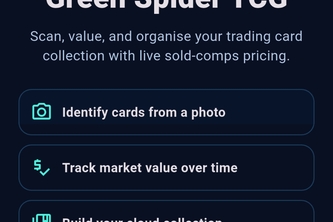
What the company appears to be: Green Spider TCG is an AI-assisted mobile application for trading card collectors that identifies cards from images, retrieves precise sold-market pricing data, manages collections, and connects vendors with collectors through live event catalogues.
What changed: The project evolved from a basic scanning and collection app into a complete product with enhanced AI recognition, improved pricing accuracy, expanded Collection features, and a full vendor/event platform built during a hackathon.
The single most important open question: Does the author's self-reported vision of precise card identification and market pricing translate into actual utility for collectors in real-world use beyond personal testing?
What The Product Actually Is
The description states that Green Spider TCG is an AI-assisted trading card identification, market-pricing and collection-management application. It enables collectors to photograph cards (raw, graded or booster packs) and receive detailed information including card name, game, set, number, language, finish, variation, grading company, grade and certificate number.
The app claims to search sold-market data, check listings before using them for pricing, separate exact matches from comparable evidence, and exclude irrelevant listings. It also includes an event and vendor platform where administrators can create events, vendors can select items from their Collection, set prices and quantities, and publish catalogues accessible via QR code or public link.
The product is built with Flutter/Dart for mobile app, React/TypeScript for admin console, Firebase for backend services, and uses AI models including Vertex AI, Gemini, GPT-5.6 and OpenAI Codex for development assistance.
Positioning & Claim Evolution
The author states that Green Spider TCG was created because they were tired of paying too much for cards without reliable information. The app's positioning centers on providing precise card identification and pricing that avoids broad ranges or misleading comparisons, particularly focusing on regional grading companies often missing from similar tools.
The claim evolution shows a shift from a basic scanning tool to a complete ecosystem including collection management, vendor connections and event catalogues. The author notes that during Build Week, they used GPT-5.6 and Codex to improve usability, navigation, recognition accuracy, pricing matching, and implement the full event platform.
Target Customer & ICP
The description states that Green Spider TCG targets collectors who want precise information about specific cards, particularly those dealing with regional grading companies like ACE, MGC, PG Grading and Get Graded. The app is positioned for UK market collectors but claims to support other countries with their own regional graders.
The primary user roles identified are collectors (who scan cards, manage collections, view pricing) and vendors (who can create event catalogues). Administrators manage events and vendor applications.
Business Model & Pricing Evidence
Not evidenced. The description does not contain any information about pricing models, revenue streams, monetization strategies or commercial arrangements.
Technical & Delivery Signals
The app is built with Flutter/Dart for mobile, React/TypeScript for admin console, Firebase for backend services (authentication, Firestore, Storage, Functions). It uses Vertex AI for card image analysis and Apify for eBay sold listing retrieval. Development was assisted by GPT-5.6 and OpenAI Codex.
The author notes that the system handles card identity, grading evidence and pricing evidence as connected but separate parts of the process to prevent incorrect value calculations from broad matches.
Traction & Maturity Signals
Not evidenced. The description contains no information about revenue, customers, user base, adoption rates or market traction beyond personal testing by the author.
Competitive Context
The description states that existing scanning apps often identify cards but provide pricing that is too broad to be useful, mixing raw and graded cards, different grades, languages, variations or grading companies. Some apps also seem to provide more advertising than practical help. The app aims to recognize regional grading companies that are often missing from similar tools.
Open Questions & Risks
- Single-person team: The project has only one team member (Lukas Pavlik), which raises questions about scalability, development capacity and long-term maintenance.
- Unverified claims: All features and capabilities are self-reported without independent verification or evidence of actual performance.
- AI dependency: Heavy reliance on specific AI models (GPT-5.6) that may not be available or stable in production environments.
- Limited testing scope: The app has been tested with hundreds of cards but lacks data about real-world adoption or user feedback.
- Unclear monetization: No evidence provided about how the platform will generate revenue or sustain operations.
Questions the description leaves open
- What specific market problems are you solving that existing tools don't address?
- How do you plan to validate the accuracy of your AI recognition and pricing algorithms at scale?
- What is your go-to-market strategy for acquiring initial users and building adoption?
- How will you handle data privacy and security concerns with user collections and event information?
- What are the technical challenges in scaling this platform beyond personal testing?
- How do you plan to support additional trading card games, languages and regional grading companies?
- What is your timeline for moving from prototype to production-ready product?
Overall Assessment
Not evidenced. The description contains no information about funding rounds, valuations, financial performance or partnership opportunities that would inform an investment or partnership decision.
The project appears to be a personal development effort with significant AI integration but lacks evidence of commercial traction, market validation or sustainable business model. The single-person team and self-reported nature of all claims make it difficult to assess the actual viability or scalability of the proposed solution.
User Stories BotA demo video on every pull request
Get a demo video on every new feature
GitHub App that watches your pull requests and records a narrated, captioned demo.
Save time on demo prep and make informed decisions faster with a video walkthrough of every new feature.
Source
Submitted to the OpenAI 2026 hackathon on Devpost. Project home on Devpost. Back to the full gallery on Devpost.
This competitive analysis was produced by top-founders.com (opens in a new tab)
Generated by a language model from this project's public Devpost page — its tagline, the author's own write-up and any built-with tags listed there — as captured in August 2026. Short quotations are the author's words. It is an opinion on the idea as a business, not on the people behind it, and it reflects the description as published then. If the project has moved on, request a correction below. The analysis is not independent research and contains no verified traction, revenue or customer data.
An independent guide by KFG International LLC — not affiliated with, endorsed by, or connected to Devpost or OpenAI.