

Archive position — measured, not model output
0 likes on Devpost
2,263 of the 7,850 archived projects have more likes, and 5,587 share exactly 0 — so this project's #4,354 place in the like-ranked listing is a tie-break inside that group, not a ranking.
Projects (log scale)
Likes on Devpost. ▲ marks this project's group.
Show the figures
| Likes | Projects | Share of archive |
|---|---|---|
| 0 | 5,587 | 71.2% |
| 1 | 1,758 | 22.4% |
| 2 | 284 | 3.6% |
| 3–4 | 132 | 1.7% |
| 5–9 | 75 | 1.0% |
| 10+ | 14 | 0.2% |
 User Stories BotA demo video on every pull request
Get a demo video on every new feature
GitHub App that watches your pull requests and records a narrated, captioned demo.
Save time on demo prep and make informed decisions faster with a video walkthrough of every new feature.
Executive Summary
What the company appears to be
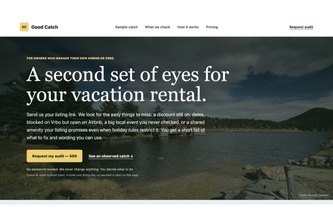
Good Catch is a self-reported read-only audit service for vacation rental property owners. It claims to offer a second set of eyes that identifies potential listing, calendar, guest-promise, and important-date mistakes before they become expensive surprises. The product is described as a public-facing tool that does not require passwords or make changes, but instead returns source-backed audits.
What changed
The project evolved from an internal prototype named EventSpotter into a publicly deployable version during Build Week. It includes a responsive homepage and automated checks for public/private boundaries. The author states that Codex and GPT-5.6 were used to help design and implement the product, including its visual layout, language translation, and boundary enforcement.
The single most important open question
Is there any evidence of traction, revenue, or customer adoption beyond the self-reported prototype and Build Week demo? The description does not indicate whether the service has been tested with actual users or monetized.
What The Product Actually Is
The description states that Good Catch is a read-only protection service for vacation rentals. It operates by:
- Receiving one public listing link from an owner.
- Checking visible evidence and returning a short, source-backed Owner Protection Audit covering:
- Discounts and minimum-stay settings.
- Calendar differences between Airbnb and Vrbo.
- Guest promises conflicting with date-specific restrictions.
- Important events and travel dates worth reviewing.
- Listing copy, photos, and recurring review themes when they reveal a supported mismatch.
- Dates and settings that already look intentional and should be left alone.
The audit costs $99, with optional monitoring at $29/month or $290/year. The service is described as never asking for a password and never changing rates, listings, calendars, or guest messages.
Inference The product appears to be a static, public-facing audit tool that provides owners with a structured report of potential issues, without modifying anything in the system.
Positioning & Claim Evolution
The author states that Good Catch began with the idea of giving owners “a second set of eyes” and showing only the few things worth checking. The positioning is framed around protection, control, and simplicity—not automation or revenue optimization.
The claim evolution shows a shift from an internal prototype (EventSpotter) to a publicly deployable product, with emphasis on:
- Trust: “Good Catch never asks for a password and never changes anything.”
- Clarity: “The audit costs $99. Optional monitoring at $29 per month or $290 per year.”
- Value: “What am I missing, what should I check, and what can I safely leave alone?”
Inference The positioning is not about increasing revenue or automating operations but about reducing risk for owners through a simple, non-invasive audit tool.
Target Customer & ICP
The description identifies the target customer as:
- Self-managing Airbnb and Vrbo owners.
- Owners who juggle discounts, calendars, listing promises, amenity rules, and important local dates across disconnected tools.
The ICP (Ideal Customer Profile) is inferred to be:
- Vacation rental property owners managing their own listings.
- Likely small to mid-sized hosts with multiple platforms (Airbnb/Vrbo).
- Owners who are concerned about mistakes that could lead to financial loss or guest dissatisfaction.
Inference There is no explicit segmentation beyond the general category of vacation rental hosts. The description does not indicate whether the tool targets specific property types, geographic regions, or host experience levels.
Business Model & Pricing Evidence
The business model is described as:
- A one-time audit fee of $99.
- Optional monitoring service priced at $29/month or $290/year.
- The service is explicitly stated to be read-only, with no changes made to listings or calendars.
There is no evidence of:
- Revenue streams beyond the audit and monitoring fees.
- Customer acquisition costs.
- Pricing tiers or volume discounts.
- Any monetization strategy beyond the two stated prices.
Inference The business model appears simple: a fixed-price audit with optional recurring monitoring. No evidence exists to suggest other revenue models or customer segments.
Technical & Delivery Signals
The product is built using:
- JavaScript, Node.js, Next.js, React
- Codex and GPT-5.6 were used for development.
- The architecture separates three surfaces:
- Public site (
public-site/) - Root Next.js app (operator workspace)
- Local engine files (
src/, scripts/, data/)
- Public site (
The system is described as:
- Evidence-first.
- Never calling a booking or publishing unsupported facts.
- Using no-dependency validation scripts.
- Preventing the public site from importing private operator or owner files.
Inference The technical architecture shows an intentional separation of concerns and a focus on trust and data integrity. However, there is no evidence of production deployment, scalability, or integration with Airbnb/Vrbo APIs.
Traction & Maturity Signals
The description states:
- The product was previously a local prototype named EventSpotter.
- It had no public product experience before Build Week.
- The current version was built during Build Week, and the author notes that it is not yet tested with real users.
There is no evidence of:
- Customers or user feedback.
- Revenue or monetization.
- Product usage metrics.
- Any form of market validation beyond the prototype and demo.
Inference The product is at a very early stage, likely in pre-launch or pilot phase. No traction or adoption data are provided.
Competitive Context
The description does not mention any competitors directly. However, it implies that:
- Owners currently manage listings across disconnected tools.
- Mistakes often involve small, ordinary issues like calendar mismatches or discount settings.
- The product is positioned as a complementary tool, not a replacement for existing platforms.
Inference There is no evidence of direct competitors. The market space may include listing management tools, calendar sync services, and trust/safety platforms, but none are named or described.
Open Questions & Risks
Key risks and open questions based on the description:
- No traction or revenue: The product has not yet been tested with real users or monetized.
- Unproven market fit: There is no evidence of customer demand or feedback.
- Limited scope: The tool is read-only and does not integrate with platforms like Airbnb or Vrbo.
- Self-reported validation only: All claims are based on internal testing, not external validation.
- AI dependency: The use of Codex and GPT-5.6 raises questions about how much the product is truly autonomous versus human-in-the-loop.
Inference The project is in a very early stage with no proven commercial viability or market traction. It may be more of a proof-of-concept than a scalable business.
Questions the description leaves open
- What was the outcome of the pilot-property audit? Did the owner act on any findings?
- How many owners have been exposed to the $99 audit, and what was their feedback?
- Are there any plans for integration with Airbnb or Vrbo APIs?
- What is the expected customer acquisition cost (CAC)?
- What are the key assumptions about user behavior that underpin this product?
- How does the team plan to validate the value proposition before scaling?
Overall Assessment
Assessment The project is in a pre-product-market-fit stage, with no evidence of traction, revenue, or customer adoption. It is described as a self-reported prototype and demo, built during a hackathon.
Confidence Level Low. The description provides no independent validation, no data on users, customers, or monetization.
Recommendation
This project is not ready for investment or partnership at this time. It requires further validation with real users and clear evidence of market demand before any strategic move can be considered.
User Stories BotA demo video on every pull request
Get a demo video on every new feature
GitHub App that watches your pull requests and records a narrated, captioned demo.
Save time on demo prep and make informed decisions faster with a video walkthrough of every new feature.
Source
Submitted to the OpenAI 2026 hackathon on Devpost. Project home on Devpost. Back to the full gallery on Devpost.
This competitive analysis was produced by top-founders.com (opens in a new tab)
Generated by a language model from this project's public Devpost page — its tagline, the author's own write-up and any built-with tags listed there — as captured in August 2026. Short quotations are the author's words. It is an opinion on the idea as a business, not on the people behind it, and it reflects the description as published then. If the project has moved on, request a correction below. The analysis is not independent research and contains no verified traction, revenue or customer data.
An independent guide by KFG International LLC — not affiliated with, endorsed by, or connected to Devpost or OpenAI.