

Archive position — measured, not model output
1 like on Devpost
505 of the 7,850 archived projects have more likes, and 1,758 share exactly 1 — so this project's #1,138 place in the like-ranked listing is a tie-break inside that group, not a ranking.
Projects (log scale)
Likes on Devpost. ▲ marks this project's group.
Show the figures
| Likes | Projects | Share of archive |
|---|---|---|
| 0 | 5,587 | 71.2% |
| 1 | 1,758 | 22.4% |
| 2 | 284 | 3.6% |
| 3–4 | 132 | 1.7% |
| 5–9 | 75 | 1.0% |
| 10+ | 14 | 0.2% |
 User Stories BotA demo video on every pull request
Get a demo video on every new feature
GitHub App that watches your pull requests and records a narrated, captioned demo.
Save time on demo prep and make informed decisions faster with a video walkthrough of every new feature.
Executive Summary
What the company appears to be
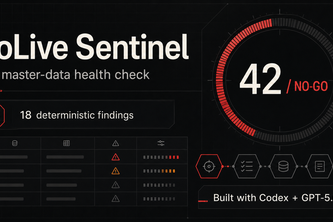
GoLive Sentinel is a self-reported tool for auditing ERP master data (Vendor, Item, BOM) before go-live, using deterministic rules and GPT-5.6 for judgment and remediation planning. It was built as a hackathon submission by one person, Vince Lin.
What changed
The author describes building a tool to address issues in ERP rollouts where technical configuration could be complete but master-data defects caused cutover delays or failures. The tool is positioned as a "go-live gatekeeper" that provides structured findings and remediation plans.
Single most important open question
Is there evidence of real-world usage, traction, or adoption beyond the author’s own demo? The description states no revenue, customers, or real-world deployment data — only a self-contained demo and synthetic dataset.
What The Product Actually Is
The description states that GoLive Sentinel audits three ERP master-data types:
- Vendor master
- Item master
- Production BOM
It uses nine deterministic rules to detect issues such as:
- Duplicate identifiers
- Duplicate descriptions
- Missing setup
- Blocked components
- Orphan components
- Unit-of-measure conflicts
- Circular BOM references
The tool then applies GPT-5.6 for judgment, including:
- Risk assessment
- Blocker classification
- Root-cause hypothesis generation
- Remediation sequencing by owner
- Drafting emails and executive summaries
Raw CSV data is not sent to the model; only structured findings are used.
Evidence
- The author states that the tool audits Dynamics 365 Business Central-style CSV exports.
- Nine deterministic rules are described, with pytest coverage.
- GPT-5.6 is used only for judgment over structured findings.
- The system runs in memory without a database or authentication.
- A one-click demo is included with synthetic data.
Inference The tool appears to be a proof-of-concept built for a hackathon, not a production-ready SaaS offering.
Positioning & Claim Evolution
The author positions GoLive Sentinel as:
- An ERP go-live gatekeeper
- A tool that makes master-data readiness visible before cutover
- A system that turns technical findings into an owned remediation plan
It is described as built by a PM who shipped a multi-country ERP rollout, implying domain knowledge and experience.
Evidence
- Tagline: “An ERP go-live gatekeeper: upload Vendor/Item/BOM masters, get a GO/NO-GO assessment, root-cause analysis, and owner-ready fix plans.”
- The author claims to have led a 200-user ERP rollout across Taiwan, China, and Vietnam.
- The tool is described as solving real-world problems in ERP cutover.
Inference The positioning reflects an attempt to position the tool as a practical solution for ERP teams, but no evidence of actual deployment or customer feedback exists.
Target Customer & ICP
The description states that GoLive Sentinel targets:
- ERP teams preparing for go-live
- Users who manage Vendor/Item/BOM master data in ERP systems like Dynamics 365 Business Central
It is implied to be used by:
- Project managers
- ERP implementation consultants
- Functional teams responsible for data governance
Evidence
- The tool audits ERP master-data types relevant to Dynamics 365 Business Central.
- It provides a NO-GO assessment and remediation plans, suggesting it’s intended for decision-makers.
Inference The ICP is likely ERP project managers or data stewards in mid-to-large enterprises undergoing ERP rollouts. No evidence of actual customer segments or personas is provided.
Business Model & Pricing Evidence
There is no evidence of pricing, monetization, or business model in the description.
Evidence
- The tool is described as a demo with no mention of pricing.
- It uses GPT-5.6 via OpenAI API but does not state if it charges for API usage or offers tiered access.
- No mention of subscriptions, per-user fees, or enterprise licensing.
Inference The business model is unclear and likely not yet defined beyond the hackathon prototype.
Technical & Delivery Signals
The tool is built with:
- Backend: Python, FastAPI, pandas, Pydantic
- Frontend: Vanilla JavaScript, minimal CSS
- AI: GPT-5.6 via OpenAI Responses API and Pydantic Structured Outputs
- Testing: pytest coverage for rules
- Data handling: in-memory, no database or authentication
Evidence
- The tool uses deterministic validation before involving the model.
- It includes synthetic data with documented ground truth.
- A one-click demo is provided without requiring an API key.
- The AI path uses cached responses to avoid API consumption.
Inference The technical stack suggests a lightweight, self-contained prototype. No evidence of scalability or enterprise-grade infrastructure is provided.
Traction & Maturity Signals
There is no evidence of traction, adoption, or usage beyond the author’s own demo and synthetic dataset.
Evidence
- The tool is described as a hackathon submission.
- It includes a one-click demo with 120 vendors, 200 items, 350 BOM lines.
- No real-world data, customers, or user feedback are mentioned.
- No revenue, headcount, or funding rounds are reported.
Inference The tool is at a very early stage — likely a prototype or proof-of-concept with no commercial traction.
Competitive Context
No competitive analysis or mention of existing tools is provided in the description.
Evidence
- The author does not reference competitors.
- No market positioning or differentiation from other ERP data quality tools is stated.
Inference The competitive context is unknown, but it likely competes with ERP data governance or audit tools, or perhaps with general-purpose data validation platforms.
Open Questions & Risks
Key risks and open questions:
- No real-world usage or adoption: The tool is described only as a demo.
- Unproven AI integration: GPT-5.6 is used for judgment but not validated in live use.
- Single-person team: No evidence of a scalable team or product development process.
- Lack of monetization strategy: No pricing, business model, or revenue path described.
- Limited scope: Only three ERP master-data types are supported.
Inference The tool is a prototype with no commercial viability or traction. It may not be ready for enterprise adoption.
Questions the description leaves open
- What real-world ERP rollout experience do you have beyond the one described?
- Have you tested this tool in any actual ERP environment, or is it purely theoretical?
- How would you scale this to handle large datasets or multiple ERP systems?
- Is there a plan for monetization or commercial deployment?
- What are your plans for integrating with real ERP APIs or data sources?
- How do you intend to validate the AI-generated remediation plans in practice?
Overall Assessment
Not evidenced.
The description states that this is a hackathon submission, and there is no evidence of:
- Revenue
- Customers
- Product-market fit
- Commercial traction
- Team or funding beyond one person
This is a prototype with no demonstrated commercial viability or market demand.
Confidence Low. The entire analysis is based on self-reported claims, with no external validation or evidence of real-world usage or adoption.
User Stories BotA demo video on every pull request
Get a demo video on every new feature
GitHub App that watches your pull requests and records a narrated, captioned demo.
Save time on demo prep and make informed decisions faster with a video walkthrough of every new feature.
Source
Submitted to the OpenAI 2026 hackathon on Devpost. Project home on Devpost. Back to the full gallery on Devpost.
This competitive analysis was produced by top-founders.com (opens in a new tab)
Generated by a language model from this project's public Devpost page — its tagline, the author's own write-up and any built-with tags listed there — as captured in August 2026. Short quotations are the author's words. It is an opinion on the idea as a business, not on the people behind it, and it reflects the description as published then. If the project has moved on, request a correction below. The analysis is not independent research and contains no verified traction, revenue or customer data.
An independent guide by KFG International LLC — not affiliated with, endorsed by, or connected to Devpost or OpenAI.