

Archive position — measured, not model output
0 likes on Devpost
2,263 of the 7,850 archived projects have more likes, and 5,587 share exactly 0 — so this project's #4,359 place in the like-ranked listing is a tie-break inside that group, not a ranking.
Projects (log scale)
Likes on Devpost. ▲ marks this project's group.
Show the figures
| Likes | Projects | Share of archive |
|---|---|---|
| 0 | 5,587 | 71.2% |
| 1 | 1,758 | 22.4% |
| 2 | 284 | 3.6% |
| 3–4 | 132 | 1.7% |
| 5–9 | 75 | 1.0% |
| 10+ | 14 | 0.2% |
 User Stories BotA demo video on every pull request
Get a demo video on every new feature
GitHub App that watches your pull requests and records a narrated, captioned demo.
Save time on demo prep and make informed decisions faster with a video walkthrough of every new feature.
Executive Summary
Project: GoReel
Author's Self-Description: A responsive website for cinema discovery and memory-building in London, built as a hackathon project using React, TypeScript, and AI tools like Codex and GPT-5.6.
What Changed: The author describes building a minimal viable product (MVP) focused on personalization, local cinema data, and user memory tracking within a limited timeframe.
Most Important Open Question: Is there evidence of any traction, revenue, or customer adoption beyond the author’s own development effort?
This is a self-reported, unverified account of a hackathon project. No financials, customers, or market validation are evident. The product appears to be an idea in early-stage development with no commercial activity.
What The Product Actually Is
The description states that GoReel is a responsive website for cinema discovery and memory-building in London. It allows users to:
- Choose films, genres, moods, and location
- Get film recommendations based on preferences
- Search and filter by genre, mood, date, time
- Find nearby cinemas, showtimes, and travel distances
- Rate suggestions to improve future recommendations
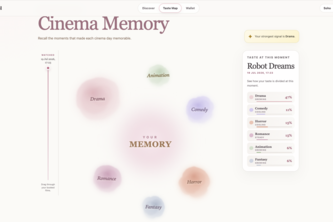
- View booked films in a "Cinema Memory" timeline
- Save details such as who they went with, what they ate, the weather, and how they felt
- Add, edit, copy, use, and remove cinema vouchers
- Receive notifications when vouchers are used or expire
It uses a rule-based recommendation system that scores films based on user taste, distance, rating, showtime, and voucher availability. The system learns from feedback.
The app is built with:
- React
- TypeScript
- Vite
- CSS and animated SVGs
- Browser localStorage
- Film posters from TMDB
- Cloudflare Workers for deployment
Not evidenced: actual functionality beyond the demo, live data integration, or production use.
Positioning & Claim Evolution
The author positions GoReel as a personalized cinema discovery tool that helps users find nearby films, plan outings, and turn screenings into memories. It is described as bridging the gap between streaming platforms (which are home-focused) and real-world cinema experiences.
Key claims:
- “It helps people discover a film, find a convenient showing, use any relevant vouchers, and save the memory afterwards.”
- “Cinema is about more than buying a ticket. It is a reason to spend time with friends, plan a date, or enjoy discovering something new on your own.”
These are claims of intent rather than evidence of traction or adoption.
Inferred: The product is positioned as an experience-focused tool for personal and social cinema planning, not just information aggregation.
Target Customer & ICP
The description states that GoReel targets users who:
- Want to discover films
- Are looking for nearby cinemas
- Plan outings with friends or alone
- Enjoy creating memories around screenings
It is explicitly focused on London as the first location, and the author mentions future expansion to other cities.
Not evidenced: No customer segmentation data, personas, or user research. The ICP is inferred from the product’s features and scope.
Business Model & Pricing Evidence
The description does not mention any business model or pricing strategy.
Inferred: If this were to scale, it might involve:
- Freemium with premium features (e.g., advanced voucher matching, calendar integration)
- Partnerships with cinemas or ticketing platforms
- Data monetization (anonymized user behavior)
None of these are stated or evidenced in the description.
Technical & Delivery Signals
The app is built using:
- React
- TypeScript
- Vite
- CSS and animated SVGs
- Browser localStorage for state management
- TMDB for film posters
- Cloudflare Workers for deployment
It uses a rule-based recommendation engine, not an AI API, during runtime. The system scores films based on:
- Taste (T)
- Distance (D)
- Rating (R)
- Showtime convenience (S)
- Voucher availability (V)
The author states that the recommendation logic was supported by Codex and GPT-5.6.
Not evidenced: No production deployment, API integrations, or scalability details beyond the demo.
Traction & Maturity Signals
No traction or maturity signals are evident in the description:
- No revenue
- No customers
- No user base
- No usage metrics
- No product-market fit indicators
The project is described as a hackathon demo, with sample data used for reliability during judging.
Inferred: The app is at MVP stage, likely not yet released to users or monetized.
Competitive Context
The description does not mention any competitors. However, the idea of cinema discovery and memory-building overlaps with:
- Cinema listing apps (e.g., Fandango, MovieTickets)
- Social event planning tools
- Personal memory or journaling apps
Not evidenced: No competitive analysis, market size estimates, or positioning against existing players.
Open Questions & Risks
- No commercial traction: The project is described as a hackathon demo with no evidence of real-world usage.
- Limited scope: Only London is supported; no expansion plans are detailed.
- Demo-only features: Sample data used for all cinema listings, showtimes, and vouchers.
- Unproven business model: No monetization strategy or revenue path described.
- Single-founder project: The team size is listed as 1, which may limit execution speed or scalability.
Questions the description leaves open
- What is the plan for integrating live cinema and booking APIs?
- How will user data be stored and protected (especially in a future version with accounts)?
- Are there any partnerships or pilot programs with cinemas or ticketing platforms?
- What are the key assumptions about user behavior that need testing?
- Is there any interest from users beyond the author’s own use case?
- How does the recommendation system plan to evolve beyond rule-based scoring?
Overall Assessment
Not evidenced: No financials, customers, or traction data are provided.
This is a self-reported hackathon project, not a commercial product with market validation or revenue. The author describes building an MVP with sample data and no live integrations.
Confidence Level: Low — the description is entirely self-reported and lacks any evidence of real-world adoption or business activity.
Inferred: If this were to become a viable product, it would require significant development beyond the current demo, including API integrations, user accounts, and monetization strategies.
User Stories BotA demo video on every pull request
Get a demo video on every new feature
GitHub App that watches your pull requests and records a narrated, captioned demo.
Save time on demo prep and make informed decisions faster with a video walkthrough of every new feature.
Source
Submitted to the OpenAI 2026 hackathon on Devpost. Project home on Devpost. Back to the full gallery on Devpost.
This competitive analysis was produced by top-founders.com (opens in a new tab)
Generated by a language model from this project's public Devpost page — its tagline, the author's own write-up and any built-with tags listed there — as captured in August 2026. Short quotations are the author's words. It is an opinion on the idea as a business, not on the people behind it, and it reflects the description as published then. If the project has moved on, request a correction below. The analysis is not independent research and contains no verified traction, revenue or customer data.
An independent guide by KFG International LLC — not affiliated with, endorsed by, or connected to Devpost or OpenAI.