

Archive position — measured, not model output
0 likes on Devpost
2,263 of the 7,850 archived projects have more likes, and 5,587 share exactly 0 — so this project's #4,327 place in the like-ranked listing is a tie-break inside that group, not a ranking.
Projects (log scale)
Likes on Devpost. ▲ marks this project's group.
Show the figures
| Likes | Projects | Share of archive |
|---|---|---|
| 0 | 5,587 | 71.2% |
| 1 | 1,758 | 22.4% |
| 2 | 284 | 3.6% |
| 3–4 | 132 | 1.7% |
| 5–9 | 75 | 1.0% |
| 10+ | 14 | 0.2% |
 User Stories BotA demo video on every pull request
Get a demo video on every new feature
GitHub App that watches your pull requests and records a narrated, captioned demo.
Save time on demo prep and make informed decisions faster with a video walkthrough of every new feature.
Executive Summary
What the company appears to be
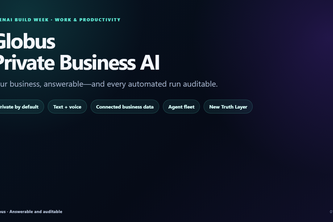
Globus is an AI-agent platform built around a self-hosted runtime that aims to enforce reliability, control, and verification in organizational workflows. It introduces a "Truth Layer" and "Verified Action SDK" designed to ensure actions taken by AI agents are not only authorized but also independently verified after execution — with immutable evidence from intent to destination.
What changed
During OpenAI Build Week, the author (Sumit Ghosh) added a new version (v0.15) of the platform that includes a strict action contract system, deterministic idempotency, independent destination verification, and a six-stage visual timeline for execution tracking. This work was built using GPT-5.6 and Codex with tools like Python, SQLite, and Docker.
Single most important open question
Is there any evidence of real-world usage or adoption beyond the author’s own development environment? The description states that this is an alpha reference implementation, not a turn-key SaaS product, and no customer data or revenue information is provided.
What The Product Actually Is
The description states that Globus is a self-hosted AI-agent platform for organizational workflows. It includes:
- Cited member chat over private organizational data.
- JARVIS-style voice conversations through ElevenLabs.
- Optional sources including Google Drive, Gmail, Microsoft Teams, WhatsApp, Telegram, Freshsales CRM, Google Analytics, Obsidian, and Markdown.
- Per-member-private vaults and organization portals.
- Four built-in background agents: Research, Sales Desk, Narada, and Infra Watch.
- A guarded public preview with no private vault or tool access.
- Mission Control for receipts, reason codes, capabilities, approvals, blocked actions, and verified outcomes.
- A deterministic Truth Layer, fail-closed Action Gate, Consequence Firewall, and Approval Center.
- In v0.15, a reusable Verified Action SDK with proof after the effect.
The author also describes the platform as including:
- A strict versioned receipt contract
- A fail-closed Action Gate that reads current persisted evidence rather than accepting a caller’s preferred assessment
- A Consequence Firewall with exact, deny-by-default runtime tool grants for the four shipped background agents
- A payload-free Approval Center with human review, fresh-Truth rechecks, unique execution claims, and replay blocking
Inference The platform is built to enforce control over AI agent actions by requiring verification of outcomes after execution.
Positioning & Claim Evolution
The author states that Globus was built around one principle:
“An agent saying 'done' is making a claim. Trust should require measurements, authorization, destination evidence, and checks.”
This suggests a shift from traditional AI-agent workflows where success might be reported without verification to a model where outcomes are validated post-execution.
The platform positions itself as:
- A self-hosted solution
- Focused on reliability, control, and verification
- Designed for organizational workflows
- With an emphasis on immutable evidence from intent to destination
It also claims to offer:
- Deterministic assessments (healthy, verified_no_work, degraded_contradictory, failed, stale)
- Immutable receipts and history
- Fail-closed mechanisms
- Human approval as one component of a multi-layered trust system
Inference The positioning reflects a move toward trustworthy automation, where AI agents must prove their actions rather than just report them.
Target Customer & ICP
The description states that Globus is intended for organizational workflows, and mentions:
- Per-member-private vaults
- Organization portals
- Four built-in background agents (Research, Sales Desk, Narada, Infra Watch)
However, there is no explicit mention of specific industries or roles within organizations.
Inference The target customer appears to be organizations seeking secure, auditable AI automation, particularly those with internal workflows that require verification and control.
Business Model & Pricing Evidence
There is no evidence in the description of:
- Revenue streams
- Pricing models
- Customer acquisition strategies
- Monetization plans
The author notes that this is an alpha reference implementation, not a turn-key SaaS product.
Inference No business model or pricing information is evident from the self-reported description.
Technical & Delivery Signals
Key technical elements mentioned include:
- Built with anthropic-claude, css3, deepseek, docker, elevenlabs, github-actions, gpt-5.6, html5, javascript, mysql, openai-codex, python, sqlite
- A deterministic Truth Layer using Python rules
- Fail-closed Action Gate reading current persisted evidence
- Consequence Firewall with exact, deny-by-default runtime tool grants
- Verified Action SDK with strict action contracts
- Immutable destination verification via SQLite connections
- Six-stage visual timeline derived from a consistent SQLite snapshot
The author also mentions:
- Two generated-local reference adapters (Email Draft and CRM Note)
- No outbound network calls or real provider integrations in v0.15
- A CLI, fixed-contract JSON API, and Mission Control dashboard
- Tests passing for 164 Truth/Mission Control tests and 11 repository-wide check groups
Inference The platform is built with a strong emphasis on local execution, security, and verifiability, using deterministic logic and SQLite-based storage.
Traction & Maturity Signals
The description states:
- This is an alpha reference implementation
- Not deployed to production
- No real-world usage or adoption beyond the author’s own development environment
- The repository is the authoritative artifact
- Tests pass, but no customer data or revenue is provided
Inference There is no evidence of traction, customers, or revenue. The project remains in early-stage development.
Competitive Context
There is no mention of competitors in the description. However, based on the features described — such as AI agent workflows, verification layers, and control planes — Globus may compete with:
- Other AI-agent platforms
- Workflow automation tools (e.g., Zapier, Make.com)
- Enterprise AI governance or compliance tools
Inference No competitive landscape is described. The author does not reference existing players in the space.
Open Questions & Risks
- No traction or revenue: The platform is described as an alpha reference implementation with no evidence of real-world usage.
- Self-hosted only: This limits scalability and ease of adoption for many organizations.
- Reference adapters only: Two local adapters are provided, but no actual integrations with major providers (e.g., Gmail, Salesforce).
- No production deployment yet: The v0.15 version is not deployed to a server.
- Single founder team: Only one member listed (Sumit Ghosh), which may limit execution capacity.
- Limited scope of capabilities: Only four built-in agents are mentioned; the full registry of 71 capabilities is not connected.
Inference The project is in early development and lacks commercial viability or market traction.
Questions the description leaves open
- What is the timeline for moving from this alpha reference implementation to a production-ready product?
- Are there any plans to integrate with real third-party providers beyond the two local adapters?
- How does Globus plan to scale beyond a single developer’s environment?
- What are the key assumptions about organizational workflows that drive the design of the Truth Layer and Consequence Firewall?
- Is there any internal testing or feedback from users outside of the development team?
- What is the long-term vision for monetization, if any?
Overall Assessment
Not evidenced: There is no evidence of revenue, customers, traction, or a clear path to market adoption.
The description indicates that Globus is an early-stage prototype, built during OpenAI Build Week, with a focus on reliability and verification in AI-agent workflows. It includes technical innovations such as a Truth Layer and Verified Action SDK, but lacks any indication of real-world usage or commercial viability.
Confidence level: Low — based entirely on self-reported information without external validation or evidence of adoption or revenue.
Assessment: Not ready for investment or partnership unless further development and traction are demonstrated.
User Stories BotA demo video on every pull request
Get a demo video on every new feature
GitHub App that watches your pull requests and records a narrated, captioned demo.
Save time on demo prep and make informed decisions faster with a video walkthrough of every new feature.
Source
Submitted to the OpenAI 2026 hackathon on Devpost. Project home on Devpost. Back to the full gallery on Devpost.
This competitive analysis was produced by top-founders.com (opens in a new tab)
Generated by a language model from this project's public Devpost page — its tagline, the author's own write-up and any built-with tags listed there — as captured in August 2026. Short quotations are the author's words. It is an opinion on the idea as a business, not on the people behind it, and it reflects the description as published then. If the project has moved on, request a correction below. The analysis is not independent research and contains no verified traction, revenue or customer data.
An independent guide by KFG International LLC — not affiliated with, endorsed by, or connected to Devpost or OpenAI.