

Archive position — measured, not model output
0 likes on Devpost
2,263 of the 7,850 archived projects have more likes, and 5,587 share exactly 0 — so this project's #4,288 place in the like-ranked listing is a tie-break inside that group, not a ranking.
Projects (log scale)
Likes on Devpost. ▲ marks this project's group.
Show the figures
| Likes | Projects | Share of archive |
|---|---|---|
| 0 | 5,587 | 71.2% |
| 1 | 1,758 | 22.4% |
| 2 | 284 | 3.6% |
| 3–4 | 132 | 1.7% |
| 5–9 | 75 | 1.0% |
| 10+ | 14 | 0.2% |
 User Stories BotA demo video on every pull request
Get a demo video on every new feature
GitHub App that watches your pull requests and records a narrated, captioned demo.
Save time on demo prep and make informed decisions faster with a video walkthrough of every new feature.
Executive Summary
What the company appears to be
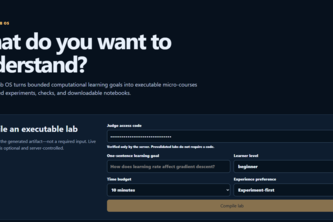
Generative Lab OS is a self-reported educational platform that uses GPT-5.6 Structured Outputs to generate interactive micro-courses in computational learning. The system claims to produce one-shot, validated educational experiences from bounded computational goals.
What changed
The project description shows an author-driven development of a system that generates and validates educational content using AI, with emphasis on trust boundaries between AI generation and host validation.
Single most important open question
Is there evidence of any real-world usage or adoption beyond the author's own development?
What The Product Actually Is
The description states that Generative Lab OS is a system that:
- Takes a one-sentence computational learning goal, learner level, time budget, and experience preference
- Makes exactly one GPT-5.6 Structured Outputs request
- Generates a complete micro-course with:
- Orientation
- Worked example
- Prediction prompt
- Bounded controls
- Restricted pure-Python experiment
- Declared observations
- Visualizations
- Measurable checks
- Contrasting condition
- Transfer task
- Debrief
- Exports the result as a downloadable notebook
The system is described as using:
- Next.js and React for frontend
- TypeScript and Zod for validation
- OpenAI Responses API and GPT-5.6 Structured Outputs
- Python 3.11 with restricted execution environment
- SQLite for storage
- Vitest, Playwright, Docker, Railway for deployment
Inference The system is a self-contained educational compiler that generates interactive learning experiences from computational goals.
Positioning & Claim Evolution
The description states:
- The product aims to create "something closer to a small scientific laboratory"
- It positions itself as turning "bounded computational learning goals into verified, executable micro-courses"
- It claims to avoid "merely explaining knowledge" and instead creates "a situation in which the learner can experience its cause-and-effect behavior"
Inference The positioning is that of an educational tool that moves beyond explanation toward experiential learning through computational experimentation.
Target Customer & ICP
The description states:
- The target is learners who want to understand computational concepts
- It supports "learner level" as a parameter
- It targets "computational learning goals"
- It mentions "experience preference" and "time budget"
Inference The primary customer appears to be students or learners in computational disciplines (e.g., computer science, data science, AI) who want hands-on experience with concepts.
Business Model & Pricing Evidence
Not evidenced.
The description does not contain any information about pricing, monetization, or business model.
Technical & Delivery Signals
The description states:
- Uses one GPT-5.6 Structured Outputs request
- No retries, repair calls, or fallback labs
- Trusted host code validates and normalizes responses
- Python runs in a bounded capability system with:
- Restricted builtins
- Approved runtime namespaces
- Protected names
- Type-aware container-method allowlists
- Literal control bindings
- Declared output contracts
- Undefined-name and attribute checks
- Source, execution-time, stdout, and output-size limits
- Isolated Python mode
- No shell, network, arbitrary imports, eval, exec, subprocesses, or file access
Inference The system is built with strong security boundaries between AI generation and execution.
Traction & Maturity Signals
Not evidenced.
The description does not contain any information about revenue, customers, usage metrics, or adoption beyond the author's own development.
Competitive Context
Not evidenced.
The description does not mention competitors or market positioning relative to existing tools in the educational technology space.
Open Questions & Risks
- The system is described as built by a single person (Shuhan Cai)
- No evidence of any real-world usage or adoption
- The use of GPT-5.6 is self-reported and unverified
- The system claims to be "production-ready" but lacks evidence of deployment beyond the author's own testing
- The description makes strong claims about educational outcomes without demonstrating them
Inference The project appears to be a proof-of-concept or prototype, with no evidence of commercial traction or real-world usage.
Questions the description leaves open
- What is the actual user base for this system?
- How does the system handle edge cases in generated code that may not have been tested during development?
- Are there any plans to monetize the platform, and if so, what are they?
- Has the system been tested with real learners or educators?
- What is the long-term vision for scaling beyond a single developer's capabilities?
Overall Assessment
Not evidenced.
The description does not contain any information about funding, investment, or partnership opportunities. The project appears to be a self-developed prototype without evidence of commercial traction or market validation.
User Stories BotA demo video on every pull request
Get a demo video on every new feature
GitHub App that watches your pull requests and records a narrated, captioned demo.
Save time on demo prep and make informed decisions faster with a video walkthrough of every new feature.
Source
Submitted to the OpenAI 2026 hackathon on Devpost. Project home on Devpost. Back to the full gallery on Devpost.
This competitive analysis was produced by top-founders.com (opens in a new tab)
Generated by a language model from this project's public Devpost page — its tagline, the author's own write-up and any built-with tags listed there — as captured in August 2026. Short quotations are the author's words. It is an opinion on the idea as a business, not on the people behind it, and it reflects the description as published then. If the project has moved on, request a correction below. The analysis is not independent research and contains no verified traction, revenue or customer data.
An independent guide by KFG International LLC — not affiliated with, endorsed by, or connected to Devpost or OpenAI.