

Archive position — measured, not model output
0 likes on Devpost
2,263 of the 7,850 archived projects have more likes, and 5,587 share exactly 0 — so this project's #4,231 place in the like-ranked listing is a tie-break inside that group, not a ranking.
Projects (log scale)
Likes on Devpost. ▲ marks this project's group.
Show the figures
| Likes | Projects | Share of archive |
|---|---|---|
| 0 | 5,587 | 71.2% |
| 1 | 1,758 | 22.4% |
| 2 | 284 | 3.6% |
| 3–4 | 132 | 1.7% |
| 5–9 | 75 | 1.0% |
| 10+ | 14 | 0.2% |
 User Stories BotA demo video on every pull request
Get a demo video on every new feature
GitHub App that watches your pull requests and records a narrated, captioned demo.
Save time on demo prep and make informed decisions faster with a video walkthrough of every new feature.
Executive Summary
What the company appears to be
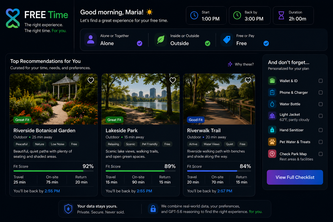
FREE Time is a personal recommendation engine for real-world activities, built as a hackathon project. It claims to recommend experiences that fit a user’s time, body, mind, budget, and companions — not just their likes — using GPT-5.6 reasoning and Codex-built matching.
What changed
The author states this is a new approach to recommendation systems, distinguishing itself from apps that simply answer “what is nearby?” by focusing on whole-person fit, including physical capability, sensory comfort, companion needs, and return time constraints.
Single most important open question
Is there evidence of traction or commercial viability beyond the hackathon submission? The description contains no data on revenue, users, or adoption.
What The Product Actually Is
The description states that FREE Time is a personalized activity recommendation system. It asks users to make three simple choices (Alone/Together, Inside/Outside, Free/Pay), then uses an interface to collect detailed personal fit information such as:
- Physical capability and walking tolerance
- Seating and accessibility needs
- Mental and sensory comfort
- Crowd, noise, and lighting tolerance
- Companion or pet requirements
- Energy preference
- Travel time and return buffer
- Budget and payment compatibility
- Prior feedback
Behind the interface, it applies deterministic constraints (e.g., time window, accessibility exclusions) before scoring remaining plans using a combination of:
- GPT-5.6 for explanation and nuanced fit interpretation
- Nearest-neighbor model for similarity-based ranking
- Codex for implementation, debugging, testing, and documentation
It also includes a feedback loop that updates the user’s profile to improve future recommendations.
Inference The system is designed to avoid generic or one-size-fits-all recommendations by integrating both hard constraints and AI interpretation.
Positioning & Claim Evolution
The description states that FREE Time was built to answer a better question than typical recommendation apps:
“Given this exact amount of time, what can this person realistically do, enjoy, afford, and return from on time?”
It positions itself as a whole-person experience engine, not just a list of nearby options. The author emphasizes:
- Dignity in suitability
- Functional reality over assumptions (e.g., age-based activity selection)
- Trust through transparency: showing what is verified, inferred, or unknown
Inference The positioning evolved from a health-themed app to one that prioritizes personalized fit over preference, with an emphasis on explainability and user control.
Target Customer & ICP
The description does not name specific customer segments. However, it implies the system targets users who:
- Have fixed time windows
- Have accessibility or sensory needs
- Want to return from activities on time
- Value personalized readiness guidance
- Are interested in whole-person fit, not just likes
It also suggests targeting users with:
- Pet companions
- Budget constraints
- Physical limitations or health considerations
Inference The ICP likely includes people who are time-constrained, health-conscious, or have accessibility needs, and who seek realistic, personalized experiences.
Business Model & Pricing Evidence
The description does not state a business model or pricing structure. It is unclear whether FREE Time intends to:
- Offer the service for free
- Charge for premium features
- Monetize through partnerships with venues or event organizers
- Sell data (though privacy is mentioned)
Inference No evidence of a monetization strategy exists in the description.
Technical & Delivery Signals
The system is built using:
- Node.js + Express
- OpenAI Responses API
- GPT-5.6
- Deterministic JavaScript constraint logic
- Cosine-similarity nearest-neighbor scoring
- Codex for implementation, debugging, testing, and documentation
It separates AI reasoning from deterministic rules to ensure constraints are not overridden by the language model.
Inference The architecture shows a deliberate separation of logic layers, with an emphasis on deterministic filtering before AI interpretation, which may reflect a mature engineering approach.
Traction & Maturity Signals
The description states that this is a hackathon project submitted to the OpenAI 2026 hackathon. It includes:
- A working prototype
- Automated tests
- Feedback-driven profile updates
- A proof-of-concept for anonymous nearest-neighbor ranking
However, there is no evidence of revenue, customers, or user adoption beyond the author’s own account.
Inference The project is in a pre-commercial, early-stage prototype phase, with no demonstrated traction.
Competitive Context
The description does not name competitors. However, it positions itself as distinct from:
- Generic recommendation apps that answer “what is nearby?”
- Apps that rely on simple preference matching
It implies it competes with systems that do not consider whole-person constraints like return time, physical capability, or sensory comfort.
Inference It may compete with event discovery platforms, lifestyle apps, and wellness-focused tools — but no direct competitors are named.
Open Questions & Risks
- No revenue or customer data: The project is described as a hackathon submission with no evidence of monetization or adoption.
- Unverified claims about GPT-5.6: The system uses an AI model that does not exist in real-world versions (GPT-5.6).
- Limited scope: The system currently focuses on a narrow set of inputs and does not yet integrate with live event discovery, calendar, or wearable data.
- No commercialization path: No evidence of how the product would scale or monetize beyond its prototype phase.
Inference The project is highly speculative, with no clear path to market traction or profitability.
Questions the description leaves open
- What are your plans for scaling beyond the hackathon prototype?
- How will you validate that users trust and act on the system’s recommendations?
- Are there any real-world partnerships or integrations planned with venues, event organizers, or health platforms?
- How do you plan to monetize this service?
- What is your roadmap for integrating live data (e.g., events, weather, traffic)?
- How will you handle user privacy and data governance as the system scales?
- What are the key assumptions about user behavior that underpin the product design?
Overall Assessment
Not evidenced.
The description is a self-reported account of a hackathon project with no evidence of traction, revenue, or commercial viability. The author states the system is in early prototype form and does not include any data on users, adoption, or monetization.
Confidence: Low.
This is a pre-commercial idea, likely not ready for investment or partnership at this stage. It may be a promising concept with potential, but no evidence supports its viability beyond the author’s own claims.
User Stories BotA demo video on every pull request
Get a demo video on every new feature
GitHub App that watches your pull requests and records a narrated, captioned demo.
Save time on demo prep and make informed decisions faster with a video walkthrough of every new feature.
Source
Submitted to the OpenAI 2026 hackathon on Devpost. Project home on Devpost. Back to the full gallery on Devpost.
This competitive analysis was produced by top-founders.com (opens in a new tab)
Generated by a language model from this project's public Devpost page — its tagline, the author's own write-up and any built-with tags listed there — as captured in August 2026. Short quotations are the author's words. It is an opinion on the idea as a business, not on the people behind it, and it reflects the description as published then. If the project has moved on, request a correction below. The analysis is not independent research and contains no verified traction, revenue or customer data.
An independent guide by KFG International LLC — not affiliated with, endorsed by, or connected to Devpost or OpenAI.