

Archive position — measured, not model output
1 like on Devpost
505 of the 7,850 archived projects have more likes, and 1,758 share exactly 1 — so this project's #1,084 place in the like-ranked listing is a tie-break inside that group, not a ranking.
Projects (log scale)
Likes on Devpost. ▲ marks this project's group.
Show the figures
| Likes | Projects | Share of archive |
|---|---|---|
| 0 | 5,587 | 71.2% |
| 1 | 1,758 | 22.4% |
| 2 | 284 | 3.6% |
| 3–4 | 132 | 1.7% |
| 5–9 | 75 | 1.0% |
| 10+ | 14 | 0.2% |
 User Stories BotA demo video on every pull request
Get a demo video on every new feature
GitHub App that watches your pull requests and records a narrated, captioned demo.
Save time on demo prep and make informed decisions faster with a video walkthrough of every new feature.
Executive Summary
What the company appears to be
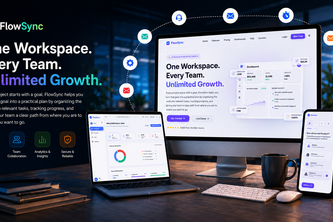
FlowSync AI is a self-reported project that aims to transform natural-language project goals into structured workflows using a React-based frontend application. The author describes it as evolving from a SaaS-style frontend concept into a functional workspace with core loops of project creation, goal description, workflow generation, task management, and progress tracking.
What changed
The project evolved during Build Week from an initial SaaS frontend idea to a more focused product experience that includes persistent data handling, UI refinement, and goal-relevant workflow generation. It was built using React, Vite, and AI tools like Codex and GPT-5.6.
The single most important open question
Is there evidence of actual user adoption or traction beyond the author's own development work? The description states no revenue, customers, or usage data exist beyond the author’s account.
What The Product Actually Is
The description states that FlowSync AI is a workspace application built with React and Vite. It allows users to:
- Create a project
- Describe a goal in natural language
- Generate a relevant structured workflow
- Manage task statuses
- Track progress based on actual task completion
- Return to their workspace and continue where they left off
The core product loop is: Create a project → Describe the goal → Generate a relevant workflow → Manage tasks → Track progress.
It was originally conceived as a SaaS frontend concept but evolved into a functional workspace during Build Week.
Evidence Self-reported by the author; no independent verification or demonstration of actual functionality beyond the developer's own account.
Positioning & Claim Evolution
The author claims that FlowSync AI addresses a common problem teams face: turning a project goal into a clear, actionable plan. It positions itself as a tool to help users move from idea to execution by generating workflows tailored to their specific goals.
It evolved from a general SaaS frontend concept to a more focused product loop around workflow generation and task management.
Evidence Self-reported claims about intent and positioning; no evidence of market validation or customer feedback.
Target Customer & ICP
The description does not specify target customers or personas. It implies the tool is for individuals or teams who want to turn project goals into actionable workflows, but it does not define who those users are or what their needs are beyond general project management.
Evidence Not evidenced; no stated customer segments or buyer personas.
Business Model & Pricing Evidence
There is no evidence of a business model or pricing structure in the description. The author describes the product as a frontend application built for a hackathon and does not mention monetization, subscriptions, or any revenue streams.
Evidence Not evidenced; no indication of how the project would generate value or income.
Technical & Delivery Signals
The project was built using:
- Technology stack: CSS3, Framer Motion, JavaScript, React, React Router, Redux Toolkit, Vite
- Development approach: Built incrementally during Build Week, with improvements to existing codebase
- AI integration: Codex and GPT-5.6 were used for development assistance and product reasoning
- Features: Persistent data handling, responsive UI, task management, workflow generation
Evidence Self-reported; no independent verification of technical architecture or delivery quality.
Traction & Maturity Signals
The description states that the project was submitted to a hackathon (OpenAI 2026) and evolved during Build Week. It includes references to improvements made over time, but there is no evidence of:
- Users
- Revenue
- Customer adoption
- Product usage metrics
- Market traction
Evidence Not evidenced; no signs of real-world use or product maturity beyond the author’s development work.
Competitive Context
The description does not mention any competitors or market context. It does not reference similar tools or platforms in the project management or AI workflow space.
Evidence Not evidenced; no competitive landscape information provided.
Open Questions & Risks
- No traction: The product is described only as a hackathon submission with no evidence of real-world adoption.
- Unverified claims: All descriptions are self-reported and unverified.
- Lack of business model clarity: No indication of how the project would monetize or scale.
- Limited scope: The tool appears to be a prototype, not a production-ready product.
- AI dependency: Reliance on AI tools (Codex, GPT-5.6) for development suggests potential instability or lack of control over core functionality.
Inference The absence of any evidence of real-world usage or business viability raises concerns about whether this is a viable commercial proposition.
Questions the description leaves open
- What specific problem are you solving, and how do you know users have that problem?
- Have you tested the workflow generation with actual users or teams?
- How does the product handle edge cases in natural-language input?
- What is your plan for monetization or scaling beyond a hackathon prototype?
- Are there any technical limitations to the current implementation that would prevent production use?
Overall Assessment
There is no evidence of revenue, customers, or traction beyond the author’s own development work. The project is described as a hackathon submission and does not show signs of commercial viability or product-market fit.
Confidence level Low — based entirely on self-reported information with no external validation.
Assessment Not ready for investment or partnership consideration without further evidence of traction, user adoption, or business model development.
User Stories BotA demo video on every pull request
Get a demo video on every new feature
GitHub App that watches your pull requests and records a narrated, captioned demo.
Save time on demo prep and make informed decisions faster with a video walkthrough of every new feature.
Source
Submitted to the OpenAI 2026 hackathon on Devpost. Project home on Devpost. Back to the full gallery on Devpost.
This competitive analysis was produced by top-founders.com (opens in a new tab)
Generated by a language model from this project's public Devpost page — its tagline, the author's own write-up and any built-with tags listed there — as captured in August 2026. Short quotations are the author's words. It is an opinion on the idea as a business, not on the people behind it, and it reflects the description as published then. If the project has moved on, request a correction below. The analysis is not independent research and contains no verified traction, revenue or customer data.
An independent guide by KFG International LLC — not affiliated with, endorsed by, or connected to Devpost or OpenAI.