

Archive position — measured, not model output
0 likes on Devpost
2,263 of the 7,850 archived projects have more likes, and 5,587 share exactly 0 — so this project's #3,647 place in the like-ranked listing is a tie-break inside that group, not a ranking.
Projects (log scale)
Likes on Devpost. ▲ marks this project's group.
Show the figures
| Likes | Projects | Share of archive |
|---|---|---|
| 0 | 5,587 | 71.2% |
| 1 | 1,758 | 22.4% |
| 2 | 284 | 3.6% |
| 3–4 | 132 | 1.7% |
| 5–9 | 75 | 1.0% |
| 10+ | 14 | 0.2% |
 User Stories BotA demo video on every pull request
Get a demo video on every new feature
GitHub App that watches your pull requests and records a narrated, captioned demo.
Save time on demo prep and make informed decisions faster with a video walkthrough of every new feature.
Executive Summary
What the company appears to be
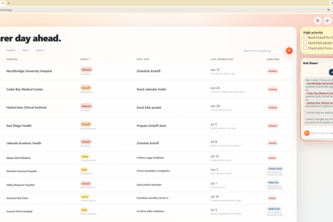
Dawn AI is a self-reported, early-stage project built by one person (Jeremy Low) for a healthtech startup. The author states it is an AI-driven onboarding tool designed to help startups manage hospital activations more efficiently. It uses GPT APIs and Codex for development, with a focus on parsing messy data from CSVs, text files, and voice input, while maintaining human approval for all changes.
What changed
The project was submitted as part of the OpenAI 2026 hackathon. The author describes building an MVP in a short timeframe using AI tools like Codex and GPT, with no external funding or traction evidence provided.
Single most important open question
Is there any evidence that Dawn AI has been adopted by real healthtech startups or hospitals beyond the author’s own use case? The description does not indicate any actual customers or revenue.
What The Product Actually Is
The description states that Dawn AI is:
- A dashboard for managing hospital onboarding
- Powered by AI (GPT API) to ingest and process messy data from CSVs, text files, and voice input
- Designed with a chat interface ("Ask Dawn") and file parsing capabilities
- Built using Next.js and deployed on Vercel
- Intended to reduce manual effort in tracking hospital activation stages (Interest → Kickoff → Pilot → Active)
- Noted as an MVP built during a hackathon, with demo data stored locally
Inference It appears to be a minimal CRM or task management tool tailored for early-stage healthtech startups dealing with complex onboarding processes involving many stakeholders.
Positioning & Claim Evolution
The author claims:
- Dawn AI solves the problem of "messy voice notes, quick emails, spreadsheets" in hospital onboarding
- It aims to provide a “frictionless onboarding experience” for hospitals
- The tool is built specifically for healthtech startups that cannot afford enterprise CRMs or Excel-based systems
- It uses AI as a copilot rather than an autopilot, requiring human approval before any changes are made
Inference The positioning seems to be targeted at lean teams in early-stage healthtech companies who need better tools to manage multi-year sales cycles and complex stakeholder interactions.
Target Customer & ICP
The description states:
- The target customer is a "lean startup with a small team and tight budget"
- These startups are in the healthtech industry
- They deal with hospital onboarding that involves many decision makers and long sales cycles
- The tool is meant to replace Excel or generic CRM tools
Inference The ICP appears to be early-stage healthtech startups, likely those in seed or pre-seed funding stages, operating with limited resources and facing challenges around tracking hospital activations.
Business Model & Pricing Evidence
There is no evidence of pricing, business model, or monetization strategy in the description. The author only mentions:
- That it was built for a startup they work at
- That it reduces manual effort but does not describe how this translates into revenue
Inference No commercial structure is described beyond personal use and hackathon demo.
Technical & Delivery Signals
The description states:
- Built using Codex GPT 5.6 Sol, Next.js, deployed on Vercel
- Uses GPT API for chat and file parsing
- AI suggests updates but requires human approval
- Local rules are used to back up GPT when responses are unreliable
- Demo data lives in the browser for the hackathon
Inference The tech stack is minimal and focused on rapid prototyping. The use of AI as a copilot with local fallbacks suggests an attempt to balance automation with control.
Traction & Maturity Signals
There is no evidence of traction, customers, or usage beyond the author’s own team. The description states:
- It was built in a hackathon
- It is an MVP
- No revenue, ARR, or customer data are mentioned
- Deployment is live for judges to test but not for general use
Inference No signs of product-market fit, adoption, or scaling beyond the author’s own environment.
Competitive Context
There is no mention of competitors in the description. The author does not reference existing CRM tools or onboarding platforms used by healthtech startups.
Inference The competitive landscape is unknown and not described.
Open Questions & Risks
- Single-founder project: Only one person built it, which raises concerns about scalability and long-term maintenance.
- No traction or customers: No evidence of real-world usage or adoption beyond the author’s own startup.
- Unverified claims: All features and benefits are self-reported without independent validation.
- Limited scope: The demo focuses only on CSV and text inputs; PDF/Excel support is planned but not implemented.
- Hackathon origin: The product was built in a short time under pressure, which may affect its robustness or readiness for production.
Questions the description leaves open
- What specific problems did your team face with hospital onboarding before building Dawn AI?
- Have you tested this tool with other healthtech startups or hospitals beyond your own?
- How do you plan to scale the product beyond a single user interface and local demo data?
- What are the key assumptions about how AI will be integrated into workflows, and how do you validate those?
- Are there any plans for monetization or revenue generation beyond personal use?
Overall Assessment
Not evidenced.
The description provides no information on:
- Revenue
- Customers
- Market traction
- Financials
- Team expansion
- Product roadmap beyond the hackathon MVP
This is a self-reported, unverified project built by one person in a hackathon setting. There is no evidence of commercial viability or adoption at this stage.
Confidence Level Low
Next Steps
If interested, further due diligence would require independent verification of claims, customer interviews, and assessment of product-market fit beyond the author’s own experience.
User Stories BotA demo video on every pull request
Get a demo video on every new feature
GitHub App that watches your pull requests and records a narrated, captioned demo.
Save time on demo prep and make informed decisions faster with a video walkthrough of every new feature.
Source
Submitted to the OpenAI 2026 hackathon on Devpost. Project home on Devpost. Back to the full gallery on Devpost.
This competitive analysis was produced by top-founders.com (opens in a new tab)
Generated by a language model from this project's public Devpost page — its tagline, the author's own write-up and any built-with tags listed there — as captured in August 2026. Short quotations are the author's words. It is an opinion on the idea as a business, not on the people behind it, and it reflects the description as published then. If the project has moved on, request a correction below. The analysis is not independent research and contains no verified traction, revenue or customer data.
An independent guide by KFG International LLC — not affiliated with, endorsed by, or connected to Devpost or OpenAI.