

Archive position — measured, not model output
1 like on Devpost
505 of the 7,850 archived projects have more likes, and 1,758 share exactly 1 — so this project's #1,063 place in the like-ranked listing is a tie-break inside that group, not a ranking.
Projects (log scale)
Likes on Devpost. ▲ marks this project's group.
Show the figures
| Likes | Projects | Share of archive |
|---|---|---|
| 0 | 5,587 | 71.2% |
| 1 | 1,758 | 22.4% |
| 2 | 284 | 3.6% |
| 3–4 | 132 | 1.7% |
| 5–9 | 75 | 1.0% |
| 10+ | 14 | 0.2% |
 User Stories BotA demo video on every pull request
Get a demo video on every new feature
GitHub App that watches your pull requests and records a narrated, captioned demo.
Save time on demo prep and make informed decisions faster with a video walkthrough of every new feature.
Executive Summary
FinDex is a self-reported AI-native personal finance tool that allows users to build custom financial dashboards and tools using natural language prompts. The author describes it as an app where "the tool adjusts to the user" rather than requiring users to adjust to fixed dashboards. It uses OpenAI Codex and GPT-5.6 for development, with a custom routing engine to manage code generation speed and security.
The project is presented as a hackathon submission (Devpost entry) by one individual developer, Suryansh Singh. No revenue, customers, or traction data are provided beyond the author's own account. The description states that the current demo uses synthetic data only, with plans to connect to real banking APIs in the future.
The single most important open question
What is the actual commercial viability of a personal finance tool built around AI-generated code generation and dynamic dashboard building? The author makes claims about user experience and technical innovation but provides no evidence of market demand or product-market fit.
What The Product Actually Is
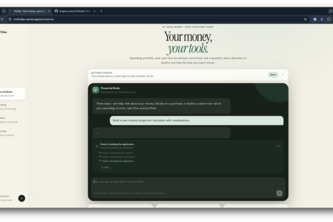
The description states that FinDex is an "AI-native personal finance tool, that's truly personalised" with a core feature called "Brain."
- The description states: "FinDex is a personal finance app built around a feature called Brain. It’s basically your own financial developer."
- The description states: "You don't get a fixed dashboard; you get a unified view of your spending, portfolio, and cash flow. From there, you can just ask the Brain to build what you need."
- The description states: "If you want a specific chart comparing your coffee spending to your dividend payouts, Brain writes the code, builds the UI widget, and saves it to your 'My tools' library so you can use it whenever."
The product is described as an app that connects financial data from multiple accounts (spending, portfolio, cash flow) and allows users to ask for specific financial visualizations or analyses through natural language prompts.
Positioning & Claim Evolution
The author makes several positioning claims about FinDex:
- The description states: "Finance is deeply personal, but personal finance apps aren't. Every budgeting app I've tried forces you into their specific way of thinking about money."
- The description states: "I wanted to build something where the user doesn't have to adjust to the tool, the tool adjusts to the user."
- The description states: "FinDex was built to solve both of these problems: keeping all your financial data under one roof, and letting AI build the perfect interface for you to interact with it."
The positioning appears to be that FinDex is a personalized alternative to traditional fixed-dashboard budgeting apps. It positions itself as an AI-powered tool that adapts to user needs rather than forcing users into predetermined workflows.
Target Customer & ICP
The description does not provide explicit information about target customer segments or ideal customer profiles.
- The description states: "Finance is deeply personal, but personal finance apps aren't."
- The description states: "I wanted to build something where the user doesn't have to adjust to the tool, the tool adjusts to the user."
The author implies a general personal finance user base who finds existing tools inflexible. However, no specific customer personas or segments are identified.
Business Model & Pricing Evidence
There is no evidence in the description about business model or pricing structure.
- The description states: "Right now, the demo runs on a synthetic, hardcoded ledger so people can test it without giving me their bank logins."
- The description states: "After that, I need to build out real authentication and user profiles so I can launch this and let people start building their own financial tools."
The author mentions future plans for authentication and user profiles but provides no information about monetization or pricing.
Technical & Delivery Signals
The project is described as built using several technologies:
- The description states: "I built this entire project using OpenAI Codex as my co-developer, running GPT-5.6 Sol on Extra High effort."
- The description states: "I used plan mode to design the architecture... and then Codex helped me grind through the implementation to ship a working Next.js app fast."
- The description states: "I built a custom routing engine for GPT-5.6. Simple questions or straightforward tool builds get routed to Terra because it's fast. But complex planning, independent code reviews, or if a build fails and needs fixing, that gets automatically bumped up to Sol."
The technical approach involves:
- AI-assisted development using Codex and GPT-5.6
- Custom routing engine for managing different AI models based on complexity
- Draft-first approach for performance optimization
- Secure iframe sandboxing for code execution
Traction & Maturity Signals
There is no evidence of traction or maturity beyond the hackathon submission.
- The description states: "Right now, the demo runs on a synthetic, hardcoded ledger so people can test it without giving me their bank logins."
- The description states: "This project was submitted to the OpenAI 2026 hackathon on Devpost."
The author mentions future development steps but provides no evidence of user adoption, revenue, or market traction.
Competitive Context
The description does not provide information about competitive landscape or existing alternatives.
- The description states: "Every budgeting app I've tried forces you into their specific way of thinking about money."
- The description states: "Finance is deeply personal, but personal finance apps aren't."
No mention of specific competitors or market positioning relative to existing financial tools.
Open Questions & Risks
Several potential risks and open questions are evident from the self-reported description:
- The description states: "Right now, the demo runs on a synthetic, hardcoded ledger so people can test it without giving me their bank logins."
- The description states: "I couldn't just eval() arbitrary generated code in the browser with access to local storage. I had to build a CSP-locked opaque iframe and a strict capability broker..."
- The description states: "The hardest part was making the Brain feel fast while keeping it secure."
Key risks include:
- Security concerns around dynamically generated code execution
- Performance challenges with AI-generated UI components
- Lack of real user data or market validation
- Dependency on proprietary AI tools (Codex, GPT-5.6) that may not be available long-term
- Single-person development team
Questions the description leaves open
- What specific financial data sources will be integrated with real banking APIs?
- How will user authentication and data security be handled at scale?
- What is the current progress toward connecting to real financial institutions?
- How does the AI routing system handle edge cases or failures in code generation?
- What are the actual costs of running this system at scale?
- How do you plan to monetize this product beyond the initial demo?
- What specific user feedback has been gathered from testing with real users?
Overall Assessment
Not evidenced.
The description provides no information about:
- Revenue or financial performance
- Customer base or user adoption
- Market size or competitive positioning
- Financial projections or business model viability
- Team experience or track record
This is a self-reported hackathon project with no evidence of commercial traction, customer validation, or market demand. The author's claims about AI-assisted development and personalized finance tools are unverified and lack supporting data. The project appears to be in early development stage with no demonstrated product-market fit or business model.
User Stories BotA demo video on every pull request
Get a demo video on every new feature
GitHub App that watches your pull requests and records a narrated, captioned demo.
Save time on demo prep and make informed decisions faster with a video walkthrough of every new feature.
Source
Submitted to the OpenAI 2026 hackathon on Devpost. Project home on Devpost. Back to the full gallery on Devpost.
This competitive analysis was produced by top-founders.com (opens in a new tab)
Generated by a language model from this project's public Devpost page — its tagline, the author's own write-up and any built-with tags listed there — as captured in August 2026. Short quotations are the author's words. It is an opinion on the idea as a business, not on the people behind it, and it reflects the description as published then. If the project has moved on, request a correction below. The analysis is not independent research and contains no verified traction, revenue or customer data.
An independent guide by KFG International LLC — not affiliated with, endorsed by, or connected to Devpost or OpenAI.