

Archive position — measured, not model output
0 likes on Devpost
2,263 of the 7,850 archived projects have more likes, and 5,587 share exactly 0 — so this project's #3,899 place in the like-ranked listing is a tie-break inside that group, not a ranking.
Projects (log scale)
Likes on Devpost. ▲ marks this project's group.
Show the figures
| Likes | Projects | Share of archive |
|---|---|---|
| 0 | 5,587 | 71.2% |
| 1 | 1,758 | 22.4% |
| 2 | 284 | 3.6% |
| 3–4 | 132 | 1.7% |
| 5–9 | 75 | 1.0% |
| 10+ | 14 | 0.2% |
 User Stories BotA demo video on every pull request
Get a demo video on every new feature
GitHub App that watches your pull requests and records a narrated, captioned demo.
Save time on demo prep and make informed decisions faster with a video walkthrough of every new feature.
Executive Summary
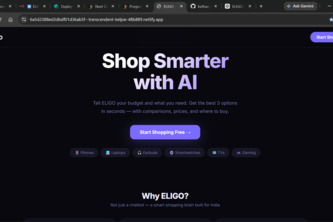
The company appears to be a single-person AI-powered shopping assistant project submitted as a hackathon entry. The author describes it as an AI chatbot that helps users make confident purchasing decisions through conversation, with features like persistent memory and personalized recommendations.
What changed
This is a self-reported, unverified project description from a hackathon submission. It does not indicate any commercial traction, revenue, or customer adoption.
The single most important open question
Is there evidence of any real-world usage, user feedback, or product-market fit beyond the author's own claims?
What The Product Actually Is
- The description states that ELIGO is an AI-powered shopping assistant.
- It functions as a personal shopping advisor rather than a search engine.
- It uses an AI chat interface with a custom chat experience.
- It includes persistent memory to store user preferences across sessions.
- It leverages GPT-5 through LangChain and n8n for its AI agent functionality.
- It delivers structured, easy-to-read recommendations based on conversation history.
- The system is built using JavaScript, natural language processing, and low-code/no-code tools.
Not evidenced No information about actual product delivery, user interface, or technical architecture beyond the author's self-description.
Positioning & Claim Evolution
- The author positions ELIGO as an AI-powered personal shopping advisor.
- It is described as helping users "buy the right product with confidence."
- The system aims to simplify online shopping by acting as a conversational assistant.
- It is positioned as more than just a search engine — it offers guidance and comparison.
Inference The author's positioning reflects an intent to create a conversational AI tool for consumer decision-making, but this has not been validated through real-world usage or feedback.
Target Customer & ICP
- The description states that ELIGO helps users "buy the right product with confidence."
- It is designed for individuals who spend time thinking about purchases and want better guidance.
- It targets consumers looking for personalized shopping advice in online environments.
Not evidenced No specific customer segments, personas, or market research are provided. The author does not describe how they would identify or reach their target audience.
Business Model & Pricing Evidence
- No business model is described.
- There is no mention of pricing, monetization strategy, or revenue streams.
- The project is presented as a hackathon submission with no indication of commercial viability.
Not evidenced No evidence of any pricing structure, subscription models, or sales channels.
Technical & Delivery Signals
- Built using GPT-5 via LangChain and n8n.
- Uses JavaScript and natural language processing tools.
- Includes persistent memory for user preferences.
- Implements auto preference saving and session context management.
- Designed with a chatbot interface and structured responses.
- The system is described as scalable through visual workflow tools like n8n.
Inference The technical stack suggests a prototype built quickly using AI-as-a-service platforms, but no evidence of production deployment or scalability beyond the MVP stage.
Traction & Maturity Signals
- The project was submitted to a hackathon (OpenAI 2026).
- It is described as a complete AI shopping assistant built during the event.
- The author mentions accomplishments such as implementing persistent memory and automated preference learning.
- No evidence of user adoption, retention, or usage metrics.
Not evidenced No data on users, engagement, or product performance beyond the hackathon timeline.
Competitive Context
- Not evidenced: No mention of competitors or competitive landscape.
- The author does not reference existing AI shopping assistants or marketplace tools.
Absence of evidence is itself a finding.
Open Questions & Risks
- Single-person team (1 member) with no external validation or support.
- Entirely self-reported and unverified claims about functionality and performance.
- No evidence of real-world testing, user feedback, or product-market fit.
- The project is described as a hackathon MVP without indication of further development or commercialization plans.
- Technical limitations noted include API constraints for live product data integration.
Inference The lack of traction, revenue, or customer validation raises significant concerns about viability beyond the prototype phase.
Questions the description leaves open
- What specific problems are users facing that this tool solves?
- Have you tested ELIGO with real users? If so, what were their reactions?
- How do you plan to monetize or scale this product beyond a hackathon prototype?
- What is your roadmap for integrating live product data and expanding categories?
- Are there any existing partnerships or integrations with e-commerce platforms?
Overall Assessment
- Not evidenced: No financials, traction, or commercial readiness are provided.
- The project appears to be a hackathon prototype with no indication of market validation or business development.
- It lacks evidence of product-market fit, revenue, or customer base.
Confidence Level Very low. This is a self-reported idea with no external corroboration or demonstration of real-world utility.
User Stories BotA demo video on every pull request
Get a demo video on every new feature
GitHub App that watches your pull requests and records a narrated, captioned demo.
Save time on demo prep and make informed decisions faster with a video walkthrough of every new feature.
Source
Submitted to the OpenAI 2026 hackathon on Devpost. Project home on Devpost. Back to the full gallery on Devpost.
This competitive analysis was produced by top-founders.com (opens in a new tab)
Generated by a language model from this project's public Devpost page — its tagline, the author's own write-up and any built-with tags listed there — as captured in August 2026. Short quotations are the author's words. It is an opinion on the idea as a business, not on the people behind it, and it reflects the description as published then. If the project has moved on, request a correction below. The analysis is not independent research and contains no verified traction, revenue or customer data.
An independent guide by KFG International LLC — not affiliated with, endorsed by, or connected to Devpost or OpenAI.