

Archive position — measured, not model output
0 likes on Devpost
2,263 of the 7,850 archived projects have more likes, and 5,587 share exactly 0 — so this project's #3,885 place in the like-ranked listing is a tie-break inside that group, not a ranking.
Projects (log scale)
Likes on Devpost. ▲ marks this project's group.
Show the figures
| Likes | Projects | Share of archive |
|---|---|---|
| 0 | 5,587 | 71.2% |
| 1 | 1,758 | 22.4% |
| 2 | 284 | 3.6% |
| 3–4 | 132 | 1.7% |
| 5–9 | 75 | 1.0% |
| 10+ | 14 | 0.2% |
 User Stories BotA demo video on every pull request
Get a demo video on every new feature
GitHub App that watches your pull requests and records a narrated, captioned demo.
Save time on demo prep and make informed decisions faster with a video walkthrough of every new feature.
Executive Summary
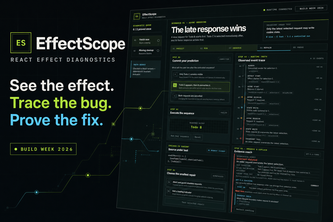
EffectScope is a self-reported educational tool for React developers that aims to teach debugging of invisible useEffect bugs by enabling learners to predict, observe, and repair real component behavior using GPT-5.6 coaching grounded in runtime traces. The project was built as part of the OpenAI 2026 hackathon and is described as a deterministic, trace-driven learning environment with interactive scenarios.
The description states that EffectScope uses React 19, TypeScript, Vite, and GPT-5.6 to create instrumented components that record events and allow learners to inspect runtime traces before and after repairs. It includes structured outputs from OpenAI and adversarial testing for robustness.
Key commercial due-diligence questions include:
- What is the actual product-market fit or demand?
- How does this differ from existing React learning resources?
- Is there a viable path to monetization or adoption beyond hackathon demonstration?
The single most important open question is: What is the intended user base and how would they pay for this?
What The Product Actually Is
The description states that EffectScope is a tool that:
- Asks learners to predict a controlled effect scenario before running it
- Uses real instrumented React components to record render, effect, cleanup, async, timer, and state events
- Provides deterministic evaluators to decide whether the scenario invariant passed
- Allows learners to inspect traces, choose repairs, and rerun interactions to prove fixes
- Incorporates GPT-5.6 for structured learning assessments, exact evidence IDs, hints, and transfer questions
The product is described as a React-based educational platform with:
- Scenario harnesses for Fetch Race and Missing Cleanup
- Immutable trace sessions and pure deterministic invariant evaluators
- Golden Trace Oracles for checking variants
- Serverless boundary using Vercel with request validation and fallbacks
- Testing with Vitest, Playwright E2E, and Testing Library
Positioning & Claim Evolution
The description states that EffectScope:
- Addresses the problem of React developers memorizing useEffect rules without forming reliable mental models
- Claims to make invisible bugs teachable by showing temporal gaps between cause and symptom
- Positions itself as an alternative to general chatbots that may confidently describe executions that never happened
- Describes its approach as using "trace-grounded GPT-5.6 coaching" where the runtime trace is the technical truth
The claim evolution appears to be:
- Problem: Developers don't understand React lifecycle mechanics
- Solution: Interactive, trace-driven learning with AI coaching
- Differentiation: Uses real execution traces rather than simulation or general chatbot responses
Target Customer & ICP
The description states that EffectScope targets:
- React developers who struggle with useEffect rules and mental models of render, cleanup, closure, timer, and request lifetimes
- Learners who want to understand temporal gaps between cause and symptom in React effects
No explicit customer segments or personas are described beyond "React developers". The product is positioned as an educational tool for learning React debugging.
Business Model & Pricing Evidence
Not evidenced. The description does not contain any information about pricing, revenue models, or monetization strategies.
Technical & Delivery Signals
The description states that EffectScope:
- Uses React 19, TypeScript, Vite
- Implements actual scenario harnesses for Fetch Race and Missing Cleanup
- Employs immutable trace sessions and pure deterministic invariant evaluators
- Uses OpenAI Responses API with gpt-5.6-terra and strict Zod Structured Outputs
- Has a Vercel serverless boundary with validation, rate limits, timeouts, and safe fallbacks
- Includes testing with Vitest, Testing Library, and Chromium Playwright E2E
- Incorporates adversarial tests for cancellation, Strict Mode, reentrancy, timer stalls, etc.
- Supports keyboard, screen-reader live status, reduced motion, and mobile (390 px)
Traction & Maturity Signals
Not evidenced. The description does not contain any information about users, customers, adoption, revenue, or traction beyond the hackathon submission.
Competitive Context
Not evidenced. The description does not contain any information about competitors, market positioning, or competitive landscape.
Open Questions & Risks
The description states:
- The project is a hackathon submission (OpenAI 2026)
- It uses GPT-5.6 which may not be available for production use
- No revenue, customer, or traction data is available beyond the author's account
- The product appears to be experimental and educational in nature
Key risks include:
- Lack of commercial viability beyond hackathon demonstration
- Dependency on proprietary AI models that may not be scalable
- Unclear path to monetization or user adoption
- Limited evidence of real-world demand or market need
Questions the description leaves open
- What is the intended target market for EffectScope beyond React developers?
- How does this differ from existing React learning resources and platforms?
- Is there a plan to monetize this educational tool, and if so, what is the business model?
- What are the technical challenges in scaling this beyond the current demo scenarios?
- How would you validate that learners actually improve their understanding of React effects?
- What is the long-term vision for EffectScope beyond the hackathon project?
- Are there any existing partnerships or distribution channels planned?
Overall Assessment
Not evidenced. The description does not contain any information about funding, valuation, or investment interest. The project appears to be a hackathon submission with no evidence of commercial traction or viability beyond its demonstration.
User Stories BotA demo video on every pull request
Get a demo video on every new feature
GitHub App that watches your pull requests and records a narrated, captioned demo.
Save time on demo prep and make informed decisions faster with a video walkthrough of every new feature.
Source
Submitted to the OpenAI 2026 hackathon on Devpost. Project home on Devpost. Back to the full gallery on Devpost.
This competitive analysis was produced by top-founders.com (opens in a new tab)
Generated by a language model from this project's public Devpost page — its tagline, the author's own write-up and any built-with tags listed there — as captured in August 2026. Short quotations are the author's words. It is an opinion on the idea as a business, not on the people behind it, and it reflects the description as published then. If the project has moved on, request a correction below. The analysis is not independent research and contains no verified traction, revenue or customer data.
An independent guide by KFG International LLC — not affiliated with, endorsed by, or connected to Devpost or OpenAI.