

Archive position — measured, not model output
0 likes on Devpost
2,263 of the 7,850 archived projects have more likes, and 5,587 share exactly 0 — so this project's #3,827 place in the like-ranked listing is a tie-break inside that group, not a ranking.
Projects (log scale)
Likes on Devpost. ▲ marks this project's group.
Show the figures
| Likes | Projects | Share of archive |
|---|---|---|
| 0 | 5,587 | 71.2% |
| 1 | 1,758 | 22.4% |
| 2 | 284 | 3.6% |
| 3–4 | 132 | 1.7% |
| 5–9 | 75 | 1.0% |
| 10+ | 14 | 0.2% |
 User Stories BotA demo video on every pull request
Get a demo video on every new feature
GitHub App that watches your pull requests and records a narrated, captioned demo.
Save time on demo prep and make informed decisions faster with a video walkthrough of every new feature.
Executive Summary
What the company appears to be
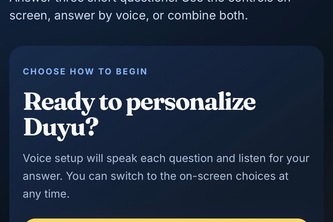
Duyu is an ontology-based accessibility app built as a progressive web app (PWA), designed to adapt to any disability. It allows users to interact via voice or text, builds a personal knowledge graph from their interactions, and uses this context to improve understanding over time. The system proposes facts as part of a private personal ontology, which can be reviewed or discarded before being saved.
What changed
The project is self-reported as a prototype built for the OpenAI 2026 hackathon. It represents a personal vision of building an accessible companion that learns only what users choose to share and remembers it with their permission. The author describes Duyu as an experiment in designing for disability through semantic knowledge graphs, using AI tools like GPT-5.6 and technologies such as React, TypeScript, and Tesseract.js.
The single most important open question
Is there evidence of user testing or feedback from people with disabilities beyond the author’s own experience? The description lacks any mention of actual users, trials, or adoption — only claims about intent and design principles.
What The Product Actually Is
- The description states that Duyu is an ontology-based accessibility app.
- It is built as a progressive web app (PWA) using React, TypeScript, Vite, Zustand, Zod, and Vercel serverless functions.
- It runs in mobile browsers and can be installed without an app store.
- It uses Web Speech API for voice input/output, with no additional cost for speech features.
- The core functionality involves building a personal knowledge graph, or ontology, from user interactions.
- This graph includes facts about people, preferences, locations, routines, medications, symptoms, goals, constraints, and relationships.
- It supports document recognition via Tesseract.js and integrates OpenStreetMap for nearby place searches.
- It uses GPT-5.6 configurations for different tasks: Terra for structured tasks, OpenAI Agents SDK for conversation and retrieval, and higher reasoning for health pattern analysis.
- The app stores personal memory in the browser on the user’s device.
- It does not automatically send messages; drafts must be approved before sharing.
Note
The product is described as a prototype built for a hackathon. No revenue, customers, or live deployment are evidenced.
Positioning & Claim Evolution
- The description states that Duyu aims to be an accessible companion that learns what users choose to share and remembers it with their permission.
- It positions itself as an alternative to assistants that treat users as if it were the first time they interacted, instead building a connected understanding of disability, language, location, routines, health context, and trusted relationships.
- The app is described as built to adapt to any disability, not just one type.
- It emphasizes that nothing is silently added — all proposed facts must be confirmed by the user.
- Duyu uses a semantic foundation based on ETSI SAREF4EHAW and SAREF Core, with a private personal layer for user-specific data.
- The author frames this as a shift from flat profiles to living knowledge graphs.
- It is presented as a tool that helps people make sense of the world in ways that work best for them, rooted in the idea of "sense" (Duyu means "sense" in Turkish).
Inference The positioning reflects an attempt to address gaps in current AI accessibility tools by focusing on context-awareness and user control. However, this is a self-described intent, not validated traction.
Target Customer & ICP
- The description states that Duyu is built for people with various disabilities including blind or low vision, deaf or hard of hearing, mobility or dexterity issues, cognitive or learning differences, or other access needs.
- Users are not required to share a diagnosis.
- It is designed to support any disability, though it acknowledges that different types may require very different interactions.
- The author notes that even two people with the same disability might prefer different combinations of speech, text, captions, structure, and detail.
- The app targets individuals who want more independence and control over how they interact with digital tools.
Not evidenced No specific customer segments, personas, or user groups are defined beyond general categories of disability. There is no evidence of actual users or market segmentation.
Business Model & Pricing Evidence
- The description does not state any business model, pricing strategy, monetization plan, or revenue streams.
- It mentions that personal memory is stored locally in the browser and that some AI features use a server-side LLM API — but no cost structure is provided.
- There is no indication of subscription plans, usage fees, or paid tiers.
Not evidenced No evidence of how the product will generate value or revenue. The focus remains on design philosophy rather than commercial viability.
Technical & Delivery Signals
- Duyu is built as a progressive web app (PWA) using React, TypeScript, Vite, Zustand, Zod, and Vercel serverless functions.
- It uses the Web Speech API for voice input/output, with no external billing for speech services.
- The interface supports accessibility features such as semantic HTML, screen reader support, live status announcements, keyboard access, and reduced-motion support.
- It integrates Tesseract.js for document recognition and OpenStreetMap for nearby place searches.
- Uses GPT-5.6 configurations tailored to specific tasks (e.g., Terra for structured extraction, OpenAI Agents SDK for conversation).
- The app uses a two-layer ontology: static semantic backbone based on ETSI SAREF4EHAW and SAREF Core; dynamic personal layer.
- Grounding is controlled via strict schemas, validation rules, confidence thresholds, and human confirmation.
- Voice interactions have fallbacks (keyboard-accessible alternatives).
- The system avoids automatic message sending — drafts must be manually approved.
Inference Technical architecture appears thoughtful and aligned with accessibility standards. However, no production deployment or scalability data is provided.
Traction & Maturity Signals
- Duyu was built as a hackathon submission (OpenAI 2026) and has not yet launched publicly.
- No evidence of users, customers, or adoption is present in the description.
- There is no mention of funding rounds, headcount, partnerships, or product releases beyond the prototype.
- The author describes it as a personal project with limited team size (1 person).
Not evidenced No traction data, user metrics, or market validation are available. This is a conceptual and experimental prototype.
Competitive Context
- The description does not reference existing competitors directly.
- It implies that current AI assistants do not adequately support people with disabilities by treating them as flat profiles.
- It positions itself as an alternative to tools that fail to understand context across sessions or that assume diagnostic information without explicit user input.
- It leverages ontology-based knowledge representation, which is distinct from typical conversational AI models.
Inference Duyu may compete with general-purpose AI assistants and accessibility-focused apps, but no competitive landscape is described. The novelty lies in its use of semantic ontologies for personalization and context-awareness.
Open Questions & Risks
- Lack of user testing or feedback from people with disabilities: The description emphasizes collaboration with users but does not provide evidence of actual engagement.
- No commercial viability or monetization strategy: No indication of how the product will be monetized or scaled.
- Prototype nature: Built for a hackathon, not intended for production use.
- Single-founder development: With only one team member, there is limited capacity to iterate quickly or scale.
- Dependency on AI models and APIs: Reliance on GPT-5.6 and OpenAI services introduces potential risks related to availability, cost, and control.
- Ambiguity in technical implementation details: While the architecture is described, there’s no clarity around how scalability, performance, or data privacy are handled at scale.
Not evidenced No evidence of real-world testing, user feedback loops, or product-market fit. The project remains largely theoretical.
Questions the description leaves open
- Have you conducted any usability tests with people who have disabilities?
- What specific accessibility standards or frameworks were used in the design process?
- How do you plan to handle data privacy and compliance (e.g., GDPR, HIPAA)?
- Are there any plans for monetization or long-term sustainability beyond the prototype phase?
- What are the key assumptions about user behavior that underpin your approach?
- How will you ensure that the system remains trustworthy and non-invasive in real-world use?
- Do you have a roadmap for expanding support to more languages, regions, or domains (e.g., legal, medical)?
- How do you intend to validate the accuracy of the semantic grounding and inference logic?
Overall Assessment
- Self-reported, unverified: This is a prototype built by one person for a hackathon.
- No evidence of traction, revenue, or customer base.
- Design philosophy is strong, emphasizing user control, context-awareness, and accessibility.
- Technical architecture shows promise, especially in its use of semantic ontologies and progressive web app delivery.
- High risk due to lack of validation, scalability, and commercialization strategy.
Assessment Not ready for investment or partnership at this stage. The project demonstrates a compelling vision but lacks evidence of real-world impact, user engagement, or business viability. It may be suitable for early-stage incubation or pilot programs with targeted communities, but not as an immediate opportunity for funding or acquisition.
User Stories BotA demo video on every pull request
Get a demo video on every new feature
GitHub App that watches your pull requests and records a narrated, captioned demo.
Save time on demo prep and make informed decisions faster with a video walkthrough of every new feature.
Source
Submitted to the OpenAI 2026 hackathon on Devpost. Project home on Devpost. Back to the full gallery on Devpost.
This competitive analysis was produced by top-founders.com (opens in a new tab)
Generated by a language model from this project's public Devpost page — its tagline, the author's own write-up and any built-with tags listed there — as captured in August 2026. Short quotations are the author's words. It is an opinion on the idea as a business, not on the people behind it, and it reflects the description as published then. If the project has moved on, request a correction below. The analysis is not independent research and contains no verified traction, revenue or customer data.
An independent guide by KFG International LLC — not affiliated with, endorsed by, or connected to Devpost or OpenAI.