

Archive position — measured, not model output
0 likes on Devpost
2,263 of the 7,850 archived projects have more likes, and 5,587 share exactly 0 — so this project's #3,618 place in the like-ranked listing is a tie-break inside that group, not a ranking.
Projects (log scale)
Likes on Devpost. ▲ marks this project's group.
Show the figures
| Likes | Projects | Share of archive |
|---|---|---|
| 0 | 5,587 | 71.2% |
| 1 | 1,758 | 22.4% |
| 2 | 284 | 3.6% |
| 3–4 | 132 | 1.7% |
| 5–9 | 75 | 1.0% |
| 10+ | 14 | 0.2% |
 User Stories BotA demo video on every pull request
Get a demo video on every new feature
GitHub App that watches your pull requests and records a narrated, captioned demo.
Save time on demo prep and make informed decisions faster with a video walkthrough of every new feature.
Executive Summary
What the company appears to be
Agent Da Vinci is a self-reported AI copilot for tribology engineering, built as a Python application with a web-based workbench. It claims to help engineers move from natural-language tribology problems to cited research, validated inputs, numerical computation, interactive results, and repeatable reports.
What changed
The project was submitted to the OpenAI 2026 hackathon on Devpost. No evidence of prior development or commercial activity is provided beyond this submission.
Single most important open question
Is Agent Da Vinci a working prototype or a conceptual demonstration? The description states it integrates tools like TriboSolver and uses Codex for development, but there is no evidence of actual deployment, usage, or performance data.
What The Product Actually Is
The description states that Agent Da Vinci is an AI copilot for tribology engineering. It claims to:
- Answer tribology questions using retrieval-augmented generation (RAG) and cited sources.
- Distinguish between knowledge questions, engineering calculations, and simulation requests.
- Perform numerical and analytical simulations using various tools.
- Prepare editable simulation inputs while exposing assumptions.
- Monitor solver jobs and summarize results.
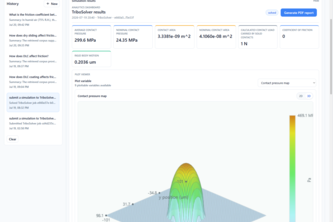
- Generate plots from large numerical result fields on demand.
- Produce downloadable PDF reports containing inputs, assumptions, and results.
- Present the entire workflow through an integrated conversational interface.
It is described as a Python application with a web-based engineering workbench. The system uses Codex and GPT-5.x/5.6 for reasoning and response synthesis, and integrates TriboSolver via API.
Evidence
- The author states that Agent Da Vinci combines conversational AI with trusted tribology knowledge and deterministic engineering tools.
- It is built using Codex, openalex, and tribosolver.
- The system handles intent, orchestration, and explanation through LLMs, while numerical results come from dedicated calculators and solvers.
Inference It appears to be a prototype or proof-of-concept for an agentic engineering tool that integrates AI with domain-specific simulation tools.
Positioning & Claim Evolution
The description states that Agent Da Vinci is designed to bring together fragmented tribology engineering steps—searching literature, selecting models, estimating material properties, configuring solvers, interpreting results, and documenting decisions—into a single conversational interface.
It positions itself as an AI copilot that helps engineers move from informal problem descriptions to traceable analysis.
Evidence
- The project is inspired by Leonardo da Vinci’s early work in tribology.
- It aims to combine accessibility of conversational AI with trusted tribology knowledge and deterministic engineering tools.
- The system is described as more than a chatbot—it is a working agentic engineering system.
Inference The positioning is that Agent Da Vinci is an intelligent assistant for engineers who need to solve tribology problems, not just answer questions. It emphasizes traceability, tool integration, and user control over assumptions.
Target Customer & ICP
The description states that the target users are engineers and researchers working in tribology—those who must navigate complex literature, models, and simulations to solve friction, lubrication, and wear problems.
It also mentions that the system is designed for both specialists and engineers new to the field.
Evidence
- The system is built for tribology engineering.
- It targets engineers who need to perform simulations and interpret results.
- The interface is described as making every step inspectable and user-friendly.
Inference The ICP appears to be engineers or researchers in mechanical, materials, or manufacturing engineering who work with tribology problems. The system may also appeal to newcomers seeking a guided experience.
Business Model & Pricing Evidence
Not evidenced.
Evidence
- No mention of pricing, licensing, or monetization strategy.
- No indication of whether the tool is open-source, freemium, or paid.
- No evidence of revenue streams or customer acquisition plans.
Technical & Delivery Signals
The system is described as a Python application with a web-based engineering workbench. It uses Codex for development and integrates TriboSolver via API.
Key technical elements include:
- Retrieval-augmented generation (RAG) pipeline using OpenAlex.
- Intent-routing and tool-selection layer.
- Input normalization, validation, and job monitoring.
- Deferred plot loading to maintain interface responsiveness.
- Integration of solver results with editable inputs and assumptions.
Evidence
- Built with Codex, GPT-5.x/5.6, and TriboSolver.
- Uses APIs for integration with external tools.
- Implements job states, scalar summaries, and error reporting.
- Designed with safety-critical workflow boundaries in mind.
Inference The system is built with engineering rigor in mind, emphasizing traceability and validation of numerical results. It appears to be a prototype or early-stage product, not a production-ready tool.
Traction & Maturity Signals
Not evidenced.
Evidence
- The project was submitted to the OpenAI 2026 hackathon.
- No evidence of users, customers, or adoption.
- No mention of performance metrics, usage data, or feedback from users.
- No indication of whether it has been deployed or tested beyond the hackathon.
Competitive Context
Not evidenced.
Evidence
- No mention of competitors or market landscape.
- No comparison to existing tribology tools or AI assistants in engineering domains.
Open Questions & Risks
- Unverified claims: The description is self-reported and unverified. There is no evidence of actual deployment, usage, or performance.
- Prototype vs. product: The system appears to be a hackathon submission, not a mature product.
- Limited scope: No evidence of integration with other tools beyond TriboSolver.
- No commercialization path: No pricing, monetization, or customer strategy is described.
- Dependency on external tools: Reliance on TriboSolver and Codex may limit scalability or control.
Questions the description leaves open
- What is the current status of Agent Da Vinci? Is it a prototype, demo, or deployed product?
- How does it handle numerical accuracy and validation in simulations?
- Has it been tested with real users or engineers in tribology?
- What are the plans for monetization or commercial deployment?
- Are there any known limitations or edge cases in its current implementation?
- How does it manage data privacy and security, especially when handling engineering inputs?
Overall Assessment
Not evidenced.
Evidence
- No financials, traction, or market validation provided.
- The project is described as a hackathon submission with no indication of commercial viability or scalability.
Inference Given the lack of evidence for traction, revenue, or customer data, and the self-reported nature of the description, there is insufficient basis to assess investment or partnership potential. It appears to be a proof-of-concept or early-stage prototype.
User Stories BotA demo video on every pull request
Get a demo video on every new feature
GitHub App that watches your pull requests and records a narrated, captioned demo.
Save time on demo prep and make informed decisions faster with a video walkthrough of every new feature.
Source
Submitted to the OpenAI 2026 hackathon on Devpost. Project home on Devpost. Back to the full gallery on Devpost.
This competitive analysis was produced by top-founders.com (opens in a new tab)
Generated by a language model from this project's public Devpost page — its tagline, the author's own write-up and any built-with tags listed there — as captured in August 2026. Short quotations are the author's words. It is an opinion on the idea as a business, not on the people behind it, and it reflects the description as published then. If the project has moved on, request a correction below. The analysis is not independent research and contains no verified traction, revenue or customer data.
An independent guide by KFG International LLC — not affiliated with, endorsed by, or connected to Devpost or OpenAI.