

Archive position — measured, not model output
0 likes on Devpost
2,263 of the 7,850 archived projects have more likes, and 5,587 share exactly 0 — so this project's #3,547 place in the like-ranked listing is a tie-break inside that group, not a ranking.
Projects (log scale)
Likes on Devpost. ▲ marks this project's group.
Show the figures
| Likes | Projects | Share of archive |
|---|---|---|
| 0 | 5,587 | 71.2% |
| 1 | 1,758 | 22.4% |
| 2 | 284 | 3.6% |
| 3–4 | 132 | 1.7% |
| 5–9 | 75 | 1.0% |
| 10+ | 14 | 0.2% |
 User Stories BotA demo video on every pull request
Get a demo video on every new feature
GitHub App that watches your pull requests and records a narrated, captioned demo.
Save time on demo prep and make informed decisions faster with a video walkthrough of every new feature.
Executive Summary
What the company appears to be
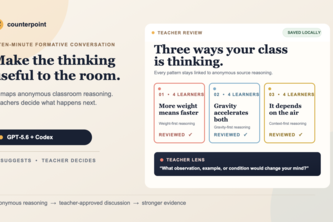
Counterpoint is a self-reported educational tool designed to help teachers turn anonymous student reasoning into structured peer discussions. The product is described as a teacher-controlled platform that uses GPT-5.6 to propose structured viewpoints from student responses, while maintaining traceability and allowing human review before any content reaches students.
What changed
The project was submitted to the OpenAI 2026 hackathon, indicating it is an early-stage prototype or proof-of-concept. It does not appear to have launched commercially or gained traction beyond its submission context.
Single most important open question
Is there evidence of real-world usage or pilot testing with teachers, and how does the described workflow actually function in practice?
What The Product Actually Is
The description states that Counterpoint is a React and TypeScript web experience built using Codex and GPT-5.6. It allows teachers to paste anonymous student responses, review them, and generate a source-linked reasoning map. The system proposes viewpoints via AI, but these must pass schema and traceability checks before being included in the teacher review process.
It supports:
- Anonymous intake of student responses
- Teacher-controlled approval or rejection of AI-generated viewpoints
- Deterministic fallback logic when AI is unavailable
- Mixed-reasoning discussion groups
- Student evidence cards with timed prompts
- Exit tickets and formative impact summaries
The product is described as a teacher orchestration tool, not an AI-driven instruction platform.
Evidence
- Built with React, TypeScript, Node.js, Vercel, and GPT-5.6
- Uses Codex for component implementation and structured AI integration
- Integrates GPT-5.6 for proposing viewpoints
- Includes safeguards like schema validation and fallbacks
Inference The product appears to be a web-based interface that processes student input through an AI layer, then allows teachers to curate and approve outputs before use in classroom settings.
Positioning & Claim Evolution
The description states that Counterpoint is not an “AI teaches the class” product, but rather a teacher-controlled orchestration tool. It emphasizes:
- Teachers control every decision
- AI output must be reviewed and approved
- Student privacy is preserved
- Reasoning maps are traceable back to original responses
- The system avoids labeling students as right or wrong
It also positions itself as a way to make human thinking easier to notice, discuss, and improve, rather than automating instruction.
Evidence
- “Counterpoint is not an ‘AI teaches the class’ product”
- “Every important safeguard is visible in the interface”
- “Teachers can edit, approve, or reject AI suggestions”
- “Impact is framed as formative reflection, not a grade or causal claim”
Inference The positioning reflects a shift away from traditional AI-assisted learning tools toward a more human-in-the-loop model, emphasizing control and transparency.
Target Customer & ICP
The description identifies the primary user as teachers, specifically those who are looking to:
- Process large volumes of student responses
- Identify meaningful patterns in anonymous reasoning
- Facilitate peer discussions based on student thinking
It does not specify a particular grade level or subject area, but implies a focus on classroom environments where student reasoning is collected and analyzed.
Evidence
- “Teachers often receive a wall of student responses…”
- “Counterpoint turns anonymous reasoning into teacher-approved, evidence-rich peer discussions”
- “We built Counterpoint to make that moment useful”
Inference The target customer is likely K–12 educators, possibly in STEM or social studies contexts where reasoning and argumentation are central.
Business Model & Pricing Evidence
No information is provided about pricing, revenue models, or monetization strategies. The project is described as a hackathon submission with no indication of commercial viability or business structure.
Evidence
- No mention of pricing, subscriptions, or sales channels
- No indication of how the product would be sold or used beyond classroom settings
Inference If this is intended to become a commercial product, it likely has no defined model yet. The lack of traction data suggests no revenue streams exist.
Technical & Delivery Signals
The project is built using:
- Frontend: React, TypeScript, HTML5, CSS3, Vite
- Backend/Infrastructure: Node.js, Vercel
- AI Integration: GPT-5.6, OpenAI API, Codex
- Data Handling: Structured input/output with schema validation and traceability checks
It includes features such as:
- Deterministic fallback logic
- Secure handling of anonymous data
- Teacher state persistence across refreshes
- Validation paths for AI outputs
Evidence
- “We built Counterpoint as a React and TypeScript web experience”
- “GPT-5.6 is used to propose structured, source-linked reasoning viewpoints”
- “If the AI route is unavailable or returns an invalid result, Counterpoint visibly switches to a deterministic local draft instead of silently failing”
Inference The technical stack suggests a modern, scalable web application with strong emphasis on data integrity and user experience design.
Traction & Maturity Signals
There is no evidence of:
- Revenue
- Customers or users
- Product adoption
- Market traction
- Any form of pilot testing or real-world deployment
The project is described as a hackathon submission, with no mention of post-submission activity or development progress.
Evidence
- Submitted to the OpenAI 2026 hackathon
- No mention of usage, feedback, or iteration beyond the demo
Inference This is an early-stage prototype. There are no signs of product-market fit or commercial maturity.
Competitive Context
The description does not reference existing competitors or similar tools in the edtech space. It does not describe how Counterpoint compares to other platforms for analyzing student reasoning or facilitating peer discussion.
Evidence
- No mention of competing products or market positioning
- No indication of differentiation from other AI-assisted educational tools
Inference Without competitive data, it is unclear whether this addresses a unique gap in the market or replicates existing functionality.
Open Questions & Risks
- Unverified claims: All descriptions are self-reported and unverified.
- No real-world usage: No evidence of pilots, customers, or actual classroom use.
- Unclear scalability: The described workflow may not scale beyond a single teacher or small group.
- AI dependency risk: Reliance on GPT-5.6 raises concerns about availability and consistency.
- Lack of business model clarity: No indication of monetization or go-to-market strategy.
Evidence
- Submitted to a hackathon
- No revenue, customer, or traction data
- No mention of commercialization plans
Inference The risk of failure is high due to lack of real-world validation and unclear path to market.
Questions the description leaves open
- Has Counterpoint been tested with actual teachers in classrooms?
- What specific classroom workflows does it support, and how do they integrate into existing curricula?
- How are the AI-generated viewpoints validated or reviewed by teachers?
- What happens if GPT-5.6 fails or returns poor results—how is this handled in practice?
- Are there plans to expand beyond anonymous reasoning into other forms of student engagement?
- What are the technical limitations of the current prototype, and how would they be addressed at scale?
Overall Assessment
Not evidenced.
The project is described as a hackathon submission with no evidence of traction, revenue, or commercial viability. It lacks any indication of a functioning product, user base, or business model. While the concept may have potential, there is insufficient data to assess whether it represents a viable investment or partnership opportunity.
Confidence Level Low
Reasoning
The entire description is self-reported and unverified; no third-party validation or historical data exists.
User Stories BotA demo video on every pull request
Get a demo video on every new feature
GitHub App that watches your pull requests and records a narrated, captioned demo.
Save time on demo prep and make informed decisions faster with a video walkthrough of every new feature.
Source
Submitted to the OpenAI 2026 hackathon on Devpost. Project home on Devpost. Back to the full gallery on Devpost.
This competitive analysis was produced by top-founders.com (opens in a new tab)
Generated by a language model from this project's public Devpost page — its tagline, the author's own write-up and any built-with tags listed there — as captured in August 2026. Short quotations are the author's words. It is an opinion on the idea as a business, not on the people behind it, and it reflects the description as published then. If the project has moved on, request a correction below. The analysis is not independent research and contains no verified traction, revenue or customer data.
An independent guide by KFG International LLC — not affiliated with, endorsed by, or connected to Devpost or OpenAI.