

Archive position — measured, not model output
1 like on Devpost
505 of the 7,850 archived projects have more likes, and 1,758 share exactly 1 — so this project's #876 place in the like-ranked listing is a tie-break inside that group, not a ranking.
Projects (log scale)
Likes on Devpost. ▲ marks this project's group.
Show the figures
| Likes | Projects | Share of archive |
|---|---|---|
| 0 | 5,587 | 71.2% |
| 1 | 1,758 | 22.4% |
| 2 | 284 | 3.6% |
| 3–4 | 132 | 1.7% |
| 5–9 | 75 | 1.0% |
| 10+ | 14 | 0.2% |
 User Stories BotA demo video on every pull request
Get a demo video on every new feature
GitHub App that watches your pull requests and records a narrated, captioned demo.
Save time on demo prep and make informed decisions faster with a video walkthrough of every new feature.
Executive Summary
What the company appears to be
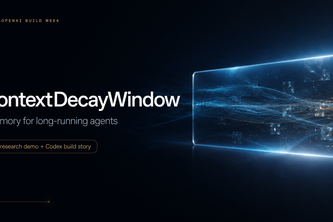
The project described as contextWindowDecay is an experimental memory architecture for long-running AI conversations. It is presented as a research prototype built by one individual (Muzaffer Ozen), focused on solving context decay in AI systems through bounded, selective memory management.
What changed
This is a self-reported research project submitted to the OpenAI 2026 hackathon. The description indicates it began as an exploration into how AI systems manage memory over long conversations and evolved into a reproducible 120-turn study with visual observability.
Single most important open question
Is there evidence of any commercial traction, revenue, or customer adoption beyond the author’s own demonstration?
What The Product Actually Is
The description states that contextWindowDecay is an experimental memory architecture for long-running AI conversations. It combines:
- similarity-based retrieval for relevant memories;
- time-decay retrieval for recent context;
- persistent rules stored outside ordinary episodic retrieval;
- topic tracking and consolidation;
- selective promotion from short-term to long-term memory; and
- a bounded prompt budget that prevents unlimited context growth.
It also includes a component called Memory Observatory, which is described as an interactive demonstration layer. This layer replays a real 120-turn research run, visualizing the context selected for each response, active topics, pinned rules, token usage, retrieval sources, consolidation events, and long-term-memory writes.
The system was tested using a locally hosted Qwen3.6 27B model, with structured telemetry recorded for every turn. The frontend is built in React and TypeScript, deployed via OpenAI Sites.
Inference This appears to be a technical proof-of-concept or research prototype rather than a commercial product. It has no evidence of being used in production or integrated into any existing AI assistant platform.
Positioning & Claim Evolution
The author positions contextWindowDecay as an approach to addressing the fundamental weakness in current AI systems: that more context does not always produce better memory. The core claim is that instead of replaying entire conversations, a bounded context window can contain only what matters now.
It evolves from a research idea into a reproducible 120-turn study with observability features. The project claims to have preserved facts across multiple topic shifts and achieved high recall rubric scores (12 out of 13), while selectively promoting some episodes to long-term memory.
Inference The positioning is academic or exploratory, not commercial. It does not indicate any intent to build a product for widespread use or integration into existing AI platforms.
Target Customer & ICP
Not evidenced.
The description does not identify specific target customers or personas. The project is framed as a research tool and demonstration, not a service for end-users or enterprise clients.
Business Model & Pricing Evidence
Not evidenced.
There is no mention of pricing models, monetization strategies, or business model assumptions in the provided description.
Technical & Delivery Signals
The system was built using:
- Cloudflare Workers
- Codex
- CUDA
- Embeddings
- GGUF
- Llama.cpp
- Next.js
- OpenAI Sites
- Pytest
- Python
- Qwen
- React
- TypeScript
- Vector search
- Vite
It includes a deterministic export pipeline, structured telemetry for each turn, and a public demo deployed through OpenAI Sites.
Inference The technical stack suggests this is a developer-oriented prototype built with modern tools. It shows some level of engineering sophistication but lacks evidence of scalability or deployment in production environments.
Traction & Maturity Signals
Not evidenced.
There is no evidence of revenue, customers, user adoption, or product-market fit beyond the author’s own demonstration and study results.
The project was submitted to a hackathon, indicating it is early-stage and experimental. The description mentions that the demo is deterministic and based on recorded artifacts, not fabricated data.
Competitive Context
Not evidenced.
There is no mention of competitors or competitive landscape in the provided description.
Open Questions & Risks
- No commercial traction: The project is described as a research prototype with no evidence of real-world usage.
- Single founder: The team size is listed as one, suggesting limited resources for scaling or development.
- Self-reported only: All claims are unverified and based solely on the author’s own account.
- Not a product yet: The description indicates this is an experimental architecture, not a ready-to-use tool or service.
Questions the description leaves open
- What specific use cases or applications do you envision for contextWindowDecay beyond research?
- Are there any plans to integrate this into existing AI assistants or platforms?
- How would you scale this system for real-time, high-volume interactions?
- Have you considered how to handle privacy and data governance in long-term memory systems?
- What are the key metrics you’d use to evaluate success if you were to commercialize this?
Overall Assessment
Not evidenced.
There is no evidence of any investment activity, partnership discussions, or commercial interest beyond the author’s own submission. The project appears to be a personal research effort with no signs of traction or market validation. It may represent an interesting technical direction but lacks indicators of readiness for investment or strategic partnership.
User Stories BotA demo video on every pull request
Get a demo video on every new feature
GitHub App that watches your pull requests and records a narrated, captioned demo.
Save time on demo prep and make informed decisions faster with a video walkthrough of every new feature.
Source
Submitted to the OpenAI 2026 hackathon on Devpost. Project home on Devpost. Back to the full gallery on Devpost.
This competitive analysis was produced by top-founders.com (opens in a new tab)
Generated by a language model from this project's public Devpost page — its tagline, the author's own write-up and any built-with tags listed there — as captured in August 2026. Short quotations are the author's words. It is an opinion on the idea as a business, not on the people behind it, and it reflects the description as published then. If the project has moved on, request a correction below. The analysis is not independent research and contains no verified traction, revenue or customer data.
An independent guide by KFG International LLC — not affiliated with, endorsed by, or connected to Devpost or OpenAI.