

Archive position — measured, not model output
1 like on Devpost
505 of the 7,850 archived projects have more likes, and 1,758 share exactly 1 — so this project's #865 place in the like-ranked listing is a tie-break inside that group, not a ranking.
Projects (log scale)
Likes on Devpost. ▲ marks this project's group.
Show the figures
| Likes | Projects | Share of archive |
|---|---|---|
| 0 | 5,587 | 71.2% |
| 1 | 1,758 | 22.4% |
| 2 | 284 | 3.6% |
| 3–4 | 132 | 1.7% |
| 5–9 | 75 | 1.0% |
| 10+ | 14 | 0.2% |
 User Stories BotA demo video on every pull request
Get a demo video on every new feature
GitHub App that watches your pull requests and records a narrated, captioned demo.
Save time on demo prep and make informed decisions faster with a video walkthrough of every new feature.
Executive Summary
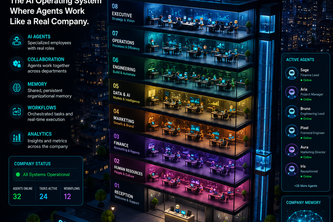
CompanyVerse is described by its author as an "Agentic Company OS" — a platform where specialized AI agents collaborate like employees in a real company, managing projects, documents, meetings, memory, and workflows from one virtual headquarters. The project was built as part of the OpenAI 2026 hackathon and is presented as an experimental operating system for AI-native organizational workflows.
The author states that CompanyVerse organizes AI agents into departments such as Engineering, Design, Documentation, QA, Operations, and Project Management, enabling them to share memory, coordinate tasks, and execute workflows together. It includes features like shared organizational memory, task orchestration, knowledge management, project management, multi-agent collaboration, secure corporate authentication, and a real-time company dashboard.
The platform is built using technologies including React, Node.js, PostgreSQL, TypeScript, Tailwind, Vite, OpenAI Codex, GPT-5.6, and others. The author claims the system supports persistent memory, autonomous workflows, cross-company collaboration, and enterprise deployment in future versions.
What changed: The project represents a shift from isolated AI assistants to multi-agent systems operating within a shared organizational structure. It is positioned as an experimental exploration of how AI might function inside a company-like framework rather than as individual tools.
Single most important open question: Is there evidence that the described system has been tested or validated with real users, or whether it can scale beyond a single developer's prototype?
What The Product Actually Is
The description states that CompanyVerse is an Agentic Company OS, where AI agents are organized into departments like Engineering, Design, Documentation, QA, Operations, and Project Management. These agents are said to collaborate by sharing organizational memory, coordinating tasks, managing projects, exchanging knowledge, and executing workflows inside a single workspace.
It includes features such as:
- Department-based AI agents
- Shared organizational memory
- Task orchestration
- Knowledge management
- Project management
- Multi-agent collaboration
- Secure corporate authentication
- Real-time company dashboard
The author notes that the current MVP combines a modern web interface with an agent orchestration architecture. It uses OpenAI Codex and GPT-5.6 during development for code generation, debugging, UI improvements, documentation, and architecture decisions.
Inference: The product appears to be a conceptual or prototype system designed to simulate a company-like structure using AI agents, rather than a fully functional commercial offering.
Positioning & Claim Evolution
The author positions CompanyVerse as an alternative to traditional chatbots or isolated AI tools. It is described as an operating system for AI agents, not just another assistant. The core claim is that the future of AI lies in teams of specialized agents working together with persistent memory, shared context, and organizational structure — rather than individual tools.
The author emphasizes:
- AI agents should operate like employees in a company
- Collaboration between agents must be seamless and integrated
- The system supports complex workflows and long-term project execution
Inference: This positioning suggests that CompanyVerse is attempting to reframe the role of AI from single-use tools into persistent, collaborative organizational units. However, this is a conceptual vision, not a demonstrated product.
Target Customer & ICP
The description does not clearly define target customers or ideal customer profiles (ICP). The author states that the long-term vision includes providing businesses with an AI-native operating system capable of managing complete organizational workflows.
There is no mention of specific industries, company sizes, or use cases beyond general business operations.
Inference: Based on the description alone, it's unclear who would use this product. It may be aimed at enterprise-level organizations looking to adopt AI-native workflows, but that is speculative without further evidence.
Business Model & Pricing Evidence
There is no information provided about pricing models, monetization strategies, or business models in the project description. The author focuses on technical architecture and conceptual design rather than commercial viability.
Inference: No evidence of a defined business model or pricing structure exists in the self-reported content.
Technical & Delivery Signals
The system is built using:
- Frontend: React, Tailwind, TypeScript, Vite
- Backend: Node.js, PostgreSQL
- AI/ML tools: OpenAI Codex, GPT-5.6
- Other technologies: CSS, systems, multi-agent, api, codex
It includes:
- Department-based AI agents
- Shared organizational memory
- Task orchestration
- Knowledge management
- Project management
- Multi-agent collaboration
- Secure corporate authentication
- Real-time company dashboard
The author mentions challenges such as coordinating multiple agents, designing shared memory, defining scalable communication, and building an interface representing an entire AI company.
Inference: The technical stack indicates a modern web application with backend DB integration and AI tooling. However, no evidence of production deployment or scalability beyond prototype level is presented.
Traction & Maturity Signals
The project was submitted to the OpenAI 2026 hackathon and is described as an MVP (minimum viable product). The author states that it includes features like task orchestration, knowledge management, and real-time dashboards. Future development plans include autonomous workflows, persistent memory, visual office interfaces, cross-company collaboration, enterprise deployment, third-party integrations, voice interaction, monitoring, and agent marketplace.
There is no evidence of:
- Revenue
- Customers
- Adoption metrics
- Product usage data
- Market traction
Inference: The project remains in early-stage development (MVP), with no indication of real-world testing or commercial adoption.
Competitive Context
The description does not mention any direct competitors. It is unclear whether similar systems already exist in the market, nor what competitive advantages or differentiation are claimed.
Inference: No evidence of competitive landscape or positioning against existing AI platforms or multi-agent systems is available.
Open Questions & Risks
- Unproven concept: The described system is largely theoretical and lacks real-world validation.
- Single developer team: Only one member (arnaldosalas-tech Salas) is listed, raising questions about scalability and execution capacity.
- No traction or revenue data: No evidence of users, customers, or monetization.
- Unclear commercial viability: The vision is ambitious but lacks a clear path to market or business model.
- Prototype-only status: The project is described as an MVP from a hackathon, not a mature product.
Questions the description leaves open
- What specific problems are you trying to solve with this system, and how do you know they exist?
- Have you tested the system with any real users or teams?
- How does CompanyVerse plan to scale beyond a single developer’s prototype?
- What is your roadmap for monetization and customer acquisition?
- Are there any existing tools or platforms that already attempt to replicate this functionality?
- How do you intend to handle agent coordination, task delegation, and error resolution in practice?
Overall Assessment
Not evidenced — There is no evidence of revenue, customers, traction, or financials to support an investment or partnership decision.
The project is described as a hackathon MVP with conceptual ambitions. While the idea of multi-agent AI collaboration is intriguing, there is no indication that it has moved beyond experimentation or proven commercial viability.
Confidence level: Low — based on self-reported evidence only, with no external validation or data points to assess product-market fit, scalability, or business potential.
User Stories BotA demo video on every pull request
Get a demo video on every new feature
GitHub App that watches your pull requests and records a narrated, captioned demo.
Save time on demo prep and make informed decisions faster with a video walkthrough of every new feature.
Source
Submitted to the OpenAI 2026 hackathon on Devpost. Project home on Devpost. Back to the full gallery on Devpost.
This competitive analysis was produced by top-founders.com (opens in a new tab)
Generated by a language model from this project's public Devpost page — its tagline, the author's own write-up and any built-with tags listed there — as captured in August 2026. Short quotations are the author's words. It is an opinion on the idea as a business, not on the people behind it, and it reflects the description as published then. If the project has moved on, request a correction below. The analysis is not independent research and contains no verified traction, revenue or customer data.
An independent guide by KFG International LLC — not affiliated with, endorsed by, or connected to Devpost or OpenAI.