

Archive position — measured, not model output
0 likes on Devpost
2,263 of the 7,850 archived projects have more likes, and 5,587 share exactly 0 — so this project's #3,437 place in the like-ranked listing is a tie-break inside that group, not a ranking.
Projects (log scale)
Likes on Devpost. ▲ marks this project's group.
Show the figures
| Likes | Projects | Share of archive |
|---|---|---|
| 0 | 5,587 | 71.2% |
| 1 | 1,758 | 22.4% |
| 2 | 284 | 3.6% |
| 3–4 | 132 | 1.7% |
| 5–9 | 75 | 1.0% |
| 10+ | 14 | 0.2% |
 User Stories BotA demo video on every pull request
Get a demo video on every new feature
GitHub App that watches your pull requests and records a narrated, captioned demo.
Save time on demo prep and make informed decisions faster with a video walkthrough of every new feature.
Executive Summary
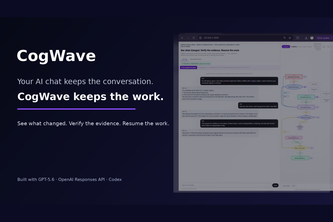
The company appears to be a solo project named CogWave, self-described as a "Cognitive Continuity Layer for AI Work". The author states that it was built during the OpenAI 2026 hackathon and is based on GPT-5.6, with a focus on preserving cognitive state across long AI conversations.
What changed: The project evolved from a research prototype into a functional system with structured-output contracts, live chat workflow, and end-to-end continuity loop (Live Chat → Cognitive Trajectory → Source Evidence → Cognitive Checkpoint → Resume Packet). It includes a dedicated GPT-5.6 Trajectory Extractor, deterministic sanitizer, and interactive SVG renderer.
Single most important open question: Is there any evidence of actual user adoption or commercial traction beyond the hackathon submission?
Analysis basis: This report is based entirely on the self-reported project description provided by the author — no external verification or historical data. All claims are stated by the author, not confirmed.
What The Product Actually Is
The description states that CogWave is a system designed to preserve the structure of long AI conversations rather than just message history. It turns live AI interactions into "evidence-linked cognitive trajectories" and compiles them into resumable work states.
Key components described:
- A GPT-5.6 Conversation Worker for collaboration during live chat
- A GPT-5.6 Trajectory Extractor that observes completed exchanges and maps cognitive advances across nine types (questions, observations, problems, insights, reframes, decisions, actions, emotion turns, memory anchors)
- A Deterministic Sanitizer to validate graph integrity before model output reaches the graph
- A Cognitive Checkpoint that compiles current work state into a resume packet
- An Interactive Renderer using SVG for visualizing trajectories
The system supports:
- Verbatim source anchors and expansion layers
- Turn-level attribution and semantic edge reasons
- Salience gate filtering non-advancing turns
- JSON export and bilingual display
Claim: The product is described as a "Cognitive Continuity Layer for AI Work" that preserves not just conclusions but the path, proof, and state of work.
Evidence: Described in detail by the author; no independent confirmation.
Positioning & Claim Evolution
The description states that CogWave addresses a "continuity problem" where long AI conversations lose structure over time. It positions itself as solving the issue of how complex, long-running tasks are handled when interfaces only preserve message history rather than the evolving work state.
It claims to:
- Preserve more than just conclusions
- Map meaningful cognitive advances
- Allow resumable work states with decisions, open branches, and next actions
The author also notes that this is not about summarization but about preserving how the work changed, why it changed, which evidence supported it, and what remains unresolved.
Claim: CogWave aims to be a "Cognitive Continuity Layer for AI Work" — a tool for managing complex AI-assisted workflows.
Evidence: Self-reported by the author; no external validation or market positioning data provided.
Target Customer & ICP
The description states that researchers, developers, and knowledge workers increasingly use AI for complex, long-running tasks. These users are described as needing tools that preserve the evolving structure of their work rather than just preserving conversation history.
Claim: The target customer is researchers, developers, and knowledge workers using AI for complex tasks.
Evidence: Stated by author; no specific segmentation or persona data provided.
Business Model & Pricing Evidence
Not evidenced. The description does not mention any pricing model, monetization strategy, or business model.
Claim: No evidence of business model or pricing.
Evidence: Not stated in the self-reported description.
Technical & Delivery Signals
The system uses:
- GPT-5.6 for multiple roles (Conversation Worker, Trajectory Extractor, Cognitive Checkpoint, Resume Packet)
- OpenAI Responses API
- Node.js backend with server-side API key handling
- Strict JSON Schema outputs
- Deterministic sanitizer for graph integrity
- Interactive SVG renderer
- Codex integration during development
The architecture separates conversation, observation, validation, visualization, and continuity compilation into distinct layers.
Claim: The system is built using GPT-5.6 with structured outputs, deterministic sanitization, and a layered architecture.
Evidence: Described in detail by the author; no independent technical review or deployment data provided.
Traction & Maturity Signals
Not evidenced. No data on users, customers, revenue, ARR, or adoption is provided beyond the fact that it was submitted to a hackathon.
Claim: No traction or maturity signals.
Evidence: Not stated in the self-reported description.
Competitive Context
Not evidenced. The description does not reference competitors or market positioning.
Claim: No competitive context.
Evidence: Not stated in the self-reported description.
Open Questions & Risks
- Solo team size (1 member) may limit scalability and execution capability
- No revenue, customer, or traction data — all claims are self-reported
- GPT-5.6 dependency — reliance on a single model version could be risky if not available or changed
- Hackathon submission — likely early-stage prototype with no commercial validation
- No evidence of real-world usage beyond demo or prototype
Inference: Given the solo team and hackathon context, there is a high risk that this remains an experimental idea without proven viability.
Evidence: Stated by author; no external confirmation.
Questions the description leaves open
- What specific use cases have you identified for CogWave beyond the prototype?
- Have you tested or validated the salience gate with real users?
- How do you plan to scale from a single developer to a product team?
- Are there any plans to monetize this tool, and if so, how?
- What are the technical limitations of GPT-5.6 that might affect long-term viability?
- Do you have any feedback or early adopters from the hackathon?
Inference: These questions aim to probe for evidence of traction, scalability, and commercial intent.
Evidence: Based on the self-reported description only.
Overall Assessment
Not evidenced. No information is provided regarding funding rounds, valuations, or investment interest.
Claim: No investment or partnership data available.
Evidence: Not stated in the self-reported description.
User Stories BotA demo video on every pull request
Get a demo video on every new feature
GitHub App that watches your pull requests and records a narrated, captioned demo.
Save time on demo prep and make informed decisions faster with a video walkthrough of every new feature.
Source
Submitted to the OpenAI 2026 hackathon on Devpost. Project home on Devpost. Back to the full gallery on Devpost.
This competitive analysis was produced by top-founders.com (opens in a new tab)
Generated by a language model from this project's public Devpost page — its tagline, the author's own write-up and any built-with tags listed there — as captured in August 2026. Short quotations are the author's words. It is an opinion on the idea as a business, not on the people behind it, and it reflects the description as published then. If the project has moved on, request a correction below. The analysis is not independent research and contains no verified traction, revenue or customer data.
An independent guide by KFG International LLC — not affiliated with, endorsed by, or connected to Devpost or OpenAI.