

Archive position — measured, not model output
5 likes on Devpost
54 of the 7,850 archived projects have more likes, and 35 share exactly 5 — so this project's #61 place in the like-ranked listing is a tie-break inside that group, not a ranking.
Projects (log scale)
Likes on Devpost. ▲ marks this project's group.
Show the figures
| Likes | Projects | Share of archive |
|---|---|---|
| 0 | 5,587 | 71.2% |
| 1 | 1,758 | 22.4% |
| 2 | 284 | 3.6% |
| 3–4 | 132 | 1.7% |
| 5–9 | 75 | 1.0% |
| 10+ | 14 | 0.2% |
 User Stories BotA demo video on every pull request
Get a demo video on every new feature
GitHub App that watches your pull requests and records a narrated, captioned demo.
Save time on demo prep and make informed decisions faster with a video walkthrough of every new feature.
Executive Summary
What the company appears to be
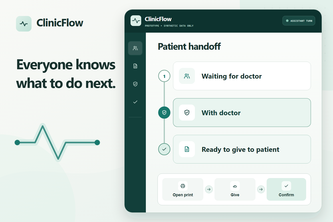
ClinicFlow is a self-reported hackathon project by one developer (Lucas Salvana) that aims to streamline clinic workflows for solo doctors and small clinic teams. It is described as a structured workflow tool managing patient intake, doctor visits, document handover, and follow-up scheduling.
What changed
The author states they built this in a hackathon context using AI tools like Codex and GPT-5.6, with a focus on simplicity, safety, and matching existing clinic practices rather than adding features.
Single most important open question
Is there any evidence of real-world usage or traction beyond the prototype? The description makes no claims about revenue, customers, or adoption — only that it's a working hackathon demo.
What The Product Actually Is
The description states that ClinicFlow is a workflow management tool for small clinics. It handles:
- Patient intake
- Doctor visits
- Approved document handover
- Follow-up scheduling
It is structured as a single workflow:
- Assistant intake → Waiting for doctor → With doctor → Doctor approval → Ready to give to patient → Confirmed handover → Follow-up
The system includes:
- A browser-based staff application that runs locally on one computer
- A separate PostgreSQL Foundation for server-controlled staff roles, clinic separation, persistent sessions, and conflict resolution
- The staff app uses HTML, CSS, JavaScript, Node.js; the Foundation uses Node.js and PostgreSQL
- It does not require public internet at runtime
It is described as a "working hackathon prototype", not a full EMR or clinical system.
Evidence Self-reported by author. No independent verification.
Positioning & Claim Evolution
The author states that ClinicFlow was built after speaking with doctors and assistants about how work moves through small clinics. The problem they identified was not a lack of software, but rather:
- Complicated screens
- Difficult training
- Concerns about sensitive information being placed online
- Another monthly subscription
They claim the tool is meant to make everyday clinic work simpler by:
- Keeping each visit, its documents, and follow-up in one clear flow
- Using reusable templates to reduce repetitive typing
- Making it easy to see what has already been done and what needs to happen next
- Reducing time spent searching for information and missed steps
The positioning is that ClinicFlow follows existing clinic workflows while keeping the doctor in control.
Evidence Self-reported. No external validation or customer testimonials.
Target Customer & ICP
The description states that ClinicFlow targets:
- Solo doctors
- Small clinic teams
- Staff who want something simple that follows their existing work patterns
It is designed for clinics where staff are concerned about:
- Complicated screens
- Difficult training
- Sensitive information being placed online
- Monthly subscriptions
The author notes that the tool runs locally on one computer and uses bundled assets, suggesting it's aimed at environments with limited internet access or privacy concerns.
Evidence Self-reported. No evidence of actual customer segmentation or targeting data.
Business Model & Pricing Evidence
There is no evidence provided about pricing, monetization, or business model in the description.
The author states that ClinicFlow is a "working hackathon prototype", not a full EMR or system approved for clinical use.
Evidence Not evidenced.
Technical & Delivery Signals
The project uses:
- Browser-based frontend with HTML, CSS, JavaScript
- Node.js backend
- PostgreSQL database
- Docker (for optional multi-user version)
- Codex and GPT-5.6 for development assistance
It includes:
- A local browser-based staff application
- A separate PostgreSQL Foundation for server-side safeguards
- Support for pausing visits without losing work
- Preservation of earlier approvals during corrections
- Handling of stale or conflicting actions through server/database authority
- Encrypted HTTPS with live updates (in optional version)
- Windows launcher for easier operation
The author mentions that the system was tested at four levels:
- Individual workflow rules
- Complete actions against PostgreSQL
- Safe client behavior when something fails
- Encrypted HTTPS with live updates
They also mention 300+ automated checks covering permissions, clinic separation, persistence, conflicting actions, privacy boundaries, and reliable refreshes.
Evidence Self-reported. No evidence of production deployment or scalability data.
Traction & Maturity Signals
The description states that ClinicFlow is a "working hackathon prototype", not a full EMR or system approved for clinical use.
It was submitted to the OpenAI 2026 hackathon on Devpost.
There is no evidence of:
- Revenue
- Customers
- Adoption
- Product-market fit
- Any form of traction beyond the prototype
Evidence Not evidenced.
Competitive Context
The description does not provide any information about competitors or market positioning.
It does not mention existing solutions in the clinic workflow space, nor does it describe how ClinicFlow compares to them.
Evidence Not evidenced.
Open Questions & Risks
- Prototype-only: The system is described as a hackathon prototype with no real-world usage.
- No revenue or customers: There is no evidence of any monetization or customer base.
- Single developer: Only one team member (Lucas Salvana) is mentioned.
- Unverified claims: All descriptions are self-reported and unverified.
- Limited scope: The tool is focused on a narrow use case within small clinics, which may limit scalability.
- No production deployment: No evidence of live systems or infrastructure beyond local testing.
Evidence Self-reported. No external validation or data to support any claims.
Questions the description leaves open
- What specific feedback did you receive from doctors and clinic staff during development?
- How many clinics have expressed interest in using this tool, if any?
- Are there plans for clinical validation or regulatory compliance?
- What are the key assumptions about workflow behavior that need testing in real clinics?
- Can you describe how the system would scale beyond a single local device?
- Have you considered integration with existing EMR systems or health IT infrastructure?
- What is your timeline for moving from prototype to production-ready software?
Inference These questions are based on the lack of evidence around traction, validation, and scalability in the description.
Overall Assessment
There is no evidence of any commercial traction, revenue, or customer base beyond a hackathon prototype. The project is described as a working demo with no indication of market readiness or business model.
The author states that ClinicFlow is a "working hackathon prototype", not a full EMR or system approved for clinical use.
Assessment Not evidenced. No basis to evaluate investment or partnership potential without further information on real-world usage, customer feedback, or commercial viability.
User Stories BotA demo video on every pull request
Get a demo video on every new feature
GitHub App that watches your pull requests and records a narrated, captioned demo.
Save time on demo prep and make informed decisions faster with a video walkthrough of every new feature.
Source
Submitted to the OpenAI 2026 hackathon on Devpost. Project home on Devpost. Back to the full gallery on Devpost.
This competitive analysis was produced by top-founders.com (opens in a new tab)
Generated by a language model from this project's public Devpost page — its tagline, the author's own write-up and any built-with tags listed there — as captured in August 2026. Short quotations are the author's words. It is an opinion on the idea as a business, not on the people behind it, and it reflects the description as published then. If the project has moved on, request a correction below. The analysis is not independent research and contains no verified traction, revenue or customer data.
An independent guide by KFG International LLC — not affiliated with, endorsed by, or connected to Devpost or OpenAI.