

Archive position — measured, not model output
1 like on Devpost
505 of the 7,850 archived projects have more likes, and 1,758 share exactly 1 — so this project's #793 place in the like-ranked listing is a tie-break inside that group, not a ranking.
Projects (log scale)
Likes on Devpost. ▲ marks this project's group.
Show the figures
| Likes | Projects | Share of archive |
|---|---|---|
| 0 | 5,587 | 71.2% |
| 1 | 1,758 | 22.4% |
| 2 | 284 | 3.6% |
| 3–4 | 132 | 1.7% |
| 5–9 | 75 | 1.0% |
| 10+ | 14 | 0.2% |
 User Stories BotA demo video on every pull request
Get a demo video on every new feature
GitHub App that watches your pull requests and records a narrated, captioned demo.
Save time on demo prep and make informed decisions faster with a video walkthrough of every new feature.
Executive Summary
What the company appears to be
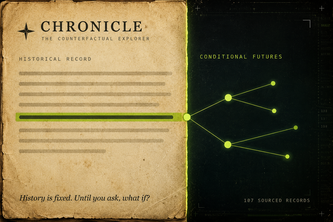
Chronicle is a self-reported tool that turns static historical articles into interactive causal models using AI. It allows users to modify key decisions in historical events and simulate plausible divergences, with structured confidence bounds and source citations.
What changed
The project description is a self-reported submission for the OpenAI 2026 hackathon. No evidence of prior traction, revenue or customers exists beyond the author’s claims.
Single most important open question
Is there any evidence that Chronicle has been used by anyone beyond its creator, or whether it functions as described in practice?
What The Product Actually Is
The description states that Chronicle:
- Turns static historical articles into interactive causal models.
- Includes over 100 pre-loaded, sourced historical records.
- Allows users to modify key decision points and evaluate edits (Historically Supported, Historically Plausible, Weak Historical Evidence, or Highly Speculative).
- Simulates consequences through a staged process involving validation, world-state reconstruction, causal propagation, and timeline construction.
- Provides confidence scores, evidence references, affected domains, and alternative outcomes for each node in the consequence graph.
- Offers divergence comparison between original and modified timelines.
Inference The product appears to be an experimental AI-powered tool aimed at exploring counterfactual history through interactive editing and simulation. It is built with Next.js, React, TypeScript, Tailwind CSS, and uses Codex and GPT-5.6 as core engines.
Not evidenced No information on actual usage, customer base, or real-world deployment.
Positioning & Claim Evolution
The description positions Chronicle as:
- A tool for exploring counterfactuals in history.
- Grounded in evidence and careful analysis.
- Designed to be "weirdly addictive" and interactive.
- Meant to make historical text more engaging by allowing users to change decisions and see outcomes.
Inference Chronicle aims to bridge the gap between traditional historical narratives and interactive exploration, using AI to simulate plausible alternate timelines while maintaining scholarly rigor.
Not evidenced No evidence of market positioning beyond a hackathon submission. No mention of target audience beyond general interest in history or education.
Target Customer & ICP
The description mentions:
- Classroom Mode as a future feature.
- Tools for educators to assign records and track student arguments.
- Potential use cases involving group analysis and structured evaluation.
Inference Chronicle may be targeting educators, students, researchers, and history enthusiasts who want to explore alternate historical scenarios.
Not evidenced No evidence of current users or actual adoption. No indication of whether the tool is being used in classrooms or by any specific segment.
Business Model & Pricing Evidence
The description does not contain:
- Any mention of pricing.
- Any indication of monetization strategy.
- Any reference to paid features, subscriptions, or commercial use.
Inference There is no evidence of a business model beyond the author’s own development efforts. The tool appears to be experimental and non-commercial at this stage.
Not evidenced No revenue streams, pricing plans, or monetization strategies are described.
Technical & Delivery Signals
The description states:
- Built with Next.js 16 (App Router), React 19, TypeScript, Tailwind CSS.
- Uses Codex and GPT-5.6 as reasoning engines.
- Features a server-authoritative API architecture.
- Implements safety pipelines including prompt isolation, authentication, rate limiting, and validation checks.
- Includes a custom streaming HTML parser for Wikipedia articles.
- Employs NDJSON streaming for consequence graph rendering.
Inference Chronicle is built on modern web stack with strong emphasis on security, reliability, and structured output from LLMs. It uses AI extensively but with strict controls to avoid speculative outputs.
Not evidenced No evidence of production deployment, scalability, or performance metrics.
Traction & Maturity Signals
The description states:
- The project was submitted to the OpenAI 2026 hackathon.
- It includes over 100 pre-loaded historical records.
- It has a live Wikipedia importer.
- It uses Codex for development and code review.
Inference This is an experimental prototype, likely developed in a short timeframe as part of a hackathon. There is no indication of ongoing user engagement or product maturity beyond the initial build.
Not evidenced No data on user adoption, retention, revenue, or long-term usage.
Competitive Context
The description does not mention:
- Direct competitors.
- Similar tools in the market.
- Any competitive differentiation strategy.
Inference Chronicle appears to be a novel concept within the space of interactive historical storytelling and AI-powered counterfactuals. However, no evidence exists of existing competition or market positioning.
Not evidenced No competitive landscape analysis is provided.
Open Questions & Risks
Key risks identified from the description:
- Unverified claims: All features are self-reported without external validation.
- Limited scope: Only one developer (Shaurya Bhushan) is listed, suggesting a small team or solo effort.
- No commercial traction: No evidence of revenue, customers, or product-market fit beyond internal development.
- Experimental nature: The tool is presented as a hackathon submission, implying it may not be production-ready.
- AI dependency: Heavy reliance on GPT-5.6 and Codex raises concerns about reproducibility, control, and scalability.
Not evidenced No risk mitigation strategies or plans for scaling are described.
Questions the description leaves open
- What is the actual source of the 100+ pre-loaded historical records? Are they curated or machine-generated?
- How does Chronicle ensure that its simulations remain grounded in evidence rather than speculative AI output?
- Has the tool been tested with real users, especially educators or historians?
- Is there any plan to monetize or commercialize this product beyond the hackathon?
- What are the technical limitations of the current system regarding scalability and performance?
- How does Chronicle handle edge cases in historical data, such as incomplete or conflicting sources?
Overall Assessment
Assessment Chronicle is an experimental AI-powered tool for exploring counterfactual history, built by a single developer as part of a hackathon submission. It shows technical sophistication and clear intent to ground speculative narratives in evidence.
Confidence Level Low — based on self-reported evidence only, with no external validation or traction data.
Recommendation
Not suitable for investment or partnership at this stage. The tool lacks commercial viability, user engagement, or measurable impact. It may be a promising concept for future development but is not yet ready for scaling or monetization.
User Stories BotA demo video on every pull request
Get a demo video on every new feature
GitHub App that watches your pull requests and records a narrated, captioned demo.
Save time on demo prep and make informed decisions faster with a video walkthrough of every new feature.
Source
Submitted to the OpenAI 2026 hackathon on Devpost. Project home on Devpost. Back to the full gallery on Devpost.
This competitive analysis was produced by top-founders.com (opens in a new tab)
Generated by a language model from this project's public Devpost page — its tagline, the author's own write-up and any built-with tags listed there — as captured in August 2026. Short quotations are the author's words. It is an opinion on the idea as a business, not on the people behind it, and it reflects the description as published then. If the project has moved on, request a correction below. The analysis is not independent research and contains no verified traction, revenue or customer data.
An independent guide by KFG International LLC — not affiliated with, endorsed by, or connected to Devpost or OpenAI.