

Archive position — measured, not model output
0 likes on Devpost
2,263 of the 7,850 archived projects have more likes, and 5,587 share exactly 0 — so this project's #3,199 place in the like-ranked listing is a tie-break inside that group, not a ranking.
Projects (log scale)
Likes on Devpost. ▲ marks this project's group.
Show the figures
| Likes | Projects | Share of archive |
|---|---|---|
| 0 | 5,587 | 71.2% |
| 1 | 1,758 | 22.4% |
| 2 | 284 | 3.6% |
| 3–4 | 132 | 1.7% |
| 5–9 | 75 | 1.0% |
| 10+ | 14 | 0.2% |
 User Stories BotA demo video on every pull request
Get a demo video on every new feature
GitHub App that watches your pull requests and records a narrated, captioned demo.
Save time on demo prep and make informed decisions faster with a video walkthrough of every new feature.
Executive Summary
What the company appears to be
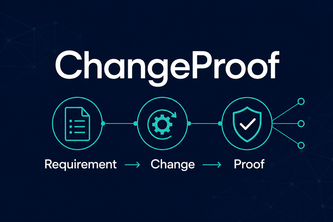
ChangeProof is a self-reported tool designed to automate and govern organizational responses to external regulatory or compliance requirements. It claims to convert an external obligation into a structured, traceable, and verifiable business change package using AI (specifically GPT-5.6) and deterministic workflows.
What changed
The project was submitted as part of the OpenAI 2026 hackathon. The description indicates it evolved from an initial prototype that relied on fixtures and global replacement to a more computed, span-targeted approach with traceability, rejection/revision workflows, and offline fallbacks.
Single most important open question
Is there evidence of real-world use or traction beyond the hackathon demo? The self-reported account does not indicate any customer base, revenue, or adoption outside of internal testing.
What The Product Actually Is
The description states that ChangeProof is a system that:
- Converts an external obligation (e.g., a regulatory change) into a cited, reviewable, and tested organizational change package.
- Extracts the exact source quote and computes affected workspace spans with evidence for every graph edge.
- Proposes coordinated changes across policies, procedures, controls, application logic, schedulers, interfaces, and tests.
- Allows reviewers to reject one impact with rationale, inspect revised plans, and approve only the reviewed snapshot.
- Applies approved packages in an isolated workspace, runs verification, and produces a hash-bound proof certificate containing citations, diffs, decisions, results, residuals, and exceptions.
- Uses GPT-5.6 for schema-constrained obligation extraction and redline drafting when an API key is configured.
- Includes deterministic offline fallback using synthetic data and no credentials.
Inference ChangeProof appears to be a compliance or change management tool that integrates AI for automation while maintaining auditability through traceability and versioning.
Positioning & Claim Evolution
The author states:
- ChangeProof began with a fictional lender responding to an RBI complaint-handling requirement changing from 30 days to 21 days.
- It was built as an evidence-backed change workflow, not a report or spreadsheet.
- The tool aims to turn external obligations into human-governed, verifiable organizational changes without pretending AI replaces legal judgment or accountable approval.
Inference Positioning has evolved from a hackathon prototype focused on compliance automation to a system emphasizing traceability, governance, and auditability of change processes. It is positioned as a tool for regulated industries or organizations requiring robust compliance workflows.
Target Customer & ICP
The description states:
- The initial use case was a fictional lender responding to an RBI requirement.
- It targets organizations needing to respond to external regulatory or compliance changes.
- The system supports “organizational change” and “business change packages.”
Inference The target customer is likely a regulated industry (e.g., financial services, healthcare) or enterprise with compliance obligations. The ICP appears to be internal compliance teams, legal departments, or change management units within large organizations.
Business Model & Pricing Evidence
Not evidenced.
Explanation
There is no mention of pricing, licensing, monetization strategy, or business model in the description.
Technical & Delivery Signals
The description states:
- Built with: aws-app-runner, codex, gpt-5.6, openai-responses-api, python, sqlite.
- Uses Python standard-library runtime components, SQLite, SHA-256 content bindings, strict JSON schemas, computed workspace scanner, and responsive reviewer UI.
- GPT-5.6 is integrated via the OpenAI Responses API.
- Repository has 61 passing tests.
- Optional private AWS deployment overlay.
- Full offline workflow runs without private infrastructure or package installation.
Inference The tool is built with a focus on portability, deterministic behavior, and auditability. It uses AI for automation but includes fallbacks to ensure reproducibility and traceability.
Traction & Maturity Signals
Not evidenced.
Explanation
There is no evidence of customers, revenue, usage metrics, or product adoption beyond the hackathon demo and internal testing.
Competitive Context
Not evidenced.
Explanation
The description does not mention competitors or market positioning relative to existing compliance or change management tools.
Open Questions & Risks
- The system is described as a hackathon project with no evidence of real-world deployment or adoption.
- It relies heavily on GPT-5.6, which may be costly and difficult to scale without clear pricing or infrastructure details.
- The description does not indicate whether the tool has been tested in production environments or with actual compliance teams.
- There is no mention of enterprise features, integrations, or scalability beyond a demo.
Inference The project is in early development. It lacks commercial traction and may face challenges in scaling or integrating into existing enterprise systems.
Questions the description leaves open
- What external requirements have been tested with this system? Has it been used in any real-world compliance scenarios?
- How does the tool handle edge cases where AI-generated changes conflict with human judgment or domain-specific knowledge?
- Are there plans to support other AI models or APIs beyond GPT-5.6?
- What is the roadmap for enterprise features, integrations, and scalability?
- Has the team considered cost implications of running this at scale in regulated environments?
Overall Assessment
Not evidenced.
Explanation
There is no evidence of funding, valuation, or investment interest. The project is described as a hackathon submission with no indication of commercial viability or traction beyond internal testing. It is not clear whether the founders are seeking investment or partnership opportunities.
User Stories BotA demo video on every pull request
Get a demo video on every new feature
GitHub App that watches your pull requests and records a narrated, captioned demo.
Save time on demo prep and make informed decisions faster with a video walkthrough of every new feature.
Source
Submitted to the OpenAI 2026 hackathon on Devpost. Project home on Devpost. Back to the full gallery on Devpost.
This competitive analysis was produced by top-founders.com (opens in a new tab)
Generated by a language model from this project's public Devpost page — its tagline, the author's own write-up and any built-with tags listed there — as captured in August 2026. Short quotations are the author's words. It is an opinion on the idea as a business, not on the people behind it, and it reflects the description as published then. If the project has moved on, request a correction below. The analysis is not independent research and contains no verified traction, revenue or customer data.
An independent guide by KFG International LLC — not affiliated with, endorsed by, or connected to Devpost or OpenAI.