

Archive position — measured, not model output
0 likes on Devpost
2,263 of the 7,850 archived projects have more likes, and 5,587 share exactly 0 — so this project's #3,168 place in the like-ranked listing is a tie-break inside that group, not a ranking.
Projects (log scale)
Likes on Devpost. ▲ marks this project's group.
Show the figures
| Likes | Projects | Share of archive |
|---|---|---|
| 0 | 5,587 | 71.2% |
| 1 | 1,758 | 22.4% |
| 2 | 284 | 3.6% |
| 3–4 | 132 | 1.7% |
| 5–9 | 75 | 1.0% |
| 10+ | 14 | 0.2% |
 User Stories BotA demo video on every pull request
Get a demo video on every new feature
GitHub App that watches your pull requests and records a narrated, captioned demo.
Save time on demo prep and make informed decisions faster with a video walkthrough of every new feature.
Executive Summary
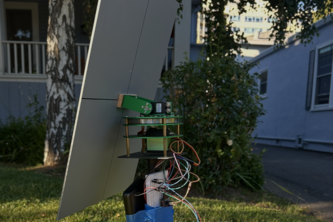
What the company appears to be: Casper the Heliostat is a self-reported physical prototype of an AI-guided heliostat — a two-axis motorized mirror system designed to redirect natural sunlight into dark indoor spaces. It uses solar tracking and computer vision, with an OpenAI-powered assistant for calibration and control.
What changed: The project description indicates development of a functional prototype, including hardware (ESP32, servo motors, PCA9685), firmware, web interface, and integration of AI for user guidance during setup and operation. It is presented as a solution to the problem of dark indoor spaces in homes, aiming to make heliostat systems accessible to homeowners without technical expertise.
Single most important open question: Is there evidence that this system has moved beyond a prototype into actual deployment or early customer use? The description states only that it is a "prototype" and does not indicate any commercial traction, revenue, or adoption.
What The Product Actually Is
The description states that Casper the Heliostat is:
- A two-axis motorized mirror system
- Controlled via a web interface
- Designed to track the sun and reflect light toward a fixed indoor target (window, wall)
- Uses ESP32-based hardware with servo motors and PCA9685 controller
- Incorporates solar-position tracking logic based on device location and time
- Includes over-the-air firmware updates and Wi-Fi connectivity
- Features an OpenAI-powered assistant for calibration and troubleshooting
It is described as a physical prototype, not a commercial product.
Evidence: The author states that it uses “ESP32 connected to two servo motors through a PCA9685 controller,” hosts a “local web interface,” and implements “solar-position tracking logic.” It also integrates “OpenAI-powered assistant.”
Inference: The system appears to be a proof-of-concept or early-stage prototype, not yet a scalable or commercial offering.
Positioning & Claim Evolution
The author positions Casper the Heliostat as:
- An affordable heliostat for homeowners
- A solution to the problem of dark indoor spaces
- A system that removes the need for understanding solar geometry or robotics
- A tool that makes installation and calibration simple through AI guidance
It is described as a way to bring “the warmth or quality of natural sunlight” indoors, without relying on artificial lighting.
Evidence: The author states: “I wanted to build an affordable heliostat that a normal homeowner could install and operate without needing to understand solar geometry, coordinate systems, or robotics.”
Inference: The positioning is focused on accessibility and ease-of-use for non-technical users. It does not indicate any market traction, pricing, or commercialization.
Target Customer & ICP
The description states that the target user is:
- A “normal homeowner”
- Someone who has dark indoor spaces due to shading
- Someone who wants natural sunlight in their home but lacks technical knowledge of solar tracking or robotics
It does not specify any细分 customer segments, personas, or market size.
Evidence: The author says: “I wanted to build an affordable heliostat that a normal homeowner could install and operate without needing to understand solar geometry…”
Inference: The ICP is likely a DIY or home improvement enthusiast with basic technical literacy but no engineering background. No evidence of segmentation, customer interviews, or market research.
Business Model & Pricing Evidence
There is no evidence in the description of:
- A pricing model
- Revenue streams
- Monetization strategy
- Commercial product offerings
- Customer acquisition plans
Evidence: The description only mentions a prototype and does not reference any sales, subscriptions, or commercialization efforts.
Inference: No business model or pricing data is evident. The project is described as a hackathon submission, not a commercial venture.
Technical & Delivery Signals
The author reports:
- Hardware: ESP32, servo motors, PCA9685 controller
- Firmware features: local web interface, Wi-Fi, OTA updates, mDNS discovery
- Software features: solar-position tracking logic, AI assistant for calibration
- Integration: OpenAI model for multimodal interaction (photos, natural language)
- Physical design: two-axis motorized mirror with potential for enclosure improvements
Evidence: The author states that the system “calculates how the sun moves throughout the day,” “uses photos and natural-language instructions to guide calibration,” and includes “a browser-based control interface.”
Inference: Technical delivery is at a prototype stage. No evidence of scalability, reliability in production, or integration with larger systems.
Traction & Maturity Signals
The description states:
- It is a functional prototype
- It includes features like saved positions, configuration storage, and Wi-Fi connectivity
- It was built for the OpenAI 2026 hackathon
- The team size is one person (Facundo Severi Licandro)
There is no evidence of:
- Customer adoption or usage
- Revenue or monetization
- Product-market fit
- Iteration beyond prototype
Evidence: The author says: “We built a functioning physical heliostat prototype,” and “This project was submitted to the OpenAI 2026 hackathon.”
Inference: No traction or maturity signals are evident. It is a one-person hackathon project, not a commercial product.
Competitive Context
The description does not mention:
- Competitors
- Market analysis
- Existing solutions in the heliostat or daylighting space
- Differentiation from other systems
Evidence: No references to competitors or market positioning beyond self-description.
Inference: The competitive context is unknown. There is no evidence of awareness of existing products or markets.
Open Questions & Risks
Key risks and open questions include:
- Prototype-only status: No evidence of commercial deployment or customer use
- Single-person team: Limited capacity for scaling or execution
- No revenue or monetization strategy: No indication of how the product will be sold or supported
- Unproven AI integration: The AI assistant is described as a feature, but no evidence of its performance or reliability in real-world settings
- Physical engineering challenges: The description notes difficulties with calibration and physical imperfections — suggesting potential for instability or failure in real-world use
Evidence: The author states: “The hardest problem was calibration,” and “small angular errors also create large targeting errors over distance.”
Inference: The project is at a very early stage. Risks are high due to lack of commercialization, team size, and scalability.
Questions the description leaves open
- What is the current status of the prototype? Is it being tested in real homes?
- Have you identified any specific market or customer segments beyond “homeowners”?
- How do you plan to scale beyond a single-person development effort?
- What are your plans for monetization, if any?
- How does the AI assistant perform in real-world calibration scenarios?
- Are there any physical or mechanical limitations that could prevent commercial deployment?
- Have you considered safety and regulatory issues related to redirecting sunlight into indoor spaces?
Overall Assessment
Not evidenced: No evidence of revenue, customers, traction, or commercial viability is present in the description.
Confidence level: Low — this is a self-reported hackathon prototype with no indication of market adoption or business development.
Assessment: This project is at an early stage and not yet a viable investment or partnership opportunity. It lacks evidence of product-market fit, scalability, or commercialization. It may be a promising idea in concept but has not demonstrated any traction or maturity.
User Stories BotA demo video on every pull request
Get a demo video on every new feature
GitHub App that watches your pull requests and records a narrated, captioned demo.
Save time on demo prep and make informed decisions faster with a video walkthrough of every new feature.
Source
Submitted to the OpenAI 2026 hackathon on Devpost. Project home on Devpost. Back to the full gallery on Devpost.
This competitive analysis was produced by top-founders.com (opens in a new tab)
Generated by a language model from this project's public Devpost page — its tagline, the author's own write-up and any built-with tags listed there — as captured in August 2026. Short quotations are the author's words. It is an opinion on the idea as a business, not on the people behind it, and it reflects the description as published then. If the project has moved on, request a correction below. The analysis is not independent research and contains no verified traction, revenue or customer data.
An independent guide by KFG International LLC — not affiliated with, endorsed by, or connected to Devpost or OpenAI.