

Archive position — measured, not model output
1 like on Devpost
505 of the 7,850 archived projects have more likes, and 1,758 share exactly 1 — so this project's #2,064 place in the like-ranked listing is a tie-break inside that group, not a ranking.
Projects (log scale)
Likes on Devpost. ▲ marks this project's group.
Show the figures
| Likes | Projects | Share of archive |
|---|---|---|
| 0 | 5,587 | 71.2% |
| 1 | 1,758 | 22.4% |
| 2 | 284 | 3.6% |
| 3–4 | 132 | 1.7% |
| 5–9 | 75 | 1.0% |
| 10+ | 14 | 0.2% |
 User Stories BotA demo video on every pull request
Get a demo video on every new feature
GitHub App that watches your pull requests and records a narrated, captioned demo.
Save time on demo prep and make informed decisions faster with a video walkthrough of every new feature.
Executive Summary
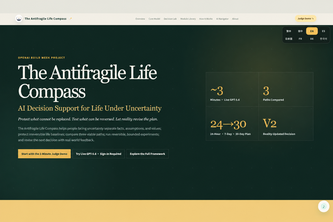
The Antifragile Life Compass is a self-reported AI-powered decision-support tool for adults navigating non-emergency life shocks under uncertainty. The author describes it as a structured navigation product that uses GPT-5.6 to generate a "Reality Feedback Navigator" — a multi-step, bounded decision process that includes survival floor protection, three-path comparison, and evidence-driven revision loops.
The project is presented as an educational tool rather than a medical, legal or financial advisor. It includes both a no-sign-in demonstration and a signed-in live analysis path using GPT-5.6. The system is designed to avoid anchoring users too early, hide uncertainty behind vague confidence scores, or recommend irreversible actions without sufficient information.
The single most important open question is: What is the actual commercial viability of this product as a decision-support service? There is no evidence of revenue, customers, pricing, or traction beyond the author's own description. The project appears to be a prototype built for a hackathon with no indication of monetization strategy or market demand.
What The Product Actually Is
The description states that the Antifragile Life Compass is a structured decision-support product for adults navigating non-emergency life shocks under uncertainty. Its flagship tool is the "Reality Feedback Navigator."
Key features include:
- A decision-state gate (Protect, Repair, Experiment, or Reassess)
- Survival floor identification
- Single point of failure analysis
- Three-path comparison (conservative, balanced, exploratory)
- Evidence and uncertainty tracking
- Bounded experiment design
- 24-hour, 7-day, and 30-day action plans
- Reality Feedback loop for plan revision
- Human-support boundaries for medical, legal, financial, physical-safety, mental-health, safeguarding, and emergency issues
- Optional meaning calibration with values, relationships, Lao–Zhuang reflection, and bounded faith perspectives
The system is described as intentionally designed not to behave like an all-knowing life adviser. It uses GPT-5.6 for live analysis but also provides a fixed, read-only English demonstration that requires no sign-in or API call.
Positioning & Claim Evolution
The author states that the project began with a different question than typical AI assistants: "How can AI help people protect what cannot be replaced, compare multiple paths, take small reversible steps, and let reality correct the next version of the plan?"
The positioning is described as:
- Not making AI decide a person's life
- Helping someone preserve options and make safer, more testable decisions
- Protecting irreversible harm first
- Making the next decision safer, more testable, and more honest about uncertainty
- Educational decision support rather than medical diagnosis, legal advice, or financial guarantee
The claim evolution shows a shift from philosophical framework to product implementation. The author notes that the broader Traditional Chinese worldview-comparison and life-antifragility framework existed before Build Week, but during the competition period, they used Codex to turn that foundation into a focused, testable GPT-5.6 product.
Target Customer & ICP
The description states that the target customer is "adults navigating non-emergency life shocks under uncertainty." These are people who:
- Have experienced job loss, financial shock, relationship crisis, health concern, or sudden change of direction
- Are facing important decisions with incomplete information
- Need to make decisions that may have irreversible consequences
- Require structured support for decision-making rather than a single confident answer
The product is positioned for non-emergency situations where people need to make decisions but cannot wait for certainty. The author notes that the system does not provide medical diagnoses, legal advice, financial guarantees, emergency intervention, pastoral authority, or irreversible commands.
Business Model & Pricing Evidence
Not evidenced.
The description provides no information about:
- Revenue streams
- Pricing models
- Customer acquisition costs
- Monetization strategy
- Subscription tiers or payment structures
- Customer lifetime value
- Unit economics
The author states that the system is educational decision support and does not provide medical diagnoses, legal advice, financial guarantees, emergency intervention, pastoral authority, or irreversible commands. However, there is no evidence of any business model or pricing structure.
Technical & Delivery Signals
The project was built using:
- GPT-5.6 (specifically gpt-5.6-luna)
- OpenAI Responses API
- React and TypeScript
- Next.js framework
- Cloudflare Workers
- D1 database
- Drizzle ORM
- Codex for engineering and editorial assistance
- Accessibility features
- Internationalization support
Key technical elements include:
- Server-side API handling without exposing API keys
- Strict JSON Schema output for GPT-5.6
- Store: false setting to prevent model from storing data
- D1-backed personal and site-wide hard request caps
- Atomic privacy and cost guardrails
- Fail-closed cost controls
- Immediate-danger screening
- No storage of life-shock text in the application database
- Language-isolated, validated browser checkpoint restoration
- Immutable in-flight request snapshots and input-to-result traceability
The system is described as intentionally designed not to behave like an all-knowing life adviser with safeguards including:
- Server-side API secrets
- ChatGPT sign-in before paid personalized analysis
- D1-backed personal and site-wide hard request caps
- Atomic quota reservation
- Request leases
- 3,000-token maximum output
- Fail-closed cost controls
- Immediate-danger screening
- No storage of life-shock text in the application database
Traction & Maturity Signals
Not evidenced.
The description provides no information about:
- Revenue or ARR
- Customer base or user numbers
- Usage metrics or engagement data
- Product adoption rates
- Market traction
- Growth indicators
- Customer feedback or testimonials
- Product iteration history
- Market validation
The author notes that the project is a prototype built for a hackathon with no indication of monetization strategy or market demand.
Competitive Context
Not evidenced.
The description provides no information about:
- Direct competitors
- Indirect substitutes
- Market size or growth trends
- Competitive positioning
- Market differentiation
- Industry benchmarks
- Competitive advantages
- Market dynamics
The author does not mention any existing products or services in this space, nor does the description provide context for how this product fits into the broader market landscape.
Open Questions & Risks
Several key risks and open questions are evident from the self-reported description:
- No commercial viability evidence: The project appears to be a hackathon prototype with no indication of monetization strategy or market demand.
- Unproven market need: There is no evidence of customer validation, user testing, or market traction beyond the author's own account.
- Unclear business model: No information about pricing, revenue streams, or monetization approach.
- High-risk domain: Providing decision support for life-shock situations carries significant liability and ethical concerns without clear safeguards or professional oversight.
- Technical complexity vs. execution: The system requires sophisticated GPT-5.6 integration with strict safety contracts, but there's no evidence of successful deployment or reliability in real-world use.
- Limited team capacity: Only one team member is mentioned (the author), which may limit development and scaling capabilities.
- Unclear regulatory compliance: Decision support for life-shock situations may require professional licensing or regulatory approval that is not addressed.
- Dependency on AI model: The system relies heavily on GPT-5.6, which may not be available or stable in production environments.
Questions the description leaves open
- What specific market problem are you solving, and how do you know there's demand for this solution?
- How do you plan to monetize this product, and what is your pricing strategy?
- What are the key risks associated with providing decision support in life-shock situations?
- How will you ensure compliance with medical, legal, and professional standards?
- What evidence do you have of user interest or market validation beyond your own description?
- How do you plan to scale this product given only one team member?
- What are the technical limitations of GPT-5.6 in this context, and how do you mitigate them?
- How will you handle liability issues when users make decisions based on the system's recommendations?
- What is your go-to-market strategy for reaching target customers?
- How do you plan to validate that your three-path comparison actually improves decision-making outcomes?
Overall Assessment
Not evidenced.
The description provides no information about:
- Financial performance or projections
- Valuation or funding history
- Investment potential or returns
- Partnership opportunities
- Strategic fit for investors or partners
- Market opportunity size
- Competitive positioning in the market
- Team experience or track record
The project appears to be a prototype built for a hackathon with no indication of commercial viability, traction, or investment readiness. The author's own description indicates this is educational decision support rather than a commercial product, and there is no evidence of revenue, customers, or business model beyond the self-reported account.
User Stories BotA demo video on every pull request
Get a demo video on every new feature
GitHub App that watches your pull requests and records a narrated, captioned demo.
Save time on demo prep and make informed decisions faster with a video walkthrough of every new feature.
Source
Submitted to the OpenAI 2026 hackathon on Devpost. Project home on Devpost. Back to the full gallery on Devpost.
This competitive analysis was produced by top-founders.com (opens in a new tab)
Generated by a language model from this project's public Devpost page — its tagline, the author's own write-up and any built-with tags listed there — as captured in August 2026. Short quotations are the author's words. It is an opinion on the idea as a business, not on the people behind it, and it reflects the description as published then. If the project has moved on, request a correction below. The analysis is not independent research and contains no verified traction, revenue or customer data.
An independent guide by KFG International LLC — not affiliated with, endorsed by, or connected to Devpost or OpenAI.