

Archive position — measured, not model output
0 likes on Devpost
2,263 of the 7,850 archived projects have more likes, and 5,587 share exactly 0 — so this project's #3,024 place in the like-ranked listing is a tie-break inside that group, not a ranking.
Projects (log scale)
Likes on Devpost. ▲ marks this project's group.
Show the figures
| Likes | Projects | Share of archive |
|---|---|---|
| 0 | 5,587 | 71.2% |
| 1 | 1,758 | 22.4% |
| 2 | 284 | 3.6% |
| 3–4 | 132 | 1.7% |
| 5–9 | 75 | 1.0% |
| 10+ | 14 | 0.2% |
 User Stories BotA demo video on every pull request
Get a demo video on every new feature
GitHub App that watches your pull requests and records a narrated, captioned demo.
Save time on demo prep and make informed decisions faster with a video walkthrough of every new feature.
Executive Summary
What the company appears to be
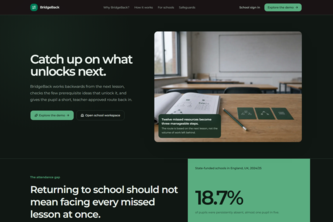
BridgeBack is a self-reported curriculum re-entry engine designed for use in schools, particularly to support pupils returning after absence. The product uses AI to map prerequisite concepts backward from an upcoming lesson and presents a short, focused diagnostic and activity sequence to help students catch up quickly. It is built as a web application using modern frontend and backend technologies.
What changed
The project was submitted by one developer (Daniel Butler) for the OpenAI 2026 hackathon. It represents a vertical slice of a concept that began with research into student attendance and re-entry challenges in English schools, particularly focusing on how to avoid overwhelming students with missed work.
Single most important open question
Is there evidence that BridgeBack’s approach—starting from the next lesson and working backward—is actually effective or preferred by teachers or students in real-world settings?
Note: This analysis is based entirely on the self-reported, unverified description provided by the author. No external data, revenue figures, customer feedback, or traction metrics are available.
What The Product Actually Is
The description states that BridgeBack is a curriculum re-entry engine for schools. It works by:
- Taking input from a teacher about an upcoming lesson and related materials.
- Using GPT-5.6 to propose a source-labeled prerequisite map.
- Requiring teacher approval before the map reaches pupils.
- Running a short diagnostic focused only on those prerequisites.
- Selecting no more than three activities for the pupil to complete, with progress preserved across refreshes.
It also includes optional features such as:
- GPT Image 2 for concept illustrations
- gpt-realtime-2.1 for voice-based interaction via WebRTC
The system is built using:
- Next.js 16, React 19, TypeScript, Tailwind CSS, shadcn/ui
- Clerk for authentication
- Convex for database and role checks
- Playwright, Vitest, axe-core for testing and accessibility
Inference: The product appears to be a prototype or vertical slice built during a hackathon. It is not described as live or deployed in any school.
Positioning & Claim Evolution
The author positions BridgeBack as an alternative to traditional catch-up workflows that begin with the backlog of missed work. Instead, it starts from the destination lesson and works backward to identify only necessary prerequisites.
Key claims:
- “BridgeBack begins with a different question: not ‘What work did this pupil miss?’ but ‘What is the minimum they need to understand to take part in the next lesson?’”
- The product makes a deliberate decision to subtract unnecessary content, avoiding overloading pupils.
- It emphasizes teacher control and source labeling, ensuring that AI-generated paths are reviewed before reaching students.
Claim vs Fact: These are self-stated positioning and intent. No evidence is provided that this approach has been validated in practice or preferred by educators.
Target Customer & ICP
The description identifies the primary user base as:
- Pupils returning to school after absence
- Teachers managing re-entry workflows
It specifically references:
- England’s state-funded schools
- Persistent absence rates (18.7% overall, 24.3% in secondary, 35.8% in special schools)
- NFER qualitative study with 85 pupils
The ICP is implied to be school-based educators and students, particularly those dealing with absenteeism issues.
Not evidenced: No explicit segmentation beyond “school” or “teacher/pupil.” No data on how many teachers or schools might use it, or whether it targets specific grade levels or subject areas beyond math and computer science examples.
Business Model & Pricing Evidence
There is no mention of pricing, monetization, or business model in the description. The project is described as a hackathon submission, not a commercial product.
Not evidenced: No indication of how the product would be sold, who pays for it, or whether there are any revenue streams.
Technical & Delivery Signals
The technical stack includes:
- Frontend: Next.js 16, React 19, TypeScript, Tailwind CSS, shadcn/ui
- Backend: Convex (database, storage, role checks)
- Authentication: Clerk
- AI tools: GPT-5.6, Terra (diagnostics), Luna (learning support), GPT Image 2, gpt-realtime-2.1
- Testing & accessibility: Playwright, Vitest, axe-core
The system supports:
- Persistent progress tracking
- Role-based views (teacher vs pupil)
- Source-labeled concept maps and diagnostics
- Structured outputs with Zod validation
- Optional image and voice modes
Inference: The architecture suggests a modern SaaS-like structure but is not described as production-ready or scalable beyond a prototype.
Traction & Maturity Signals
The description states:
- A working, two-sided journey (teacher + pupil)
- Teacher-reviewed concept maps and diagnostics
- Persistent progress and consistent views across roles
- Responsive mobile interface
- Automated accessibility checks
- Optional visual and voice learning modes
However:
- It is described as a Build Week hackathon project
- No real-world deployment or live usage is mentioned
- No customer data, adoption metrics, or feedback are provided
Not evidenced: No evidence of traction, user engagement, or product-market fit beyond the prototype stage.
Competitive Context
There is no mention of competitors in the description. The author does not reference existing tools for student catch-up or re-entry workflows.
Not evidenced: No competitive landscape or differentiation from other platforms is described.
Open Questions & Risks
- Unvalidated assumptions: The approach is based on a hypothesis derived from research, but no real-world validation or pilot data is presented.
- Limited scope: Only two subject examples (math and computer science) are shown; no indication of broader curriculum coverage.
- No commercial viability: Not described as a product for sale or deployment in schools.
- AI dependency without clarity on safety or governance: While it uses teacher approval gates, there is no detail on how AI outputs are audited or regulated.
- Ethical concerns: The system explicitly states it does not infer absence reasons, emotion, disability, etc., but the use of synthetic data and lack of real-world testing raises questions about safeguarding.
Inference: The project lacks evidence of real-world impact or scalability. It is a proof-of-concept, not a product ready for market.
Questions the description leaves open
- What specific feedback have you received from teachers or schools regarding the proposed workflow?
- How do you plan to validate that the AI-generated prerequisite maps are accurate and useful in practice?
- Are there any plans to pilot BridgeBack with real students and educators?
- What would be the minimum viable product (MVP) for a school deployment, and how does this current version compare?
- How is data privacy managed beyond the synthetic user data used in development?
- What are the key metrics you would track if this were to move into a live environment?
Overall Assessment
The description indicates that BridgeBack is a hackathon prototype, not a commercial product or company. It shows early-stage thinking around solving a real problem (student re-entry after absence) but lacks evidence of traction, market validation, or scalability.
Confidence level: Low
Assessment: Not suitable for investment or partnership at this stage. This is a concept with potential, but it requires further development, testing, and demonstration of real-world utility before any strategic move can be made.
User Stories BotA demo video on every pull request
Get a demo video on every new feature
GitHub App that watches your pull requests and records a narrated, captioned demo.
Save time on demo prep and make informed decisions faster with a video walkthrough of every new feature.
Source
Submitted to the OpenAI 2026 hackathon on Devpost. Project home on Devpost. Back to the full gallery on Devpost.
This competitive analysis was produced by top-founders.com (opens in a new tab)
Generated by a language model from this project's public Devpost page — its tagline, the author's own write-up and any built-with tags listed there — as captured in August 2026. Short quotations are the author's words. It is an opinion on the idea as a business, not on the people behind it, and it reflects the description as published then. If the project has moved on, request a correction below. The analysis is not independent research and contains no verified traction, revenue or customer data.
An independent guide by KFG International LLC — not affiliated with, endorsed by, or connected to Devpost or OpenAI.