

Archive position — measured, not model output
0 likes on Devpost
2,263 of the 7,850 archived projects have more likes, and 5,587 share exactly 0 — so this project's #6,502 place in the like-ranked listing is a tie-break inside that group, not a ranking.
Projects (log scale)
Likes on Devpost. ▲ marks this project's group.
Show the figures
| Likes | Projects | Share of archive |
|---|---|---|
| 0 | 5,587 | 71.2% |
| 1 | 1,758 | 22.4% |
| 2 | 284 | 3.6% |
| 3–4 | 132 | 1.7% |
| 5–9 | 75 | 1.0% |
| 10+ | 14 | 0.2% |
 User Stories BotA demo video on every pull request
Get a demo video on every new feature
GitHub App that watches your pull requests and records a narrated, captioned demo.
Save time on demo prep and make informed decisions faster with a video walkthrough of every new feature.
Executive Summary
The company appears to be a single-person project, SafeStance — an industrial safety posture monitoring solution using computer vision. The author states that the product uses MediaPipe for pose estimation in the browser and is deployed as a static front-end on Netlify. It monitors real-time worker postures via existing camera devices, aiming to flag risky behavior before injuries occur.
The project was submitted to the OpenAI 2026 hackathon by Mason Kuang. The description is self-reported and unverified; no evidence of revenue, customers, or traction exists beyond the author's own account.
What changed
This is a prototype built in a hackathon context, not a commercial product. It represents an idea that could evolve into a scalable solution but currently lacks any demonstration of adoption or business model.
Single most important open question
Is there a viable market need for this type of real-time posture monitoring in industrial environments, and does the author have plans to validate that need with actual users or partners?
What The Product Actually Is
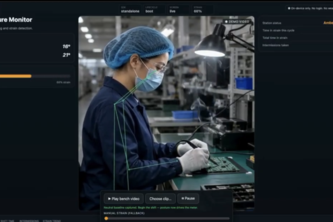
The description states that SafeStance is an industrial health and posture monitoring solution. It uses computer vision, specifically MediaPipe for pose estimation, to analyze worker movements in real time.
It processes webcam feeds directly in the browser, computes joint angles, and translates them into a posture risk score. The system surfaces this score on a simple dashboard and is deployed as a static front-end application on Netlify.
There are no wearables or new sensors involved — only existing camera infrastructure.
Inference: Based on the author’s description, it seems like a proof-of-concept prototype built for demonstration purposes rather than a production-grade tool. The use of MediaPipe and JavaScript implies a lightweight implementation that runs locally in the browser without backend processing.
Positioning & Claim Evolution
The project claims to be an industrial health and posture monitoring solution that turns existing cameras into real-time risk monitors, aiming to decrease workplace accidents and injuries.
It positions itself as a non-intrusive alternative to wearable devices or dedicated sensors, relying instead on existing camera hardware.
The author also mentions that the idea came from observing workers in a real factory setting, suggesting an intent to address a genuine ergonomic issue rather than just a technical challenge.
Inference: The positioning reflects a shift from general computer vision tools toward industrial safety applications, with a focus on preventive care. However, this is still early-stage thinking — no market validation or customer feedback is evident.
Target Customer & ICP
The description states that SafeStance targets assembly line workers in industrial settings, particularly those who perform repetitive tasks and may develop long-term injuries due to poor posture.
It implies a need for safety teams or plant managers who want to monitor and improve working conditions without investing in new hardware.
There is no mention of specific industries, company sizes, or decision-makers beyond the general industrial environment.
Inference: The ICP likely includes manufacturing plants, industrial facilities, or workplace safety departments. However, since there’s no evidence of customer engagement or market research, this remains speculative.
Business Model & Pricing Evidence
There is no evidence in the description of any business model or pricing structure.
The author describes building a static front-end app and deploying it on Netlify, but does not indicate whether they plan to monetize the solution, offer subscriptions, or sell access to the software.
No mention of licensing, SaaS models, or enterprise sales is present.
Inference: The current version appears to be a demo or prototype, not a commercial offering. Any future business model would need to be inferred from further development or strategic direction.
Technical & Delivery Signals
The project was built using:
- MediaPipe for pose estimation
- JavaScript for logic and UI
- Codex (OpenAI’s code generation tool) for scaffolding
- Netlify for deployment
It runs entirely in the browser, processing webcam feeds directly without backend infrastructure.
The author notes challenges with:
- Real-time performance
- Lighting and partial views affecting landmark accuracy
- Determining what constitutes "risky" posture from an ergonomics standpoint
They also mention that they are working on aligning scoring with standards like REBA and RULA, and adding support for multiple people in frame.
Inference: The technical stack suggests a lightweight, client-side solution, which may limit scalability or accuracy. The author acknowledges ongoing development to improve reliability and usability — indicating the prototype is not yet production-ready.
Traction & Maturity Signals
There is no evidence of traction, revenue, or customer adoption beyond the author’s own account.
The project was submitted to a hackathon, and no deployment history, usage metrics, or feedback from users is provided.
The author mentions shipping a working product but does not describe how many people have used it or what kind of impact it has had.
Inference: This is a pre-product stage, likely a prototype or MVP. There are no signs of market traction, user engagement, or commercial viability at this point.
Competitive Context
The description provides no information about competitors or similar products in the marketplace.
No mention of existing posture monitoring systems, wearable devices, or industrial safety platforms is included.
It’s unclear whether there are comparable solutions already available or if this addresses a gap in the market.
Inference: Without any reference to competition, it's impossible to assess how SafeStance might fit into the broader ecosystem of workplace safety tools. The lack of competitive awareness raises questions about market understanding.
Open Questions & Risks
- No commercial traction or revenue data: The project is described as a hackathon submission with no evidence of real-world usage.
- Single-person team: With only one developer, scalability and long-term development are uncertain.
- Unproven market need: No validation that industrial clients actually want or will pay for such a solution.
- Technical limitations: Real-time performance issues, accuracy concerns, and lack of backend processing suggest the prototype may not scale well.
- No pricing or monetization strategy: The business model is undefined, raising doubts about commercial viability.
Inference: These risks point to a high degree of uncertainty around whether this idea will evolve into a viable product or service. It’s currently in an exploratory phase with no clear path to market adoption.
Questions the description leaves open
- What specific industrial environments have you identified as potential users, and how did you come to that conclusion?
- Have you tested the system with actual factory workers or safety teams? If so, what were their reactions?
- How do you plan to validate the ergonomics scoring against recognized standards like REBA or RULA?
- Are there any partnerships or pilot programs in progress with manufacturers or safety organizations?
- What is your roadmap for moving from prototype to a scalable product or service?
- Do you have any plans for monetization, and how do you expect to price the solution?
Overall Assessment
This project is currently at the pre-product stage, representing a conceptual idea with some technical execution behind it.
The author has built a functional prototype that demonstrates core functionality but lacks any evidence of traction, market validation, or commercial readiness.
There is no indication of a clear business model, customer base, or competitive positioning.
Assessment: Not ready for investment or partnership at this time. The idea shows promise in addressing an industrial safety problem, but further development and proof-of-concept testing are required before any serious consideration can be given to scaling or commercializing the solution.
User Stories BotA demo video on every pull request
Get a demo video on every new feature
GitHub App that watches your pull requests and records a narrated, captioned demo.
Save time on demo prep and make informed decisions faster with a video walkthrough of every new feature.
Source
Submitted to the OpenAI 2026 hackathon on Devpost. Project home on Devpost. Back to the full gallery on Devpost.
This competitive analysis was produced by top-founders.com (opens in a new tab)
Generated by a language model from this project's public Devpost page — its tagline, the author's own write-up and any built-with tags listed there — as captured in August 2026. Short quotations are the author's words. It is an opinion on the idea as a business, not on the people behind it, and it reflects the description as published then. If the project has moved on, request a correction below. The analysis is not independent research and contains no verified traction, revenue or customer data.
An independent guide by KFG International LLC — not affiliated with, endorsed by, or connected to Devpost or OpenAI.